
Cuantificación por densitometría de la proteína Cry de Bacillus thuringiensis
Barra lateral del artículo
Contenido principal del artículo
Resumen
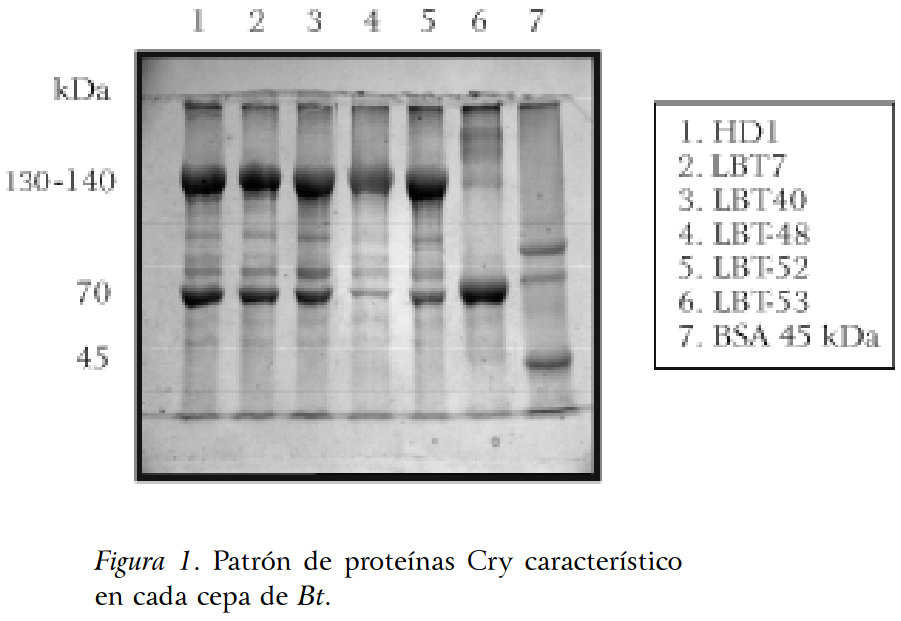
Las toxinas proteicas Cry producidas por varias cepas de Bacillus thuringiensis, crecidas en el medio de fermentación GTE, fueron separadas por electroforesis en geles de poliacrilamida con dodecil sulfato de sodio, y las bandas proteicas obtenidas fueron entonces cuantificadas por densitometría. El resultado se comparó con la producción del estándar HD1 en el medio de fermentación LB. Se concluyó que, en la producción de esta bacteria, tan importante es el medio de cultivo donde ella se reproduce como la cepa con que se trabaja.
Detalles del artículo

Esta obra está bajo una licencia internacional Creative Commons Atribución-NoComercial 4.0.
Aquellos autores/as que tengan publicaciones con esta revista, aceptan los términos siguientes de la Licencia CC Reconocimiento-NoComercial 4.0 Internacional (CC BY-NC 4.0):
Usted es libre de:
- Compartir — copiar y redistribuir el material en cualquier medio o formato
- Adaptar — remezclar, transformar y crear a partir del material
El licenciador no puede revocar estas libertades mientras cumpla con los términos de la licencia.
Bajo las condiciones siguientes:
- Reconocimiento — Debe reconocer adecuadamente la autoría, proporcionar un enlace a la licencia e indicar si se han realizado cambios. Puede hacerlo de cualquier manera razonable, pero no de una manera que sugiera que tiene el apoyo del licenciador o lo recibe por el uso que hace.
- NoComercial — No puede utilizar el material para una finalidad comercial.
- No hay restricciones adicionales — No puede aplicar términos legales o medidas tecnológicas que legalmente restrinjan realizar aquello que la licencia permite.
La revista no se responsabiliza con las opiniones y conceptos emitidos en los trabajos, son de exclusiva responsabilidad de los autores. El Editor, con la asistencia del Comité de Editorial, se reserva el derecho de sugerir o solicitar modificaciones aconsejables o necesarias. Son aceptados para publicar trabajos científico originales, resultados de investigaciones de interés que no hayan sido publicados ni enviados a otra revista para ese mismo fin.
La mención de marcas comerciales de equipos, instrumentos o materiales específicos obedece a propósitos de identificación, no existiendo ningún compromiso promocional con relación a los mismos, ni por los autores ni por el editor.
Cómo citar
Referencias
Agaisse, H.; D. Lereclus: «How Does Bacillus thuringiensis Produce so much Insecticidal Crystal Protein», J. Bacteriol. 177:6027-6032, 1995.
Baum, J. M.; T. Malvar: «Regulation of Insecticidal Crystal Protein Production in Bacillus thuringiensis», Mol Microbiol 18:1-12, 1995.
Bradley, D. «The Insecticidal CryIB Crystal Protein of Bacillus thuringiensis ssp. thuringiensis Has Dual Specificity to Coleopteran and Lepeidopteran Larvae», J. Invertebr. Pathol. 65:162-173, 1995.
Brussock, S. M.: T. C. Currier: «Use of Dodecyl Sulfate-Polyacrylamide Gel Electrophoresis to Quantify Bacillus thuringiensis Delta-Endotoxins», Analytical Chemistry of Bacillus thuringiensis. Chapter 9, 1990, pp. 78-87.
Carreras, B.: «Caracterización de cepas de Bacillus thuringiensis para el control fitosanitario». Tesis en opción al título académico de Maestro en Microbiología, Mención en Microbiología General, Facultad de Biología, Universidad de La Habana, 2003.
Farrera, R. R.; F. Pérez-Guevara; M. de la Torre: «Carbon:Nitrogen Ratio Interacts with Initial Concentration of Total Solids of InsecticidalCrystal Protein and Spore Production in Bacillus thuringiensis HD-73», Appl. Microbiol Biotechnol. 49:758-765, 1998.
Galán, L. J.; J. A. GarcÍa; M. E. Santos; I. Quintero: «Mecanismo molecular de acción de la delta-endotoxinas de Bacillus thuringiensis», Avances en la biotecnologia de B. thuringiensis, Univ. Autónoma de Nuevo León, México, 1996, pp. 129-155.
Glare, T. R.; M. O’Callaghan: Characterization in Bacillus thuringiensis: Biology, Ecology and Safety, Inglaterra, 2001, pp. 6-10.
Laemmli, N. K.: «Cleavage of Structural Proteins During the Assembly of the Head of Bacteiophage T4», Nature 227:680, 1970.
Narva, K. E., J. M. Payne; G. E. Schwab; L. A. Hickle; T. Galasan; A. J. Sick: «Novel Bacillus thuringiensis Microbes Active Against Nematodes and Genes Encoding Novel Nematode-Active Toxins Cloned from Bacillus thuringiensis Isolates», GeneBank 85 (GeneWorks 2.4, release 14.0, October 94), 1991.
Payne, J. M.; R. J. C. Cannon; A. L. Bagley: Novel Bacillus thuringiensis Isolates for Controlling Acarides, PCT International Patent Application No. WO 92/19106, 1992.
Rowe, G. E.; A. Margaritis: «Bioprocess Developments in the Production of Bioinsectisides by Bacillus thuringiensis», J. Ferm. Bioeng. (6): 87-120, 1987.
Salama, H. S.; M. S. Foda; H. T. Dulmage; A. El-Sharaby: «Novel Fermentation Media for Production of Delta-Endotoxins from Bacillus thuringiensis», J. Invertebr. Pathol. 41:8-19, 1983.
Sambrook, J.; E. F. Fritsch; T. Maniatis: Molecular Cloning. A Laboratory Manual 2nd ed., Cold Spring Harbor Laboratory Press, Cold. Spring Harbor, New York, 1989.
Schagger, H.; G. von Jagow: «Tricine-Sodium Dodecyl Sulfate-Polyacrylamide Gel Electrophoresis for the Separation of Proteins in the Range from 1 to 100 kDa», Analytical Biochemistry 166:368-379, 1987.
Smith, G. P.; D. J. Ellar: «Mutagenesis of Two Surface-Exposed Loops of the Bacillus thuringiensis CryIC-Endotoxin Affects Insecticidal Specificity», Biochem. J. 302:611-616, 1994.
Warren, G. M.; M. G. Koziel; M. A. Mullins; G. J. Nye; B. Carr; N. M. Desai; K. Kostichka; N. B. Duck; J. J. Estruch: «Novel Pesticidal Proteins and Strains». Patent WO 96/10083. World Intellectual Property Organization, 1996.
Yamamoto, T.; G. K. Powell: «Bacillus thuringiensis Criytal Protein: Recent Advances in Understanding Its Insecticidal Activity», Advanced Engineered Pesticides, Mrcel Dekker, Inc., E. U., 1993, pp. 3-42.
Yudina, T. G.; O. V. Salamakha; E. V. Olekhnovich; N. P. Rogstykh; N. S. Egorov: «Effect of Carbon Source on the Biological Activity and Morphology of Paraspore Crystal from Bacillus thuringiensis», Microbiology 61:402-407, 1992.
Ziniu, Y.; H. Biwang: «Biocontrol of Plant-Parasitic Nematodes by Bacteria», Journal of Fujian Agricultural University 27(3):316-321, 1998.