
Leaf damage caused by herbivory on black mangrove (Avicennia germinans L.) trees in Tabasco, México
Article Sidebar
Main Article Content
Abstract
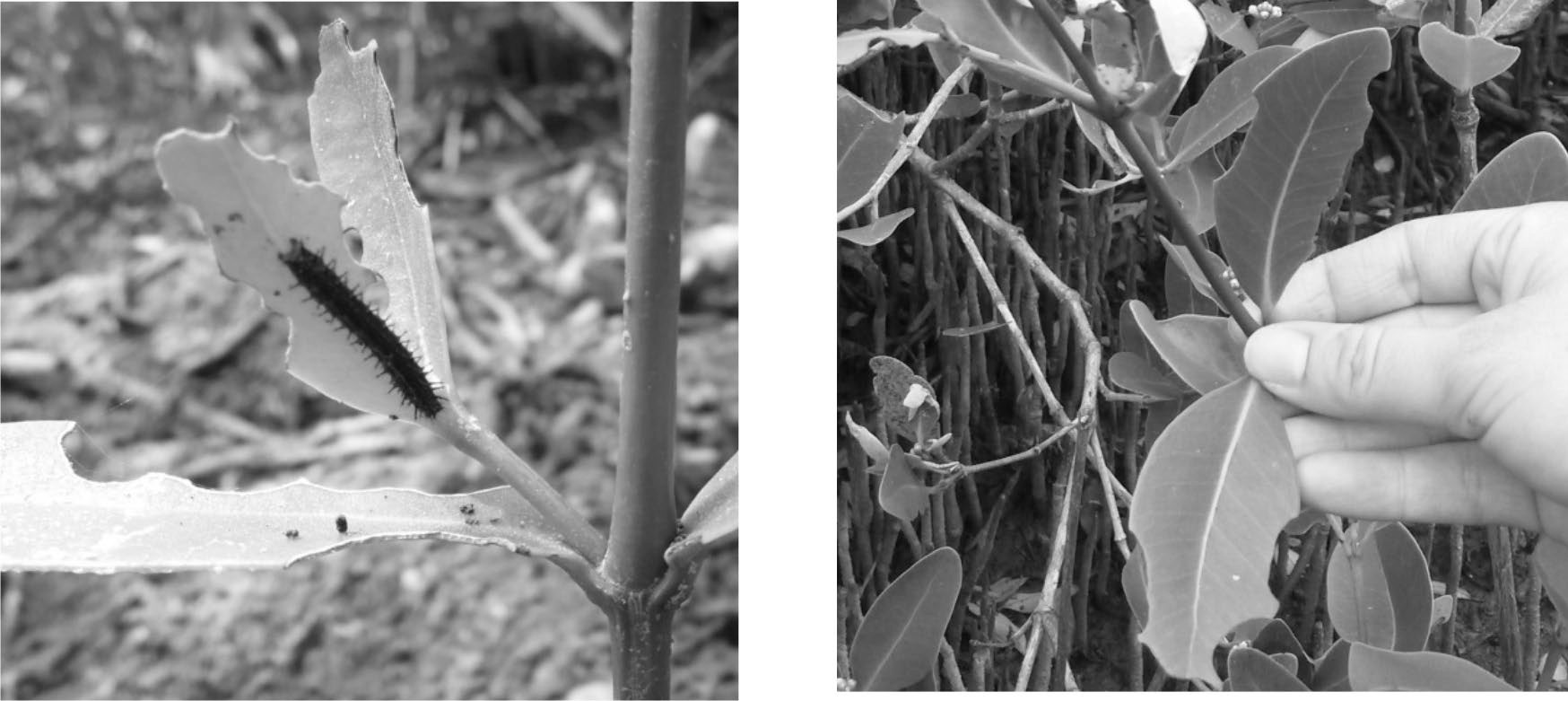
Mangrove swamps are exposed to natural disturbances caused by biotic and abiotic factors. In 2010, the incidence of Anacamptodes sp. affected 3,841 ha of black mangrove in Tabasco, México. Therefore, leaf herbivory damage on black mangrove trees in Las Coloradas, Ampliación Las Aldeas, Tabasco was evaluated. In a plot of 1000 m2, 28 black mangrove manually planted trees and 28 naturally regenerated trees were selected. Leaf damage, tree height, and stem diameter variables measured during dry, rainy and windy seasons in 201 and 2014; besides, organisms responsible of leaf damage were identifying. A randomly complete design in split plot arrangement was used considering the tree category and the season as big and small plots, respectively. For leaf damage data, an Anova (p < 0.05) was performed while Pearson correlation coefficient was determined between leaf area damaged and growth variables. There was not significant differences between tree categories for leaf damage variable; in contrast, significant differences were observed in relation to the season and the interaction tree category x season. The highest leaf damage values were register during windy season in 2013 and dry season in 2014. Planted trees registered higher leaf damage during the dry (20.17 %) and rainy (16.72 %) season of 2013. There was found a low significant Pearson correlation coefficient between leaf damaged and tree height (r = -0.13; p = 0.047) and between leaf damaged and stem diameter (r = 0.16; p = 0.38). Foliar damage was caused by caterpillars of Junonia sp. grasshoppers of the family Acrididae and Tettigoniidae and crabs (Aratus pisonii), and consisted on consumption of leaf area around leaf edges; this damage did not significantly affect the growth of black mangrove trees.
Article Details

This work is licensed under a Creative Commons Attribution-NonCommercial 4.0 International License.
Those authors who have publications with this journal accept the following terms of the License Attribution-NonCommercial 4.0 International (CC BY-NC 4.0):
You are free to:
- Share — copy and redistribute the material in any medium or format
- Adapt — remix, transform, and build upon the material
The licensor cannot revoke these freedoms as long as you follow the license terms.
Under the following terms:
- Attribution — You must give appropriate credit, provide a link to the license, and indicate if changes were made. You may do so in any reasonable manner, but not in any way that suggests the licensor endorses you or your use.
- NonCommercial — You may not use the material for commercial purposes.
- No additional restrictions — You may not apply legal terms or technological measures that legally restrict others from doing anything the license permits.
The journal is not responsible for the opinions and concepts expressed in the works, they are the sole responsibility of the authors. The Editor, with the assistance of the Editorial Committee, reserves the right to suggest or request advisable or necessary modifications. They are accepted to publish original scientific papers, research results of interest that have not been published or sent to another journal for the same purpose.
The mention of trademarks of equipment, instruments or specific materials is for identification purposes, and there is no promotional commitment in relation to them, neither by the authors nor by the publisher.
How to Cite
References
Aceves, N. L. A.; L. J. F. Juárez; L. D. J. Palma; L. R. López; H. B Rivera; R. J. A. Rincón; C. R. Morales; A. R. Hernández; S. A. Martínez y S. J. L. Hernández: «Estudios para determinar zonas de alta potencialidad de los cultivos en el estado de Tabasco (Informe general)», SAGARPA, Colegio de Posgraduados Tabasco, 1:14-16, México, 2008.
Barba, E.; J. Juárez-Flores y F. Estrada-Loreto: «Distribución y abundancia de crustáceos en humedales de Tabasco, México», Revista Mexicana de Biodiversidad, 81:53-183, México, 2010.
Castillo, P. S.: «Evaluación de las principales plagas del mangle rojo (Rhizophora mangle), mangle salado (Avicennia germinans) y mangle blanco (Laguncularia racemosa) en Tumbes, Perú», Rev. Per. Ent. 42:185-189, Perú, 2001.
Coley, P. D.: «Effects of plant growth rate and leaf lifetime on the amount and type of anti-herbivore defense», Oecologia, 74:531-536, Berlín, 1988.
Conabio: Comisión nacional para el conocimiento y uso de la biodiversidad manglares de México. 2008. México http://www.conabio. gob.mx/conocimientos/manglares/doctos/manglares. (consultado en noviembre de 2009).
Cruz, H. T. N.; R. López; M. C. Berrios; Y. Varela; A. Fernández; M. Betancourt; C. Sosa y M. Valle: «Lista anotada de los termites en Cuba», Fitosanidad. 8:3-8. Cuba, 2004.
Díaz, G. J. M.: «Una revisión sobre los manglares: características, problemáticas y su marco jurídico. Importancia de los manglares, el daño de los efectos antropogénicos y su marco jurídico: caso sistema lagunar de Topolobampo», Ra Ximhai, 7:355-369. México, 2011.
Domínguez, D M.; J. C. Zavala y P. Z. Martínez: Manejo forestal sustentable de los manglares de Tabasco, Secretaría de Recursos Naturales y Protección Ambiental, Colegio de Posgraduados, Villahermosa, Tabasco, México, 2011, p. 137.
Erickson, A. A.; S. S. Bell y C. J. Dawes: «Associational resistance protects mangrove leaves from crab herbivory», Acta Oecologica 41:46-57, EE. UU., 2012.
Farnsworth, E. J. y A. M. Ellison: «Patterns of Herbivory in Belizean mangrove swamps», Biotropica 23(4):555-567, EE.UU., 1991.
Fernández, J. L.: «Estimación de umbrales económicos para Spodoptera frugiperda (J. E. Smith) (Lepidoptera: Noctuidae) en el cultivo del maíz», Invest. Agr. Prod. Prot. Veg. 17(3): 467-474, España, 2002.
Flores, R. M. E.; M. H. Ruiz y S. U. S. Salas: «Insectos xilófagos y su incidencia en la muerte de mangle en barra salada, del área natural protegida Los Cóbanos, Sonsonate y Bahía de Jiquilísco, Usulután, El Salvador». Tesis de Licenciatura, Universidad de El Salvador, Facultad de Ciencias Agronómicas, El Salvador, 2014.
Hernández, M. G. I.: «Legislación, cambio de uso de suelo y reforestación en manglares de Cárdenas, Tabasco». Tesis de Doctorado, Colegio de Posgraduados, Campus Veracruz, México, 2013.
Herrera, J.; Y. Maldonado-López; C. L. F. Cuenca y P. Cueva-Reyes: «Patrones de herbivoría en Avicennia germinans: Importancia de la defensa química y la calidad nutricional», Biológicas, 9:72-80, México, 2007.
INE (Instituto Nacional de Ecología): Textología forestal, 4ta. ed., Secretaría de Medio Ambiente, Recursos Naturales y Pesca, México, 2000.
Marín-Mézquita, L.; L. Baeza; O. Zapata-Pérez y G. Gold-Bouchot: «Trace metals in the American oyster, Crassostrea virginica, and sediments from the coastal lagoons Mecoacan, Carmen and Machona, Tabasco, México, Chemosphere. 34: 2437-2450, EE.UU., 1997.
Menezes, T. L. F y A. L. Peixioto: «Leaf damage in a mangrove swamp at Sepetiba Bay, Rio de Janeiro, Brazil», Revista Brasil. Bot., 32(4):715-724, Brasil, 2009.
Mohamed, Y. F.; M. Bardin; P. C. Nicot y M. Pitrat: «Causal agents of powdery mildew of cucurbits in Sudan», Plant Dis, (79):634-636, EE. UU., 1995.
Orozco, R. A.: «El defoliador de manglar en Tabasco», Memoria de Resúmenes. IX Simposio Nacional sobre Parasitología Forestal, Universidad Autónoma Agraria Antonio Narro, Saltillo, Coahuila, 1997.
Palacio P. J. L.; P. M. A. Ortiz y P. A. Garrido: «Cambios morfológicos costeros en Isla del Carmen, Campeche, por el paso del huracán Roxanne», Investigaciones Geográficas 40: 48-57, México, 1999.
Robertson, A. I.; D. M. Alongi y K. G. Boto: «Food chains and carbon fluxes», Tropical mangrove ecosystem, American Geophysical Union, Washington, D. C., 1992.
Romero, C. I.; J. R. Cantera y S. E. J. Peña: «Consumo de hojas por herbívoros en manglares del estuario del río Dagua, Costa Pacífica colombiana, Rev. Biol.Trop. 4: 1205-1214, San José, Costa Rica. 2006.
Ruíz, B. T.; J. L. Rangel-Salazar y C. B. Hernández: «Resilience in a Mexican Pacific Mangrove after Hurricanes: Implications for Conservation Restoration», Journal of Environmental Protection. 4:1383-1391, EE. UU., 2013.
SAS: Institute Inc. Logistic Regression Examples Using the SAS System, Version 6, Cary, p 163, EE.UU., 1995.
Schowalter, D. T.: «Herbivory», Insect Ecology. An ecosystem approach, Third. edition, 2011.
Sol, S. A; G. F. Sánchez; M. G. I. Hernández; L. F. C. Zamora; O. G. Sardiñas; C. Rivera y P. J. Toruño: «Volumen maderable de mangle negro (Avicennia germinans L.) impactado por herbivoría de Anacamptodes spp. en Cárdenas, Tabasco», Revista Iberoamericana de Bioeconomía y Cambio Climático, 1(1):115-133, México, 2015.
Sol, S. A; M. G. I. Hernández y G. F. Sánchez: «Volumen de madera de mangle negro (Avicennia germinans L.) muerto defoliado por la oruga de Anacamptodes sp. en el ejido Las Coloradas, Cárdenas, Tabasco, México», Memoria del Segundo Congreso Mexicano de Ecosistemas de Manglar, Ciudad del Carmen, Campeche, México, 2012.
Sousa, W. P. and E.M. Dangremond: «Trophic Interactions in Coastal and Estuarine Mangrove Forest Ecosystems», University of California, Berkeley, CA, USA. Elsevier Inc., pp: 43-90, 2011.