
BANANA FARM BEST PRACTICES FOR PREVENTION OF FUSARIUM WILT TR4 AND OTHER EXOTIC BANANA DISEASES
Article Sidebar
Main Article Content
Abstract
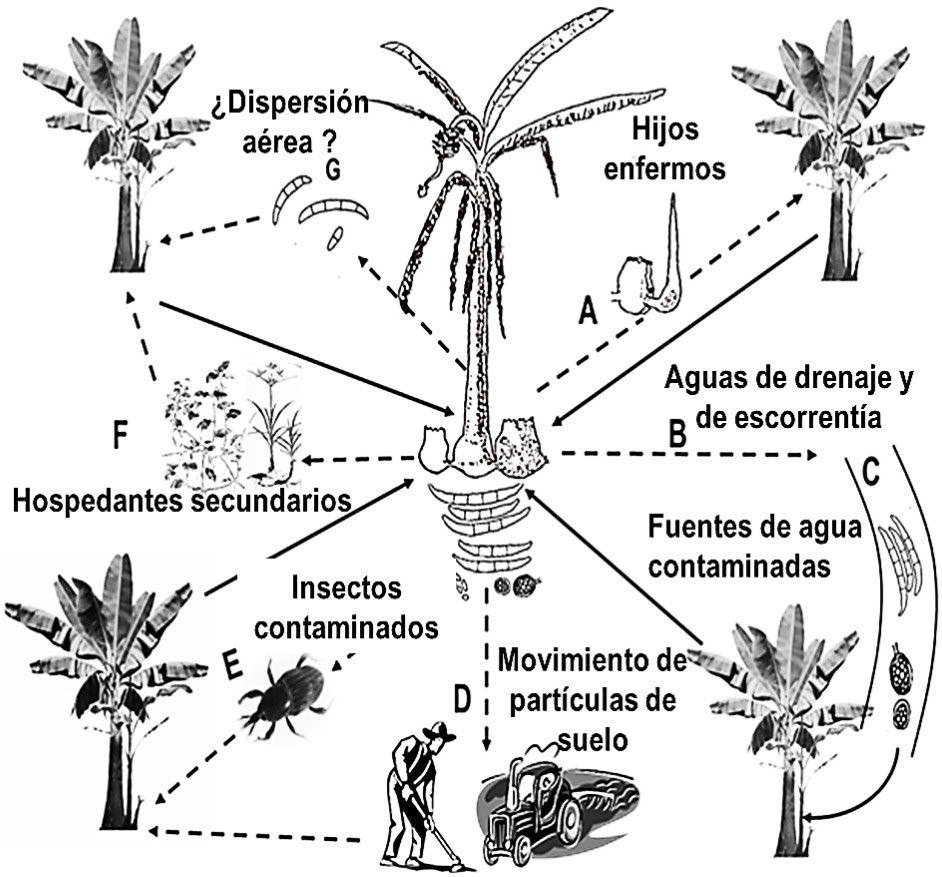
Banana production in Latin America and Caribbean is threatened by important endemic and exotic diseases caused by fungi as Fusarium oxysporum f. sp. cubense tropical race 4, bacterial wilts and rots by Ralstonia solanacearum complex, Xanthomonas campestris pv. musacearum, Dickeya spp. and the viruses BBTV, BBrMV, BSV complex, CMV, etc. Current increment of movement of persons and commodities, increase risks of transboundary movement of pests putting under press exotic pest surveillance. This report describes the dispersal ways of Fusarium wilt and other important diseases threatening banana production, conditions that predispose plants to infection and actions to adopt routinely to prevent their introduction to production sites. Unrestricted movement of infected suckers and plant residues, surface runoff and free movement of machinery, animal and persons inside and between farms and plots, can carry soil and move chlamydospores of pathogen between infected and disease free areas. Some lessons that arose from last century Foc race 1 epidemic in America are discussed. Some basic and simple measures that contribute to reduce the risks of introduction of exotic pathogens at the farm level are discussed. The implementation of measures to prevent introduction and dissemination of exotic diseases should be a shared responsibility between NPPO and growers.
Article Details

This work is licensed under a Creative Commons Attribution-NonCommercial 4.0 International License.
Those authors who have publications with this journal accept the following terms of the License Attribution-NonCommercial 4.0 International (CC BY-NC 4.0):
You are free to:
- Share — copy and redistribute the material in any medium or format
- Adapt — remix, transform, and build upon the material
The licensor cannot revoke these freedoms as long as you follow the license terms.
Under the following terms:
- Attribution — You must give appropriate credit, provide a link to the license, and indicate if changes were made. You may do so in any reasonable manner, but not in any way that suggests the licensor endorses you or your use.
- NonCommercial — You may not use the material for commercial purposes.
- No additional restrictions — You may not apply legal terms or technological measures that legally restrict others from doing anything the license permits.
The journal is not responsible for the opinions and concepts expressed in the works, they are the sole responsibility of the authors. The Editor, with the assistance of the Editorial Committee, reserves the right to suggest or request advisable or necessary modifications. They are accepted to publish original scientific papers, research results of interest that have not been published or sent to another journal for the same purpose.
The mention of trademarks of equipment, instruments or specific materials is for identification purposes, and there is no promotional commitment in relation to them, neither by the authors nor by the publisher.
How to Cite
References
Blomme, G.; M. Dita; K. Jacobsen; L. Pérez-Vicente; A. Molina; O. Walter y P. Prior: «Bacterial diseases of bananas and Enset: current state of knowledge and integrated approaches towards sustainable management», Frontier of Sciences (submitted), 2016.
Côte F.X.; S. Galzi; M. Folliot; Y. Lamagnère; P.Y. Teycheney; M.L. Iskra-Caruana: «Micropropagation by tissue culture triggers differential expression of infectious endogenous Banana streak virus sequences (eBSV) present in the B genome of natural and synthetic interspecific banana plantains», Mol. Plant Pathol. 11:137-144, 2010.
Dallot, S.; P. Acuña; C. Rivera; P. Ramírez; F. Cote; B.E.L. Lockhart y M.L. Caruana: «Evidence that the proliferation stage of micropropagation procedure is determinant in the expression of Banana streak virus integrated into the genome of the FHIA 21 hybrid (Musa AAAB)», Arch. Virol. 146: 2179-2190, 2001.
Daniells, J.W.; A.D.W. Geering; N.J. Bryde y J.E.Thomas: «The effect of Banana streak virus on the growth and yield of dessert banana in tropical Australia», Annals of Applied Biology 139: 51-60, 2001.
Davis, R.; P. Kokoa; L.M. Jones; J. Mackie; F. E. Constable; B.C. Rodoni; T.G. Gunua y J. B. Rossel: «A new wilt disease of banana plants associated with phytoplasmas in Papua New Guinea (PNG)», Australasian Plant Dis. Notes 7:91-97, 2012.
Diekmann, D. R. and C.A.J. Putter: Musa FAO/IPGRI Technical Guidelines for the Safe Movement of Germplasm, 2nd.ed., Rome, 1996.
Dita-Rodríguez, M.; P. Echegoyen-Ramos and L. Pérez-Vicente: «Plan de contingencia ante un brote de la raza 4 tropical de Fusarium oxysporum f. sp. cubense en un país de la región del OIRSA», El Salvador, 2013 Http://www.oirsa.org/aplicaciones/subidoarchivos/BibliotecaVirtual/ PlandecontingenciacontraFocR4TOIRSA.pdf.
Domínguez, J.; M. A. Negrín and C.M. Rodríguez: «Aggregate water stability, particle size and soil solution properties in conducive and suppressive soils to Fusarium wilt of banana from Canary Islands», Soil Biology and Biochemistry 33; 349-455, 2001.
Faostat, 2013. http://faostat.fao.org/.
Geering, A. D.; N. E. Olszewski; G. Harper; B. E. Lockhart; R. Hull y J. E. Thomas: «Banana contains a diverse array of endogenous badnaviruses», J. Gen. Virol. 86 (Pt 2): 511-520, 2005.
Geering, A.D.W.; J.N. Parry; J.E. Thomas: «Complete genome sequence of a novel badnavirus, banana streak IM virus», Arch. Virol. 156:733-737, 2011.
Harper, G.; D. Hart; S. Moult y R. Hull: «Banana streak virus is very diverse in Uganda», Virus Research 100: 51-56, 2004.
Harper, G.; D. Hart; S. Moult; R. Hull; A. Geering y J. Thomas: «The diversity of Banana streak virus isolates in Uganda», Archives of Virology 12: 2407-2420, 2005.
http://www.fao.org/agriculture/crops/news-events-bulletins/detail/en/ item/235419; http://www.fao.org/agriculture/crops/news-events-bu-lletins/detail/en/item/235419/icode/?no_cache=1
James, A.P.; R.J. Geijskes; J.L. Dale y R.M. Harding: «Molecular characterization of six badnavirus species associated with leaf streak disease of banana in East Africa», Ann. Appl. Biol. 158: 346-353, 2011a.
Javer-Higinson, E.; I. Acina-Mambole; J. Efrain; C. Font; G. González;
A.L. Echemendía; E. Muller; P.Y. Teycheney: «Occurrence, prevalence and molecular diversity of Banana streak viruses in Cuba», Eur. J. Plant Pathol 138:157-166, 2014.
Lescot, T.: Genetic diversity of banana. Close-up. FRuiTReP 231 April 2015.
Marinho, V.L.A. and M. F. Batista: «Interceptação, pelo serviço de quarentena, de vírusem mudas meristemáticas de bananeiras importadas», Fitopatol. Bras., 30, 2005.
May S.; G. Plaza: The United Fruit Company in Latin America, Seventh Case in an NPA Series on United States Business Performance Abroad, 1958.
Ordóñez, N.; M.C. Seidl; C. Waalwijk; A. Drenth; A. Kilian; B.P.H.J. Thommas; R.C. Ploetz y G.H.J. Kema: «Worse Comes to Worst: Bananas and Panama Disease-When Plant and Pathogen Clones Meet», PLOS Pathogens.DOI:10.1371/journal.ppat.1005197, 2015.
Péréfarres, F.; G. Le Provost; I. Acina; B.E.L. Lockhart; A. Allah-Dghim; M.L. Iskra-Caruana et al.: «Detection, prevalence and diversity of banana streak virus (BSV), banana mild mosaic virus (BanMMV) and banana virus X (BVX) in Guadeloupe», Acta Horticulturae 828:205-212, 2009.
Peng, H.X.; K. Sivasithamparama, D.W Turner: «Chlamydospore germination and Fusarium wilt of banana plantlets in suppressive and conducive soils are affected by physical and chemical factors», Soil Biology and Biochemistry 31: 1363-1374, 1999.
Pérez-Vicente, L.: «Fusarium wilt (Panama disease) of bananas: an updating review of the current knowledge on the disease and its causal agent», Proceedings of the XVI International Acorbat Meeting, Oaxaca, México, oct. 2004, 2004.
Pérez-Vicente, L.; M.A. Dita; E. Martínez de la Parte: «Technical Manual: Prevention and diagnostic of Fusarium Wilt (Panama disease) of banana caused by Fusarium oxysporum f. sp. cubense Tropical Race 4 (TR4)», Prepared for the FAO/CARDI Regional Workshop on the Diagnosis of Fusarium Wilt (Panama disease) caused by Fusarium oxysporum f. sp. cubense Tropical Race 4: Mitigating the Threat and Preventing it Spread in the Caribbean. University of West Indies, Trinidad and Tobago, 5-9 May 2014.
Plant Health Australia Ltd.: Industry Biosecurity Plan for the Banana Industry, 2003 (Version 2.0-2010), Plant Health Australia, Canberra, ACT.
Plant Health Australia Ltd.: Farm Biosecurity Manual for the Banana Industry, Reducing the risk of exotic and damaging pests, becoming established in crops (Version 1.0), Plant Health Australia, Canberra, ACT, 2009.
Ploetz, R.C.; K.G. Pegg: «Fusarium wilt», Diseases of Banana, Abaca and Enset, CABI Publishing, Wallingford, UK, 2000.
Ploetz, R.C.: «Management of Fusarium wilt of banana: A review with special reference to tropical race 4», Crop Protection 73:7-15, 2015.
Pocasangre, L.; L. Pérez-Vicente; H. Ferris: «Organic banana disease management. Chapter 5.8. Plant diseases and their management in organic agriculture», American Phytopathological Soc., St. Paul, Mn., 2015.
Rishbeth, J.: «Fusarium wilt of banana in Jamaica. I. Some observations on the epidemiology of the disease», Ann. Bot. 19, 293, 1957.
Reinking, O.A.; M.M. Manns: «Significance of disease spread in the field under different conditions, Bull 44», Res. Dept. United Fruit Co., 1932. Stover, R.H. Banana, plantain and abaca diseases, CMI, CAB, Surrey, 1972.
Stover, R.H. «Fusarium wilt of banana: some history and currentstatus of the disease», Fusarium Wilt of Banana, APS Press, St. Paul, MN., 1990.
Stover, R.H.; N.W. Simmonds Bananas, third ed. Longmans, London, UK, 1987.
Su, H.J.; S.C. Hwang; W.H. Ko: «Fusarial wilt of Cavendish bananas in Taiwan», Plant Dis. 70, 814-818, 1986.
Thomas, J.: Musa Net Technical Guidelines for the Safe Movement of Musa Germplasm, 3rd Edition, Bioversity International, Rome, 2015.