
Etiología de la mancha foliar del chile dulce (Capsicum annuum L.) y su control in vitro en Yucatán, México
Article Sidebar
Main Article Content
Abstract
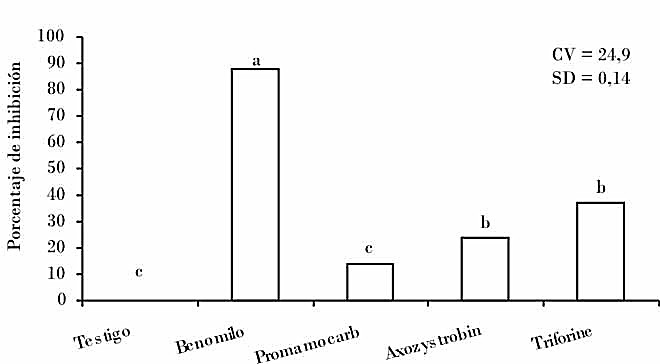
The fungus Corynespora cassiicola (Berk &Curt) was isolated and identified in bell pepper leaves with symptoms of brown leaf spot, it was used three days later to inoculate bell pepper, hot habanero pepper (Capsicum chinense Jacq.) and local xcat’ik pepper (Capsicum annuum L.) contained in moist atmosphere; brown spots surrounded by a yellow ring, which grew in size in time, was induced then, however in tomato leaves (Lycopersicon esculentum Mill.) these spots appeared until day five, in relation to the control leaves without inoculation which did not show signs of spotting. In sensibility assays fungicides that most inhibited in vitro the presence of C. cassiicola micelliums were mancozeb, cuper oxicloride, and benomile at a ratio of 0.1 mg • L–1 and a multibacterial complex at 100 mg • L–1 with percentages higher than 76%.
Article Details

This work is licensed under a Creative Commons Attribution-NonCommercial 4.0 International License.
Those authors who have publications with this journal accept the following terms of the License Attribution-NonCommercial 4.0 International (CC BY-NC 4.0):
You are free to:
- Share — copy and redistribute the material in any medium or format
- Adapt — remix, transform, and build upon the material
The licensor cannot revoke these freedoms as long as you follow the license terms.
Under the following terms:
- Attribution — You must give appropriate credit, provide a link to the license, and indicate if changes were made. You may do so in any reasonable manner, but not in any way that suggests the licensor endorses you or your use.
- NonCommercial — You may not use the material for commercial purposes.
- No additional restrictions — You may not apply legal terms or technological measures that legally restrict others from doing anything the license permits.
The journal is not responsible for the opinions and concepts expressed in the works, they are the sole responsibility of the authors. The Editor, with the assistance of the Editorial Committee, reserves the right to suggest or request advisable or necessary modifications. They are accepted to publish original scientific papers, research results of interest that have not been published or sent to another journal for the same purpose.
The mention of trademarks of equipment, instruments or specific materials is for identification purposes, and there is no promotional commitment in relation to them, neither by the authors nor by the publisher.
How to Cite
References
Barnett, H. L.; B. B. Hunter: Illustrated General of Imperfect Fungi, Burguess Publishing, Minnesota, EE. UU.,1999.
Cabrera, M. G.; M. A. Cúndom; S. A. Gutiérrez; R. E. Álvarez: «Situación de la mancha anillada (Corynespora casiicola) de la soja en provincias del NE de Argentina», Comunicaciones Científicas y Tecnológicas, Resumen A-022, Facultad de Ciencias Agrarias, Universidad Nacional del Nordeste, Argentina,. 2006.
Cutrim, F. A.; G. S. Silva: «Patogenicidad de Corynespora cassiicola a diferentes especies de plantas», Fitopatologia Brasileira 28:193- 194, Brasil, 2003.
Félix, G. R.; J. A. Ávila; B. O. Valenzuela; J. A. Trigueros; R. M. Longoria: «Identificación y control químico de los agentes causales de la mancha foliar y la cenicilla del tomatillo (Physalis ixocarpa Brot.) en el norte de Sinaloa, México», Revista Mexicana de Fitopatología 25(1):1-10, México, 2007.
Ferrer, G. C. A.: «Comportamiento y control de la enfermedad tizón de fuego causada por el hongo Corynespora cassiicola (Berk & Curt) Wei. en el cultivo del pepino (Cucumis sativus L.) en sistemas de organopónicos en la provincia de Camagüey y su relación con otros patógenos fúngicos presentes en el cultivo», Fitosanidad 9(4):67, Cuba, 2005.
French, E. R.; T. T. Hebert: «Métodos de investigación fitopatológica», Instituto Interamericano de Cooperación para la Agricultura (IICA), San José, Costa Rica, 1982.
Furukawa, T.; K. Ushiyama; K. Kishi: «Corynespora Leaf Spot of Scarlet Sage Caused by Corynespora cassiicola», J. Gen. Plant Pathol. 74:117-119, Japón, 2008.
Herrera, P. E.: «Sensibilidad in vitro de Fusarium oxysporum Schletch y Alternaria solani Jones & Grout a fungicidas de contacto y sistémicos», Tesis de Licenciatura, Instituto Tecnológico Agropecuario no. 2, Conkal, Yucatán, México, 2004.
INEGI: «Anuario estadístico de Yucatán», Instituto Nacional de Estadística Geográfica e Informática, t. II. gobierno del estado de Yucatán, México, 2007.
Jayasuriya, K. E.; B. I. Thennakoon: «First Report of Corynespora cassiicola on Codiaeum variegatum (croton) in Sri Lanka», Cey. J. Sci. (Bio. Sci.) 36(2):138-141, Sri Lanka, 2007.
Kurt, S.: «Genetic Variation in Corynespora cassiicola, the Target Leaf Spot Pathogen», Pakistan Journal of Biological Sciences 8(4):618- 621, 2005.
Kwon, J. H.; S. W. Kang; J. S. Kim; C. S. Park: «First Report of Corynespora Leaf Spot in Pepper Caused by Corynespora cassicola in Korea», Plant Pathol. J. 17(3):180-183, Corea, 2001.
Kwon, J. H.; H. J. Jee; C. S. Park: «Corynespora Leaf Spot of Balsam Pear Caused by Corynespora cassiicola in Korea», Plant Pathol. J. 21(2):164-166, Corea, 2005.
Mendoza, Z. C.: «Diagnóstico de enfermedades fungosas de las hortalizas», Departamento de Parasitología Agrícola, Ed. Universidad Autónoma de Chapingo, estado de México, 1999.
Navas, M.; L. J. Subero: «Efecto de cinco fungicidas sobre Corynespora cassiicola (Berk & Curt.) Wei en semilla de ajonjolí (Sesamum indicum L.)», Rev. Fac. Agron. 21:119-127, Maracay, 1995.
Pech, M. A. M.: «Aptitud combinatoria y heterosis en germoplasma de chile dulce (Capsicum annuum L.)», Tesis de Maestría, Instituto Tecnológico Agropecuario no. 2, Conkal, Yucatán, México, 2006.
Pérez, W.; B. Bernal; A. Martín; C. Romeu: «Estudio preliminar de dos extractos vegetales para el control in vitro del hongo Corynespora cassiicola (Berk and Curt) Wei», Fitosanidad 4(1-2):43-46, Cuba, 2000.
Shimomoto, Y.; R. Adachi; Y. Morita; K. Yano; A. Kiba; Y. Hikichi; S. Takeuchi: «Corynespora Blight of Sweet Pepper (Capsicum annuum) Caused by Corynespora cassiicola (Berk. & Curt.) Wei», J. Gen. Plant Pathol. 74:335-337, Japón, 2008.
Zaletas, M. E.: «Control químico y epidemiología de la mancha foliar del chile habanero (Capsicum chinense Jacq.) en Yucatán, México», Tesis de Maestría en Horticultura Tropical, Instituto Tecnológico Agropecuario no. 2, Conkal, Yucatán, México, 2003.