
Composición y riqueza de insectos y arañas asociados a plantas florecidas en sistemas agrícolas urbanos
Article Sidebar
Main Article Content
Abstract
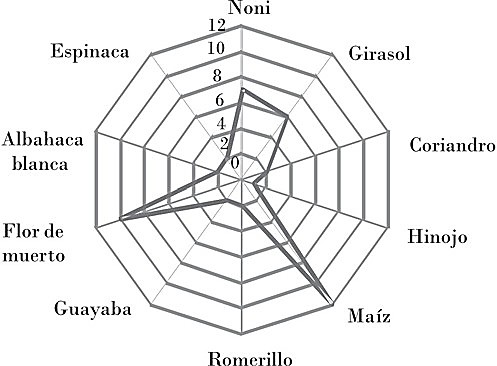
The knowledge of arthropod fauna associated with flowers of plants in agricultural systems is a basic element for natural enemies species of phytophagous insects conservation. Species that most frequently visit flowers of different plant species in urban agricultural systems were determined in this study. Simple random sampling was done weekly in different production systems of Havana province during the period 2007-2009. Insects and spiders were collected, classified and identified using taxonomic keys and comparison with biological collections. Functional groups with higher species richness associated with the flowers were Coleoptera > Araneae > Hymenoptera. In this way Cycloneda sanguinea limbifer Casey and Apis mellifera L. were arthropods that visited a greater number of flowering plant species. Plant species that presented greater taxonomic richness of arthropods were Zea mays L. (12), Tagetes spp. (10), Morinda citrifolia L. (7) and Helianthus annuus L. (6).
Article Details

This work is licensed under a Creative Commons Attribution-NonCommercial 4.0 International License.
Those authors who have publications with this journal accept the following terms of the License Attribution-NonCommercial 4.0 International (CC BY-NC 4.0):
You are free to:
- Share — copy and redistribute the material in any medium or format
- Adapt — remix, transform, and build upon the material
The licensor cannot revoke these freedoms as long as you follow the license terms.
Under the following terms:
- Attribution — You must give appropriate credit, provide a link to the license, and indicate if changes were made. You may do so in any reasonable manner, but not in any way that suggests the licensor endorses you or your use.
- NonCommercial — You may not use the material for commercial purposes.
- No additional restrictions — You may not apply legal terms or technological measures that legally restrict others from doing anything the license permits.
The journal is not responsible for the opinions and concepts expressed in the works, they are the sole responsibility of the authors. The Editor, with the assistance of the Editorial Committee, reserves the right to suggest or request advisable or necessary modifications. They are accepted to publish original scientific papers, research results of interest that have not been published or sent to another journal for the same purpose.
The mention of trademarks of equipment, instruments or specific materials is for identification purposes, and there is no promotional commitment in relation to them, neither by the authors nor by the publisher.
How to Cite
References
Alayo, P. D.: «Los neurópteros de Cuba», Poeyana, Serie B (2):1-127, Instituto de Ecología y Sistemática, Cuba, 1968.
Alayo, P. D.: «Introducción al estudio de los himenópteros de Cuba. Superfamilia Vespoidea», Serie Biológica no. 62:17-18, Academia de Ciencias de Cuba, 1976.
Alayo, P. D.; G. Garcés: Introducción al estudio del orden Diptera en Cuba, Ed. Oriente, Santiago de Cuba, 1989, pp. 59-61.
Alayón, G.: «Las arañas endémicas de Cuba (Arachnida: Araneae)», Rev. Ibérica de Aracnología 2:1-48, España, 2000.
Altieri, M. A.; C. I. Nicholls; M. Fritz: Manage Insects on Your Farm. A Guide to Ecological Strategies, Sosteinable Agriculture Network, Handbook Series, Book 7, Beltsville, Md., EE. UU., 2005.
Altieri, M. A.; C. I. Nicholls: Biodiversidad y manejo de plagas en agroecosistemas. Perspectivas agroecológicas no. 2, Ed. Icaria, Barcelona, 2007.
Ávalos, G.; M. P. Damborsky; M. E. Bar; E. B. Oscherov; E. Porcel: «Composición de la fauna de Araneae (Arachnida) de la reserva provincial Iberá, Corrientes, Argentina», Rev. Biol. Trop. 57 (1-2):339- 351, San José, Costa Rica, 2009.
Dennis, D.: «Ecología de comunidades», curso de posgrado Ecología de Comunidades, Facultad de Biología, Universidad de La Habana, 2006.
De Zayas, F.: Entomofauna cubana. Sección Oligoneoptera (Ordenes Hymenoptera y Strepsiptera), t. VIII, Ed. Científico-Técnica, La Habana, 1981.
Fernández, J. L; G. Garcés; E. Portuondo; P. Valdés; I. Expósito: «Insectos asociados con flores de malezas del Jardín Botánico de Santiago de Cuba, con énfasis en Hymenoptera», Rev. Biol. Trop. 49 (3-4):1013-1026, San José, Costa Rica, 2001.
Flórez, E.: «Estructura y composición de una comunidad de arañas (Araneae) en un bosque muy seco tropical de Colombia», Bol. Entomol. Venez. 14(1):37-51, julio 1999, http://avepagro.org.ve/ entomol/v14-1/141b0004.html.
González, G.: «Los Coccinellidae de Chile», http://www.coccinellidae.cl (consultado el 6 de mayo de 2006).
Gordon, R. D.: «Coccinellidae (Coleoptera) of America North of México», Journal of the New York Entomological Society 93(1):660-662, EE. UU., 1985.
Halaj, J.; D.W. Ross; A. R. Moldenke: «Habitat Structure and Prey Availability As Predictors of the Abundance and Community Organization of Spiders in Western Oregon Forest Canopies», The Journal of Arachnology 26:203-220, EE. UU., 1998.
Landis, D. A.; S. D. Wratten; G. A. Gurr: «Habitat Management to Conserve Natural Enemies of Arthropod Pests in Agriculture», Annual Review of Entomology 45:175-201, EE. UU., 2000.
Loayza, A.; R. Ríos: «Características del néctar y visitas de insectos a flores de Nicotiana glauca L. (Solanaceae): ¿Asociadas a cambios de la temperatura y humedad del ambiente?», Ecología en Bolivia 33:51-61, 1999.
Matienzo, Y.; Ana I. Elizondo; M. Veitía; E. Botta; Y. Grana; H. Carmenate; M. Ramos; O. Milán; M. Matamoros: «Percepción de los agricultores sobre las prácticas que contribuyen a la conservación de artrópodos biorreguladores de plagas en la agricultura urbana de Ciudad de La Habana», Agricultura Orgánica 14(2):37-39, Actaf, Cuba, 2008.
Matienzo, Y.: «Prácticas agroecológicas para la conservación de enemigos naturales de las plagas agrícolas en la finca», memorias del curso-taller Prácticas para el Manejo Agroecológico de Plagas en Fincas de la Agricultura Suburbana, Programa de Agricultura Suburbana, Subprograma Manejo Agroecológico de Plagas, Instituto de Investigaciones de Sanidad Vegetal, La Habana, 2010.
Mexzón, R. G.; C. M. Chinchilla: «Especies vegetales atrayentes de la entomofauna benéfica en plantaciones de palma aceitera (Elaeis guineensis Jacq.) en Costa Rica», http://www.asd-cr.com/ASD-Pub/ Bol19/B19Esp.htm (consultado el 2 de mayo de 2006).
Milán, O.; N. Cueto; N. Hernández; T. Ramos; M. Pineda; R. Granda; M. Peñas; J. Díaz; S. Caballero; I. Essen; T. Corona; L. A. Rodríguez; J. L. de Armas; J. M. Montalvo; E. Delís: «Prospección de los coccinélidos benéficos asociados a plagas y cultivos en Cuba», Fitosanidad 12 (2):71-78, La Habana, 2008.
Montero, G. A.: «Comunidades de artrópodos en vegetación de áreas no cultivadas del sudeste de Santa Fe», Tesis de Maestría en Manejo y Conservación de Recursos Naturales, Facultad de Ciencias Agrarias, Universidad Nacional de Rosario, Argentina, 2008.
Nicholls, C. I.: Control biológico de insectos: Un enfoque agroecológico, Ciencia y Tecnología, Ed. Universidad de Antioquia, Colombia, 2008.
Rico, A.; J. P. Beltrán; A. Álvarez; E. Pérez: «Diversidad de arañas (Arachnida: Araneae) en el Parque Nacional Natural Isla Gorgona, Pacífico colombiano», Biota Neotrop. 5(1a):1-12, Brasil, 2005, http://www.scielo.br/pdf/bn/v5n1a/v5n1aa08.pdf (consultado en febre- ro del 2010).
Valdés, G.: El polen. Características y explotación. Apicultura, Asociación Cubana de Técnicos Agrícolas y Forestales, La Habana, 2004, pp. 83-100.
Vázquez, L. L.; Y. Matienzo; M. Veitía; J. Alfonso: Conservación y manejo de enemigos naturales de insectos fitófagos en los sistemas agrícolas de Cuba, Inisav, La Habana, 2008.
Vázquez, L. L.: «Manejo de plagas en la agricultura ecológica», Boletín Fitosanitario, no. 1, Instituto de Investigaciones de Sanidad Vegetal, La Habana, 2010.
Wise, D.: «Efectos directos e indirectos de las arañas en la red trófica del mantillo del bosque», V Congreso Argentino de Entomología, Buenos Aires, 18-22 de marzo de 2002, pp. 53-55.