
Efecto in vitro de siete fungicidas químicos sobre Beauveria bassiana (Bals.) Vuil.
Article Sidebar
Main Article Content
Abstract
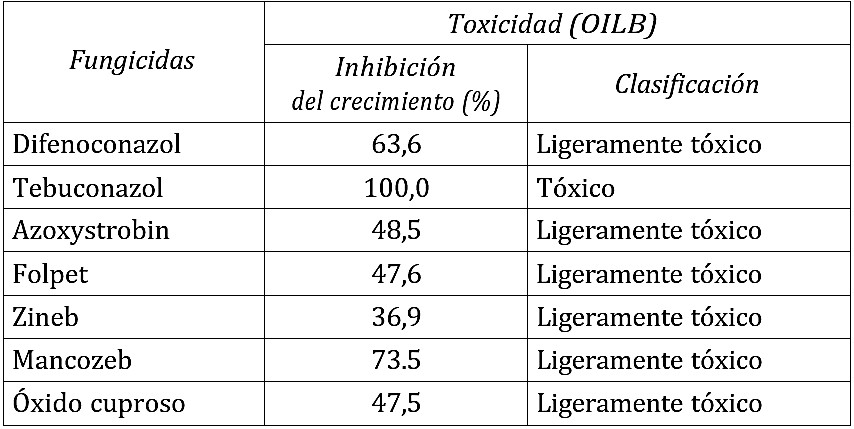
The effect of seven fungicides on the entomopathogen fungus Beauveria bassiana strain LBb-1. (Bals) Vuil.) was studied in vitro with fungicides concentrations of 10, 100, 200, 500, 1000 and 2000 mg • L–1. The inhibition of fungus colony growth, the effect on spore production capacity and conidia germination were evaluated. DL-50 and the DL- 95 of fungicide tebuconazol were considered below 10 mg • L–1. DL-50 for difenoconazol was considered in 30.45 mg • L–1, for mancozeb it was 161.49 mg • L–1, for folpet it was 398.92 mg • L–1 and for azoxystrobin it was 1463.11 mg • L–1. DL-50 for copper oxide and zineb were > 2000 mg • L–1. DL-95 for difeconazol was considered as 1019.04 mg • L–1, while for the rest of the fungicides it was considered above 2000 mg • L–1. Tebuconazol was classified as toxic for Beauveria bassiana by the OILB scale, while the rest were classified as lightly toxic. The seven studied fungicides were classified as very toxic for the fungus according to their T value, and they were not compatible with this. Conidia germination of Beauveria bassiana were not observed in none of tebuconazol, difenoconazol, mancozeb, azoxystrobin and folpet concentrations assayed, while in front of zineb and copper oxide they germinated up to 1000 mg • L–1 and 2000 mg • L–1, respectively.
Article Details

This work is licensed under a Creative Commons Attribution-NonCommercial 4.0 International License.
Those authors who have publications with this journal accept the following terms of the License Attribution-NonCommercial 4.0 International (CC BY-NC 4.0):
You are free to:
- Share — copy and redistribute the material in any medium or format
- Adapt — remix, transform, and build upon the material
The licensor cannot revoke these freedoms as long as you follow the license terms.
Under the following terms:
- Attribution — You must give appropriate credit, provide a link to the license, and indicate if changes were made. You may do so in any reasonable manner, but not in any way that suggests the licensor endorses you or your use.
- NonCommercial — You may not use the material for commercial purposes.
- No additional restrictions — You may not apply legal terms or technological measures that legally restrict others from doing anything the license permits.
The journal is not responsible for the opinions and concepts expressed in the works, they are the sole responsibility of the authors. The Editor, with the assistance of the Editorial Committee, reserves the right to suggest or request advisable or necessary modifications. They are accepted to publish original scientific papers, research results of interest that have not been published or sent to another journal for the same purpose.
The mention of trademarks of equipment, instruments or specific materials is for identification purposes, and there is no promotional commitment in relation to them, neither by the authors nor by the publisher.
How to Cite
References
Alves, S. B.; A. Moino; J. E. M. Almeida: «Produtos fitossanitários e entomopatógenos», Controle microbiano de insetos, FEALQ, Piracicaba, Brasil, 1998, pp. 217-238.
Batista, S.: «Seguridad de los agentes de control microbianos», O. Biológico 59(2):79-86, São Paulo, Brasil, 1997.
Castellanos, L.; R. Mur; J. L. Ayala; C. Ferrer: «Principales enfermedades fúngicas observadas en canteros de organopónicos y huertos intensivos y su manejo en Venezuela», memorias del XIX Congreso Venezolano de Fitopatología, Barquisimeto, 2005.
Castellanos, L.; M. E. Lorenzo; B. L. Muiño; A. Rodríguez: «Efecto de quizalofop-p etilo sobre Beauveria bassiana (Bals.) Vuill. y Lecanicillium (Verticillium) lecanii (Zimm.) Zare & Gams) in vitro», Fitosanidad 12(1):45-50, La Habana, 2008.
Ciba Geigy: Manual de ensayos de campo en producción vegetal, 2.a ed., Basilea, Suiza, 1981.
CNSV: Lista Oficial de Plaguicidas Autorizados, Departamento Registro de Plaguicidas, CNSV, Minag, La Habana, 2005.
Fernández-Larrea, O.: Temas interesantes acerca del control microbiológico de plagas, Ed. Cidisav, Inisav, La Habana, 2001.
Loureiro, E. de S.; A. Moino; A. Arnosti; G. C. Souza: «Efeito de produtos fitossanitários químicos utilizados em alface e crisântemo sobre fungos entomopatogênicos», Neotropical Entomology 31 (2): 263-269, Brasil, 2002.
Minag: Manual técnico de organopónicos y huertos intensivos, Minag, La Habana, 2000.
Minag: Manual técnico para organopónicos, huertos intensivos y organoponía semiprotegida, Minag, La Habana, 2007.
Muiño, B. L.; L. Larrinaga: «Efecto de los plaguicidas sobre Verticillium lecanii», Fitosanidad 2(1-2):33-35, La Habana, 1998.
Muiño, B. L.; M. Sáenz; M. Stefanova; A. Porras; I. Díaz: «Compatibilidad de Trichoderma spp. con algunos plaguicidas y fertilizantes en el cultivo del tabaco», Fitosanidad 5(2):3-9, La Habana, 2001.
Viñuela, E.; J. A. Jacas; V. Marco; A. Adrón; F. Badia: «Los efectos de los plaguicidas sobre los organismos beneficiosos en la agricultura y el grupo de trabajo de la OILB. Plaguicidas y organismos beneficiosos I. Insecticidas y acaricidas», Phytoma 45:18-25, España, 1993.