
Phytophthora nicotianae Brenda de Han en la especie ornamental helecho mano de mono (Microsorium scolopendrium (Burm.) Copel)
Article Sidebar
Main Article Content
Abstract
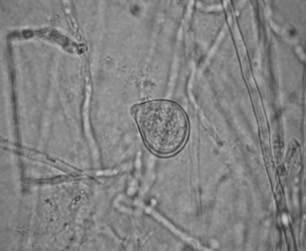
A través de los años Phytophthora nicotianae Brenda Hann ha representado un problema fitosanitario grave para la agricultura cubana al provocar cuantiosos daños en cultivos agrícolas y en plantas ornamentales, dadas sus características etiológicas y biológicas que le han permitido infectar un mayor número de hospedantes en diferentes géneros de plantas . De acuerdo con las características observadas al microscopio óptico y las definitorias para la especie y a la sintomatología que presentaban las plantas de helecho, se determinó que el agente causal era P. nicotianae, primera vez detectado en Cuba en Microsorium scolapemdrium.
Article Details

This work is licensed under a Creative Commons Attribution-NonCommercial 4.0 International License.
Those authors who have publications with this journal accept the following terms of the License Attribution-NonCommercial 4.0 International (CC BY-NC 4.0):
You are free to:
- Share — copy and redistribute the material in any medium or format
- Adapt — remix, transform, and build upon the material
The licensor cannot revoke these freedoms as long as you follow the license terms.
Under the following terms:
- Attribution — You must give appropriate credit, provide a link to the license, and indicate if changes were made. You may do so in any reasonable manner, but not in any way that suggests the licensor endorses you or your use.
- NonCommercial — You may not use the material for commercial purposes.
- No additional restrictions — You may not apply legal terms or technological measures that legally restrict others from doing anything the license permits.
The journal is not responsible for the opinions and concepts expressed in the works, they are the sole responsibility of the authors. The Editor, with the assistance of the Editorial Committee, reserves the right to suggest or request advisable or necessary modifications. They are accepted to publish original scientific papers, research results of interest that have not been published or sent to another journal for the same purpose.
The mention of trademarks of equipment, instruments or specific materials is for identification purposes, and there is no promotional commitment in relation to them, neither by the authors nor by the publisher.
How to Cite
References
Bruna, A.; G. Tobar: «Determinación de Phytophthora nicotianae causante del cancro del tomate en Chile», Agricultura Técnica 64(3):314- 318, Chile, 2004.
CPC Data Sheet: «PhytID-Identification of Plant Pathogenic Phytophthora Species by ITS Fingerprinting», Inglaterra, 2002, http://www.phytid. org (consultado en enero de 2009).
Erwin, D. C.; O. K. Ribero: Phytophthora diseases worldwide, St. Paul, Minnesota, APS Press, EE. UU., 1996.
García, A.; M. Aranguren; R. Luzbet; M. Ríos; L. Herrera: «Relación de los niveles de inóculo de Phytophthora sp. en plantaciones de pomelo con suelo desnudo y con césped en la calle», Centro Agrícola 3(29):59-61, Cuba, 2002.
Gilchrist Saavedra, L.; G. Fuentes Dávila; C. Martínez Cano; R. M. López Atilano; E. Duveiller; R. P. Singh; M. Henry; I. García: Guía práctica para la identificación de algunas enfermedades de trigo y cebada, 2.a ed., CIMMYT, México, 2005.
Minter, D. W.; M. Rodríguez; J. Mena: Fungi of the Caribbean an annotated checklist, PDMS Publishing 1 Ridgeway Road, Isleworth, Middlesex, Tw 75LB, Inglaterra, 2001.
Sandoval, I; T. Bonilla; M. O. López; Y. Tomas: «Hongos de suelo que atacan el clavel y antagonismo in vitro con Trichoderma spp.», Fitosanidad 2(3-4):41-44, La Habana.
Sandoval, I; T. Bonilla; M. O. López; Y. Tomas: «Captura y cuantificación de Phytophthora parasitica en muestras de flores y ornamentales», Fitosanidad 3(2):3-5, La Habana, 1999.