
The Xyleborini tribe (Coleoptera: Scolytidae) in Cuba and its host plants
Article Sidebar
Main Article Content
Abstract
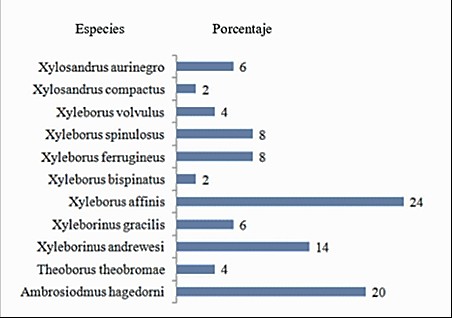
An update is offered on the species belonging to the Xyleborini tribes and their host plants. This group of coleopterans are wood borers of the Scolytidae family. Currently some of its species are considered roughing pests for causing the death of the tree due to its ability to be a vector for ambrosia fungi, which interrupt the flow of nutrients through conductive vessels. This mycosis also causes stains on the wood that devalue it in the market for carpentry work. For the prospection of the species, the national and international collections were reviewed, the literature was consulted and collections were made in different locations. The samplings were carried out in plants with attack symptoms between the years 2017-2019, in Havana and Artemisa, using direct collection methods in damaged trees and by means of flight interception traps to capture these insects. A total of 30 host species were sampled, where a total of 10 species of escolitidos from the Xyleborini tribes were detected, distributed in five genera. Xyleborini gracilis species are first reported with a recognized host. The genus Xyleborus and the species X. affinis presented a higher relative frequency of appearance. 10 host plants for 7 species of escolitidae were reported as new records from the species recorded by other authors and the review of reference entomological collections, the list of species of the Xyleborini tribe for Cuba was updated to 18 species from the exclusion of a species from the previous list and the inclusion of 7 species according to other authors.
Article Details

This work is licensed under a Creative Commons Attribution-NonCommercial 4.0 International License.
Those authors who have publications with this journal accept the following terms of the License Attribution-NonCommercial 4.0 International (CC BY-NC 4.0):
You are free to:
- Share — copy and redistribute the material in any medium or format
- Adapt — remix, transform, and build upon the material
The licensor cannot revoke these freedoms as long as you follow the license terms.
Under the following terms:
- Attribution — You must give appropriate credit, provide a link to the license, and indicate if changes were made. You may do so in any reasonable manner, but not in any way that suggests the licensor endorses you or your use.
- NonCommercial — You may not use the material for commercial purposes.
- No additional restrictions — You may not apply legal terms or technological measures that legally restrict others from doing anything the license permits.
The journal is not responsible for the opinions and concepts expressed in the works, they are the sole responsibility of the authors. The Editor, with the assistance of the Editorial Committee, reserves the right to suggest or request advisable or necessary modifications. They are accepted to publish original scientific papers, research results of interest that have not been published or sent to another journal for the same purpose.
The mention of trademarks of equipment, instruments or specific materials is for identification purposes, and there is no promotional commitment in relation to them, neither by the authors nor by the publisher.
How to Cite
References
Bright D. E., 2019. A taxonomic Monograph of the bark and ambrosia beetles of the West Indies (Coleoptera: Curculionoidea: Scolytidae). Ocassional Papers of the Florida State collection of Arthropods. 12: 251-310.
Gómez D., Rabaglia R., Fairbanks K. y Hulcr J., 2018. North American Xyleborini north of Mexico: a review and key to genera and species (Coleoptera, Curculionidae, Scolytinae). Zoo Keys. 768: 19–68.
Gómez D., Johnson A., Carton de Grammont P., Simonetti J., Montaigne J., Elizondo A., Muiño B., Ojeda D., Vidal J y Hulcr J.,2019. New records of bark and ambrosia beetles (Coleoptera: Scolytinae) from Cuba with description of a new species. Florida Entomologist. 102(4): 717-724.
Moreno D., González H., Botta E., Martínez A. y Ovies J., 2005. Evaluación de la efectividad de trampas rústicas para la captura de hembras adultas de la broca del café Hypothenemus hampei (Coleoptera: Scolytidae). Fitosanidad. 9(3).
Norton, D. C., 1978. Ecology of Plant Parasitic Nematodes, John Wiley and Sons, New York.
Pérez M., Equihua A., Estrada, E., Muñoz A., Valdez J., Sánchez J. y Atkinson, T., 2015. Sinopsis de especies mexicanas del género Xyleborus Eichhoff, 1864 (Coleoptera: Curculionidae: Scolytinae). Acta Zoológica Mexicana. 31(2): 239-250.
Vázquez, L. Rodríguez M. y Zorrilla M., 2003. Lista de Escolítidos (Coleoptera) de Cuba y sus plantas hospedantes. Rev. Fitosanidad. 7 (1).
Wood SL., 2007. Bark and ambrosia beetles of South America (Coleoptera, Scolytidae). Brigham Young University, Provo, Utah. Monte L. Bean Life Science Museum. 900 pp.