
Producción de conidios de Trichoderma harzianum Rifai en dos medios de multiplicación
Article Sidebar
Main Article Content
Abstract
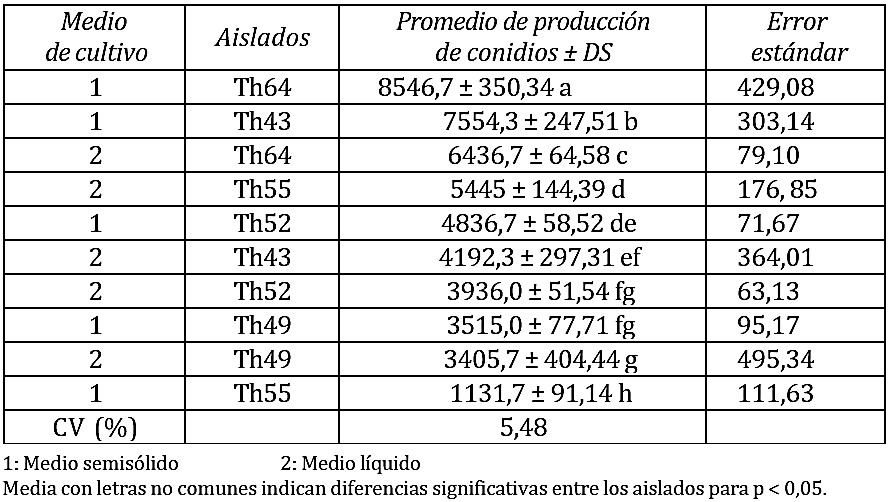
Trichoderma is a suitable model for studies of biocontrol due to the ease offered by their culture in vitro. Previous studies have achieved encouraging results on fungal pathogens biological control of coriander and basil using Trichoderma. With this background two ways of multiplication were tested in order to identifying the most suitable for conidia production of five Trichoderma isolates which were previously cultured on potato-glucose-agar and inoculated in a liquid and semisolid medias, contained in a experimental bioreactor. Conidia production data were analized by factorial ANOVA, considered media, isolates and time. Tests were carried out by triplicate and trial distribution was completely random. Results showed variability in conidia production rate by time, multiplication media and T. harzianum isolates. Interactions were detected between multiplication media and isolates of Trichoderma. Semi-solid media increased conidia production rate of an isolate from basil phylloplane. While the liquid substrate increased conidia production rate of the isolate from rosemary rhizoplane. In other isolates one from phylloplane of rosemary and two from biosustrates culture there were no significant differences in conidia production rate of the two media used. Obtained results have practical application because the production of conidia of T. harzianum has great importance for the control of root pathogens and other organs of adult plant.
Article Details

This work is licensed under a Creative Commons Attribution-NonCommercial 4.0 International License.
Those authors who have publications with this journal accept the following terms of the License Attribution-NonCommercial 4.0 International (CC BY-NC 4.0):
You are free to:
- Share — copy and redistribute the material in any medium or format
- Adapt — remix, transform, and build upon the material
The licensor cannot revoke these freedoms as long as you follow the license terms.
Under the following terms:
- Attribution — You must give appropriate credit, provide a link to the license, and indicate if changes were made. You may do so in any reasonable manner, but not in any way that suggests the licensor endorses you or your use.
- NonCommercial — You may not use the material for commercial purposes.
- No additional restrictions — You may not apply legal terms or technological measures that legally restrict others from doing anything the license permits.
The journal is not responsible for the opinions and concepts expressed in the works, they are the sole responsibility of the authors. The Editor, with the assistance of the Editorial Committee, reserves the right to suggest or request advisable or necessary modifications. They are accepted to publish original scientific papers, research results of interest that have not been published or sent to another journal for the same purpose.
The mention of trademarks of equipment, instruments or specific materials is for identification purposes, and there is no promotional commitment in relation to them, neither by the authors nor by the publisher.
How to Cite
References
Agamez Ramos, E. Y.; R. I. Zapata Navarro; L. E. Oviedo Zumaqué; J. E. Vbarrera Violeth: «Evaluación de sustratos y procesos de fermentación sólida para la producción de esporas de Trichoderma sp.», Rev. Colomb. de Biotecnol. X (2): 23-34, Colombia, 2008.
Chávez García, M.; J. S. Montaña Lara; M. M. Martínez Salgado; M. Mercado Reyes; M. X. Rodríguez; B. Quevedo Hidalgo: «Efecto del sustrato y la exposición a la luz en la producción de una cepa de Trichoderma sp.», Universitas Scientiarum 13 (3): 245-251, Colombia, 2008.
Cortez Madrigal, H.: «Producción de Lecanicillium (= Verticillium) lecanii en diferentes sustratos y patogenicidad», Agric. Téc. Méx. 33 (1): 83-87, México, 2007.
Donoso, E.; G. Lobos; N. Rojas: «Efecto de Trichoderma harzianum y compost sobre el crecimiento de plántulas de Pinus radiata en vivero», Bosque 29 (81): 52-57, Chile, 2008, http://www.scielo.cl/pdf/bosque/v29n1/art06.pdf (consultado en agosto de 2010).
Elosegui, O.: «Métodos artesanales de producción de bioplaguicidas a partir de hongos entomopatógenos y antagonistas», Instituto de Investigaciones de Sanidad Vegetal, La Habana, 2006, http://inisav.cu/ Otras Pub/METODOS%20ARTESANALES%20DE%20PRODUCCION%20DE%20BIOPLAGUICIDAS.pdf(consultado en diciembre de 2011).
García, R.; M. A. Durán; R. Riera: «Producción de biomasa de Trichoderma harzianum por fermentación líquida», Fitosanidad 10 (4): 295-298, La Habana, 2006.
Harman, G. E.: «Developments Tactis for Biological Agent in Plant Pathology», New Directions in Biological Control: Alternatives for Suppressing Agricultural Pest and Diseases, EE. UU., 1990, pp. 779-792.
Hermosa, R.; A. Viterbo; I. Chet; E. Monte: «Plant Beneficial Effects of Trichoderma and of its Genes», Microbiology 158: 17-25, Reino Unido, 2012.
Infante, D.; B. Martínez; N. González; Y. Reyes «Mecanismos de acción de Trichoderma frente a hongos fitopatógenos», Rev. Protección Veg. 24: 14-21, Cuba, 2009, http://scielo.cu/scielo.php? script=sci_arttext&pid=s1010 (consultado en diciembre de 2011).
Jin, X.; G. E. Harman; A. G. Taylor: «Conidial Biomass and Desiccation Tolerance of Trichoderma harzianum Produced at Different Medium Water Potentials», Biol. Control 1: 237-243, Holanda, 1991.
Lo, C. T.; C. K. Hayes; G. E. Harman: «Ecological Studies of Transformed Trichoderma harzianum Strain 1295-22 in the Rhizosphere and on the Phylloplane of Creeping Bent Grass», Phytopathology 88: 129- 136, EE. UU., 1998.
Rincón, A. M.; A. C. Codón; T. Benítez: «Hidrolasas y genes fúngicos de interés en biocontrol», Pallás, V.; C. Escobar; P. Rodríguez; J. F. Marcos (Editores). Herramientas biotecnológicas en Fitopatología, Ediciones Mundi Prensa, Madrid, 2008.
Sandoval, M. C.: «Control biológico de Colletotrichum fusarioides O´Gara, patógeno de semillas de albahaca (Ocimum basilicum L.) con Trichoderma Rifai», BLACPMA 8 (2):104-109, Chile, 2009.
Torres, E.; J. Iannacone; H. Gómez: «Biocontrol del moho foliar del tomate Cladosporium fulvum empleando cuatro hongos antagonistas», Bragantia 67 (1): 169-178, Brasil, 2008.
Zeilinger, S.; M. Omann: «Trichoderma Biocontrol: Signal Transduction Pathways Involved in Host Sensing and Mycoparasitism», Gene Regulation and Systems Biology 1: 227-234, EE. UU.,. 2007.