
Patogenicidad de Fusarium solani (Mart.) Sacc. y Alternaria alternata (Fries) Keissler en Thevetia peruviana (Pers.) K. Schum. y su control in vitro
Article Sidebar
Main Article Content
Abstract
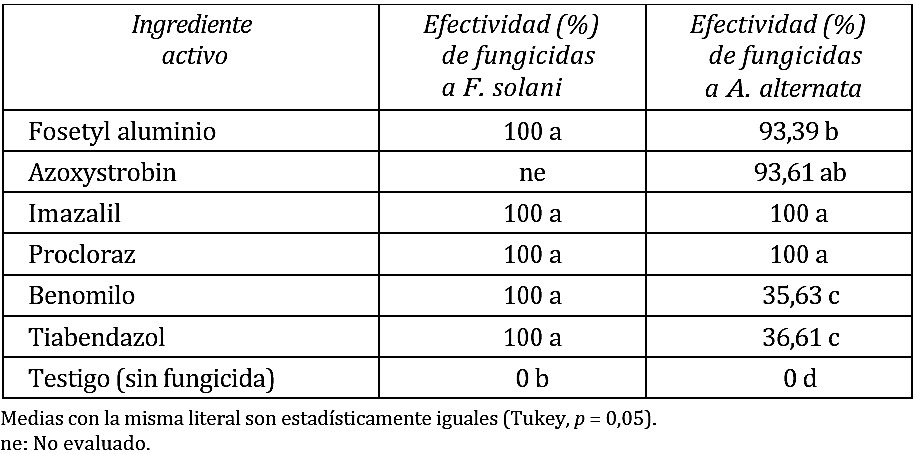
Causal agents of fungal diseases were identified in plants and leaves of Thevetia peruviana (Pers.) K. Schum. (Lucky nut) The fungi isolated were used for pathogenicity tests and for in vitro sensibility tests to the chemical fungicides fosetyl-Al, azoxystrobin, imazalil, procloraz, benomil and tiabendazole. The presence of Fusarium solani causing necrosis in the hypocotyl and cotyledons of seedlings was observed. Seedlings inoculated with pathogen showed symptoms eight days after inoculation, pathogen was isolated then and its identity was confirmed. All chemical fungicides were 100% effective to control it. Another fungus, Alternaria alternata was identified in foliar spots. The pathogenicity test showed that symptoms were visible two days after inoculation. Fungicides imazalil and procloraz showed 100% effectiveness to control this fungus.
Article Details

This work is licensed under a Creative Commons Attribution-NonCommercial 4.0 International License.
Those authors who have publications with this journal accept the following terms of the License Attribution-NonCommercial 4.0 International (CC BY-NC 4.0):
You are free to:
- Share — copy and redistribute the material in any medium or format
- Adapt — remix, transform, and build upon the material
The licensor cannot revoke these freedoms as long as you follow the license terms.
Under the following terms:
- Attribution — You must give appropriate credit, provide a link to the license, and indicate if changes were made. You may do so in any reasonable manner, but not in any way that suggests the licensor endorses you or your use.
- NonCommercial — You may not use the material for commercial purposes.
- No additional restrictions — You may not apply legal terms or technological measures that legally restrict others from doing anything the license permits.
The journal is not responsible for the opinions and concepts expressed in the works, they are the sole responsibility of the authors. The Editor, with the assistance of the Editorial Committee, reserves the right to suggest or request advisable or necessary modifications. They are accepted to publish original scientific papers, research results of interest that have not been published or sent to another journal for the same purpose.
The mention of trademarks of equipment, instruments or specific materials is for identification purposes, and there is no promotional commitment in relation to them, neither by the authors nor by the publisher.
How to Cite
References
Abbott, W. S.: «A method of computing the effectiveness of an insecticide» J. Econ. Entomol. 18: 265-267. EE. UU. 1925.
Alvarado, C. L. O.; H. Ochoterena: «A Phylogenetic Analysis of the Cascabela-Thevetia Species Complex (Plumerieae, Apocynaceae) Based on Morphology», Annals of the Missouri Batanical Garden 94 (2): 298-323, EE. UU., 2007.
Ambang, Z.; D. J. P. Ngoh; G. Essono; N. Bekolo; G. Chewachong; C. C. Asseng: «Effect of Thevetia peruviana Seeds Extract on in vitro Growth of Four Strains of Phytophthora megakarya», Plant Omics Journal 3 (3): 70-76, Australia, 2010.
Arias, T. J. K.; R. A. P. Jerez: «Elaboración de un atlas para la descripción macroscópica y microscópica de hongos fitopatógenos de interés en especies de flores de corte cultivadas en la sabana de Bogotá», trabajo de grado en Microbiología Industrial, Pontificia Universidad Javeriana, Facultad de Ciencias, Colombia, 2008.
Aular de González, Y.; M. Peña; A. J. Pérez; M. Díaz: «Intoxicación por la administración de tabletas de Thevetia peruviana como tratamiento para bajar de peso: presentación de un caso», Rev. Toxicol 20: 221-223, España, 2003.
Barnett, H. L.; B. B. Hunter: Ilustrated General of Imperfect Fungi, 4th edition, Burgess Publishing Company, Minessota, EE. UU., 1999.
Cabrera, M. G.; R. E. Álvarez; N. T. Sosa de Castro; L. A. Sosa: «Patógenos de Chrysanthemum sp. en cultivos de las provincias de Corrientes y Chaco, Argentina», Comunicaciones Científicas y Tecnológicas, Universidad Nacional del Nordeste, Argentina, 2004.
Cova, J.; D. Rodríguez: «Hongos asociados con el quemado foliar de la cebolla (Allium cepa L.) en el Estado Lara, Venezuela», Bioagro 15 (3): 157-163, Venezuela, 2003.
Cúndom, M. A.; M. G. Cabrera: «Tizón foliar de Celosia argentea en el nordeste de Argentina», Prod. Prod. Veg. 17 (3): 463-466, España, 2002.
Demirbas, A.: «Current Technologies in Biodiesel Production», Biodiesel, Ed. Springer London, Cap. 7, Reino Unido, 2008, pp. 161-173.
Díaz, B. L.; S. J. F. López; T. Vega-Lizama; D. M. López: «Characterization of Soil from Plant Growth in Mexico as a Feedstock to Produce Biodiesel», XIX International Materials Research Congress (IMRC XIX), 15-19 agosto, Cancún, México, 2010.
Escalona, Y.; D. Rodríguez; N. Contreras; N. Jiménez: «Patógenos del suelo en el cultivo del pimentón en la zona baja del municipio Jiménez, Estado Lara, Venezuela», Bioagro 18: 3-13, Venezuela, 2006.
Félix, G. R.; F. C. A. Gálvez: «Control de moho negro Alternaria alternata en el fruto de tomate (Lycopersicon esculentum Mill.) considerando unidades calor y variables ambientales para la aplicación de Azoxystrobin en Sinaloa, México», Revista Mexicana de Fitopatología 20: 72-76, México, 2002.
Fernández, G. J.: «Incidencia y caracterización: morfológica, patogénica y genética de Alternaria spp. en cultivos de cebolla del sur de Puerto Rico», Tesis de Maestría en Ciencias en Protección de Cultivos, Universidad de Puerto Rico, Recinto Universitario de Mayagüez, Puerto Rico, 2005.
Fraire-Cordero, M. L.; D. Nieto-Ángel; E. Cárdenas-Soriano; G. GutiérrezAlonso; R. Bujanos-Muñiz; H. Vaquera-Huerta: «Alternaria tenuissima, A. alternata y Fusarium oxysporum, hongos causantes de la pudrición del florete de brócoli», Revista Mexicana de Fitopatología 28: 25-33, México, 2010.
Herrera, P. E. A.: «Sensibilidad in vitro de Fusarium oxysporum Schletch y Alternaria solani Jones & Grout a fungicidas de contacto y sistémicos», Tesis de Licenciatura en Biología, Instituto Tecnológico Agropecuario Conkal, Yucatán, México, 2004.
López, B. A.; B. S. R. López; M. E. Vázquez-Badillo; H. S. A. Rodríguez; E. M. Mendoza; C. E. Padrón: «Inhibición del crecimiento micelial de Fusarium oxysporum Schlechtend. f. sp. lycopersici (Sacc.) Snyder y Hansen, Rhizoctonia solani Kühn y Verticillium dahliae Kleb. mediante extractos vegetales acuosos», Revista Mexicana de Fitopatología 23 (2): 183-190, México, 2005.
Madrigal, V. M.: «Control biológico de la mancha negra (Alternaria alternata) como alternativa de prevención en el manejo poscosecha del mango», Tesis de Maestría Tecnológica en Agroindustria, Institución de Enseñanza e Investigación en Ciencias Agrícolas, Colegio de Posgraduados, Córdoba, Veracruz, México, 2009.
Martínez, G. M.; D. S. Hernández; R. J. S. Padilla; P. N. Mayek: «Diversidad patogénica y genética de aislamientos de Fusarium de Aguascalientes, México», Revista Mexicana de Fitopatología, 22 (3): 321-327, México, 2004.
McDonald, A. E.; B. R. Grant; V. C. Plaxton: «Phosphite (Phosphorous acid): its Relevance in the Enviorement and Agriculture and Influence on Plant Phosphate Starvation», Journal of Plant Nutrition 24 (10): 1505-1519, EE. UU., 2001.
Montealegre, J.; S. Donoso; R. Herrera; X. Besoain: «Identificación de Fusarium solani (Mart.) Sacc. como agente causal de la podredumbre del pie de tomate», Boletín Micológico 18: 53-55, Chile, 2003.
Nieto, A. D.; R. M. Acosta; A. M. Valencia; N. G. Mena: «Estudio de efectividad biológica con fungicidas», Bases para realizar estudios de efectividad biológica de fungicidas, Colegio de Posgraduados, Montecillo, Texcoco, Estado de México, México, 2001.
Oluwaniyi, O. O.; S. A. Ibiyemi: «Efficacy of Catalysts in the Batch Esterification of the Fatty Acids of Thevetia peruviana Seed Oil», J. Appl. Sci. Environ. Mgt. 7 (1): 15-17, Nigeria, 2003.
Quilambaqui, J. M.; M. E. Zavaleta; A. G. Mora; S. F. Delgadillo; J. A. Marín: «Patogenicidad de tres especies de fusarium asociadas con el declinamiento del espárrago (Asparagus officinalis L.) en Guanajuato, México», Revista Mexicana de Fitopatología 22 (1): 30-36, México, 2004.
Ravikumar, P. H. S.; H. K. Makari; H. Gurumurthy: «In vitro Antimicrobial Activity of Ethanol Extract of Thevetia peruviana», Electronic Journal of Environmental, Agricultural and food Chemistry 6 (9): 2318-2322, España, 2007.
Rotem, J.: «The Genus Alternaria: Biology, Epidemiology and Pathogenicity», American Phytopathology Society, St. Paul, MN, EE. UU., 1994.
Simmons, E. G.: «Alternaria Themes and Variations», Mycotaxon 55: 55-163, EE. UU., 1995.
Stevens, W. D.; U. C. Ulloa; A. Poll; O. M. Montiel: «Flora de Nicaragua», Missouri Botanical Garden Press, EE. UU., 2001.
Torres, N.: «Actualización sobre intoxicación con Thevetia peruviana», Retel, Revista de Toxicología en Línea, http://www.sertox.com.ar/img/item_full/19001.pdf Argentina, 2003, pp. 2-19.
Tutte, J.: «Media and Nutrient Solutions Used by Plant Pathologist and Mycologist», Plant pathologhycal methods fungi and bacteria, Burgess Publishing Company Minneapolis, Menn, EE. UU., 1998.