
Evaluación in vitro de cinco fungicidas para el control de sarocladium oryzae
Article Sidebar
Main Article Content
Abstract
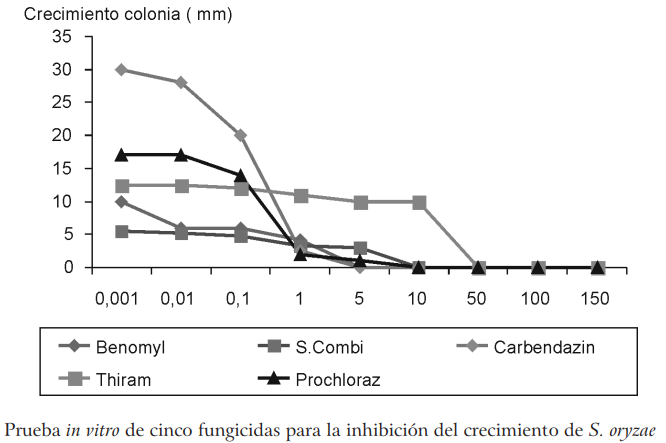
The fungicides Octave 50% (prochloraz), Curacarb 50% (carbendazin), Fundazol 50% (benomyl), Silvacur Combi 50% (tebuconazol + triadimenol) and TMTD 80% (Thiram) were in vitro evaluated for the control of sheath rot disease caused by S. oryzae. The following concentrations of fungicides used were 0,001; 0,1; 1; 5; 10; 50; 100 and 150 ppm of active ingredient of the product added to plates with potato dextrose agar. The mycelial growth was completely inhibited at concentrations of 5 ppm or higher with Octave 50% (prochloraz), Fundazol 50% (benomyl) and Curacarb 50% (carbendazin).
Article Details

This work is licensed under a Creative Commons Attribution-NonCommercial 4.0 International License.
Those authors who have publications with this journal accept the following terms of the License Attribution-NonCommercial 4.0 International (CC BY-NC 4.0):
You are free to:
- Share — copy and redistribute the material in any medium or format
- Adapt — remix, transform, and build upon the material
The licensor cannot revoke these freedoms as long as you follow the license terms.
Under the following terms:
- Attribution — You must give appropriate credit, provide a link to the license, and indicate if changes were made. You may do so in any reasonable manner, but not in any way that suggests the licensor endorses you or your use.
- NonCommercial — You may not use the material for commercial purposes.
- No additional restrictions — You may not apply legal terms or technological measures that legally restrict others from doing anything the license permits.
The journal is not responsible for the opinions and concepts expressed in the works, they are the sole responsibility of the authors. The Editor, with the assistance of the Editorial Committee, reserves the right to suggest or request advisable or necessary modifications. They are accepted to publish original scientific papers, research results of interest that have not been published or sent to another journal for the same purpose.
The mention of trademarks of equipment, instruments or specific materials is for identification purposes, and there is no promotional commitment in relation to them, neither by the authors nor by the publisher.
How to Cite
References
Damicone, J.; B. Moore; J. Fox; G. Sciombato: «Rice Diseases in Mississippi: A guide to Identification», Mississippi State University, Extension Service http://ext.msstate.edu/pubs/pub1840.htm4/29/1999.
Das, S. R.; N. Nivedita; N. Nayak: «Efficacy of Fungicides in Controlling Sheath Rot of Rice in Orissa», Crop Research-Hisar. 14 (3): 497-500, 1997.
Donan, D. S.; S. Ram; S. Sunder; R. Singh: «Efficacy of Fungi Toxicants Against Sheath Rot of Rice», Indian Journal of Mycology and Plant Pathology, 26 (3):283-84, 1996.
Hernández, J.: «Manchado del grano del arroz», III Seminario Científico Internacional de Sanidad Vegetal. I Taller Internacional de Uso de Plaguicidas (Programas), La Habana, 1997.
––––: «Sarocladium oryzae. Pudrición de la vaina en arroz. Aventis Crop Science. Información Preferencial», Arroz 1:6, octubre 2000.
Misra, A. K.; V. Dharam: «Efficacy of Fungicides-XLVI: Effect of Fungicidal Seed Treatment Against Heavy Inoculum Pressure of Certain Fungi Causing Discolouration of Paddy Seeds», Indian Phytopathology 43(2):175-78, 1990.
Mithrasena, Y. S. P. K.; R. L. C. Wijesundera: «Growth and Sporulation of Sarocladium oryzae the Rice Sheath Rot Pathogen»,Tropical Agriculturist. 148:1-13, 1992.
Pérez, L.; A. Hernández; A. Batlle: «Enfermedades fungosas del cultivo del arroz encontrados en la empresa arrocera Los Palacios durante 1997 y factores de manejo que determinan su presencia. Resúmenes. I Encuentro Internacional de Arroz. Palacio de Convenciones 9-11 de junio de 1998.
Pupo, E.; I. Heredia; A. Solís: «Hongos presentes en las semillas de arroz y su influencia en la calidad de la semilla». Resúmenes. I Encuentro Internacional de Arroz, Palacio de Convenciones, 9-11 de junio de 1998.
Sandoval, I.; M. O. López; T. Bonilla; Y. Tómas: «Primer reporte en Cuba de la enfermedad de la pudrición de la vaina del arroz por Sarocladium oryzae», Fitosanidad 3, 1999.
Sandoval, I.; M. O. López; G. Estrada; T. Bonilla; W. Wong: «Hongos asociados al manchado del grano del arroz en variedades afectadas por la enfermedad de la pudrición de la vaina». Resúmenes. IV Seminario Científico Internacional de Sanidad Vegetal. 11-15 junio, Palacio de Convenciones, Plaza América, Varadero, Cuba, 299-300, 2001.