
Efectividad de Trichoderma spp. para el control de hongos patógenos de la semilla y el suelo en el cultivo del frijol
Article Sidebar
Main Article Content
Abstract
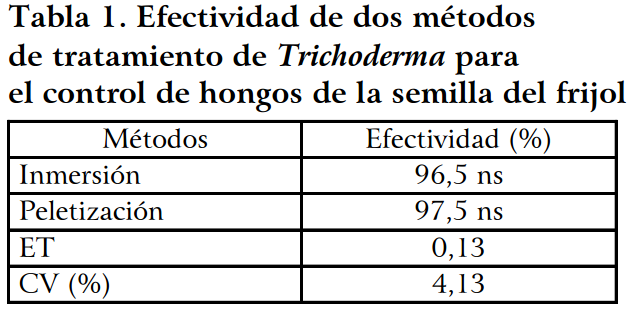
The effect of Trichoderma for the control of pathogen fungi on soil and bean seeds was evaluated “in vitro” and field conditions. In laboratory test, three treatments of Trichoderma harzianum (A-34), Trichoderma viride (C-66) and a control were proved with immersion and pelleting as sub-treatments in every variant. Fifty seeds for replica were tested by traditional method of wet chamber incubated for eight days at 25 ±1°C. The isolates A-34 and C-66 showed the same effectiveness results with more than 99 % on Rhizoctonia solani, while C-66 was more effective on Macrophomina phaseoli with 97,4%. Strain C-66 was probed in field with seed immersion, and treatments to soil before and after sowing. The best variant resulted a soil treatment of Trichoderma in sowing and two later every 15 days.
Article Details

This work is licensed under a Creative Commons Attribution-NonCommercial 4.0 International License.
Those authors who have publications with this journal accept the following terms of the License Attribution-NonCommercial 4.0 International (CC BY-NC 4.0):
You are free to:
- Share — copy and redistribute the material in any medium or format
- Adapt — remix, transform, and build upon the material
The licensor cannot revoke these freedoms as long as you follow the license terms.
Under the following terms:
- Attribution — You must give appropriate credit, provide a link to the license, and indicate if changes were made. You may do so in any reasonable manner, but not in any way that suggests the licensor endorses you or your use.
- NonCommercial — You may not use the material for commercial purposes.
- No additional restrictions — You may not apply legal terms or technological measures that legally restrict others from doing anything the license permits.
The journal is not responsible for the opinions and concepts expressed in the works, they are the sole responsibility of the authors. The Editor, with the assistance of the Editorial Committee, reserves the right to suggest or request advisable or necessary modifications. They are accepted to publish original scientific papers, research results of interest that have not been published or sent to another journal for the same purpose.
The mention of trademarks of equipment, instruments or specific materials is for identification purposes, and there is no promotional commitment in relation to them, neither by the authors nor by the publisher.
How to Cite
References
Bhargava, Y. R.: «Pleiotropic Effect of Seed Pelleting in Controling Seed Borne Fungal Disease in Brassica oleraceae var. Capitata», Seed Pathology and Microbiology 6:36, 1995.
Castellanos, L.; M. González; T. Santana; I. Irimia: «Generalización de la producción y uso de Trichoderma spp. para el control de enfermedades». Segundo Encuentro Nacional Científico-Técnico de Bioplaguicidas, EXPO CREE, La Habana., 1995, p. 26.
Ciba-Geigy: Manual de ensayos de campo. Basilea, Suiza, 1979, pp. 11-20.
CIAT: Cultivando afinidades, Boletín sobre cooperación en investigación agrícola, Unidad de Comunicaciones, Cali, Colombia,1998, p. 8.
González, Mirta: Enfermedades fungosas del fríjol de Cuba, Ed. Científico-Técnica, La Habana, 1984, pp. 39-60.
Hadar, Y; I. Chet; R. Baker: «Biological Control of Rhizoctonia solani Damping off with Wheat from Culture of Trichoderma harzianum», Phytopathology 69: 64-68, 1979.
Infante, M. A.; C. M. Scotie; U. Gutiérrez: «Producción y consumo de fríjol seco y su contribución a la oferta de proteína a nivel mundial», Centro Internacional de Agricultura Tropical. Informe Anual, Cali, Colombia, 1975, p. 47.
Lifshitz, R.; B. Windham, B.; R. Tand Baker: «Mechanism of Biological Control of Preemergence Damping off Pea by Seed Treatment with Trichoderma spp.», Phytopathology 76:720-725, 1986.
Sanders, J.; C. Álvarez: Evaluation of Beans Productions During the Last Year, CIAT, 1978, p. 34.
Sandoval, I.; M. Neyra; D. García; M. López; I. Mendoza: «Trichoderma: biocontrol de hongos fitopatógenos en el cultivo del tomate en hidropónico». Resúmenes. I Simposio Latinoamericano de Micología, La Habana, 1995, p. 61.
Sandoval, I.; M. López; T. Bonilla; Y. Tomas: «Hongos del suelo que atacan al clavel y antagonismo in vitro con Trichoderma spp.», Fitosanidad 3 y 4 (2): 41, 1998.
Santana, T.; M. Lorenzo: «Acción antagónica que ejercen diferentes cepas de Trichoderma contra Sclerotium rolfsii Sacc. aislado de Topinambur (Helianthus tuberosum L.)». Resúmenes. III Encuentro Nacional Científico-Técnico de Bioplaguicidas, EXPO CREE, 1995, p. 38.
Silveira, N. S. S.; S.J. Michereffi; M. Meneses; G. M. Campos-Takaki: «Potential of Trichoderma spp. Isolates for the Control of Sclerotium rolfssi on Beans», Seed Pathology and Microbiology 6:36(296), 1995.
Stefanova, Marusia: «Empleo de biopreparados de Trichoderma en el control de hongos fitopatógenos del suelo en tabaco, pimiento y tomate de hidropónico». Resúmenes. Forum de Ciencia y Técnica, INISAV, La Habana, 1993, p. 33.
Zaumeyer, W. J.; H. R. Thomas: «Monography Study of Bean Diseases and Methods for Their Control», Techn. Bull. U. S., Departament of Agriculture, 1957, p. 868.