
Comparación de poblaciones de Aschersonia aleyrodis (webber) en diferentes especies de coccoideos
Article Sidebar
Main Article Content
Abstract
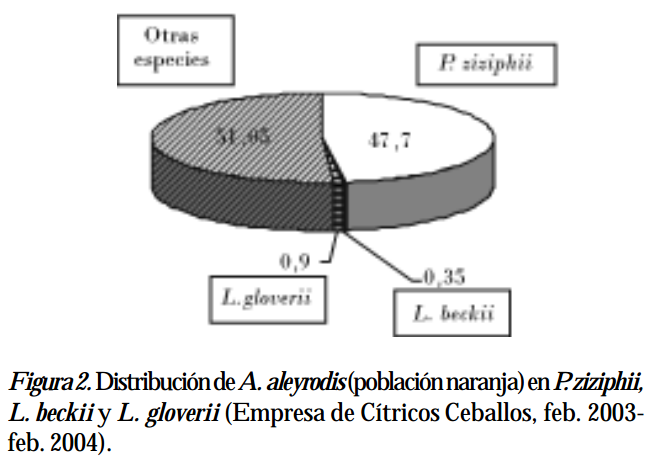
In order to improve pest management in citrus (Citrus sinensis L), a research work was realized at Ceballo Citric Enterpise, in the province of Ciego de Avila in Cuba from Feb/2003 to Feb/2004, on Valencia orange, by the characterization of two Aschersonia aleyrodis Webber populations, one of orange color conidiomas (Pn) and another of white (Pb), on Paralatoria ziziphi L, Lepidosaphes beckii N and Lepidosaphes gloverii P., which are important pests for this cultivation. To determine coccoideos population levels and to count parasited ones decennial samplings were made. It was calculated also the rate of parasitism, its distribution and dynamics in each population. Populations were characterized for presenting greater increases from September to February. Pn-P. ziziphi; Pb-P. ziziphi, Pb-L. gloverii and Pb-L. becckii showed to be similar among them, but greater and significatively different from Pn–L. beckii and Pn-L. gloverii. Orange population infested 47.7% of P. ziziphi, 0.35% of L. beckii and 0.9% of L. gloverii, whereas white population over-parasited 61, 0.85 and 1.4% of the same species respectively. The species of coccoideos with greater hyperparasitism was P. ziziphii, with significant differences compared to L. beckii and L. gloverii.
Article Details

This work is licensed under a Creative Commons Attribution-NonCommercial 4.0 International License.
Those authors who have publications with this journal accept the following terms of the License Attribution-NonCommercial 4.0 International (CC BY-NC 4.0):
You are free to:
- Share — copy and redistribute the material in any medium or format
- Adapt — remix, transform, and build upon the material
The licensor cannot revoke these freedoms as long as you follow the license terms.
Under the following terms:
- Attribution — You must give appropriate credit, provide a link to the license, and indicate if changes were made. You may do so in any reasonable manner, but not in any way that suggests the licensor endorses you or your use.
- NonCommercial — You may not use the material for commercial purposes.
- No additional restrictions — You may not apply legal terms or technological measures that legally restrict others from doing anything the license permits.
The journal is not responsible for the opinions and concepts expressed in the works, they are the sole responsibility of the authors. The Editor, with the assistance of the Editorial Committee, reserves the right to suggest or request advisable or necessary modifications. They are accepted to publish original scientific papers, research results of interest that have not been published or sent to another journal for the same purpose.
The mention of trademarks of equipment, instruments or specific materials is for identification purposes, and there is no promotional commitment in relation to them, neither by the authors nor by the publisher.
How to Cite
References
Berlanga, P.; Angélica María; V. Hernández Velásquez: «Aschersonia aleyrodis Webber en el control microbial de mosca blanca de los cítricos Dialeurodes sp.», Centro Nacional de Referencia de Control Biológico, DGSV-SAGAR, Estación FFCC, Tecomán, Colima, México, 2002, http://www.procesosvirtuales.com/documentos/archivos/DT-BT01-1.pdf.2002.
Ceballos, Margarita; Marlene Hernández: Guía de campo para la identificación de calcidos parásitos de cóccidos en las principales regiones citrícolas del país, CENSA, La Habana, 1992.
El Choubassi, W.: «Biología, ecología y control de Paralatoria ziziphii (Lucas) en los cítricos de Ciego de Ávila». Resumen de Tesis de Doctorado en Ciencias Agrícolas, Universidad de Ciego de Ávila, Cuba, 2001.
El Choubassi, W.; M. A. Iparraguirre; María L. Sisne; H. Grillo: «Incidencia del género de Aschersonia sobre la población de Parlatoria ziziphii (Lucas) (Hemíptera: Diaspididae) en naranjo valencia (Citrus inensis) de la provincia Ciego de Ávila», Rev. Centro Agrícola 28 (3):42-45, 2001.
Fernández-Larrea, Orieta: Temas interesantes acerca del control microbiológico de plagas, INISAV, La Habana, 2001.
Gao, R. V.: «A Preliminary Report on Aschersonia aleyrodis to Control Citrus Whitefly», Journal of Fujian Agricultural College (China) 14 (2):127-133,1985.
Hernández, A.; Caridad Daquinta Rico; W. El Choubassi; Nury Pérez Valdés; Aliuska Sierra Peñal: «Efecto climático sobre el desarrollo parasitario de Aschersonia spp. sobre cóccidos en plantaciones de naranjo valencia en Ciego de Ávila», Memorias de la VI Conferencia Científica Internacional, Universidad de Ciego de Ávila, Cuba, octubre 2002.
Hernández, M. A.: «Efecto de la temperatura y humedad relativa en la germinación de los conidios de Aschersonia spp. 2004 (inédito).
Messias, C. L.: «Utilização de fungus entomopatogênicos para el controle biológico das pargas agrícola. Ciclo de palestras sobre controle biológico de pragas, 2. Campinasa. Anais», Campinas: Fundação Cargill. (2):111-125, 1992.
Silva, A. B.: «Controle biológico natural da entomofauna danhina da laranjeira en Belem e Capitão Poco, estado do para. EMBRAPA-CPATU», Boletín Pesquiza de EMBRAPA (25):162, 1996.
Suris, Moraima; Ivonne Varona: «Distribución espacial de Selenaspidus articulatus (Coccoidae: Diaspididae) en una plantación de naranjo valencia», Revista Protección de Vegetal 3(1):38-44, 1988.
Zou, W.: «Parasitism of Aschersonia sp. On Dialeurodes citri.», Zhejiang Agricultural Sciences (China) (6):280-282, 1988.