
Consumo de alimento por Diaphania hyalinata (l.) (lepidoptera: pyralidae) en pepino (Cucumis sativus l.)
Article Sidebar
Main Article Content
Abstract
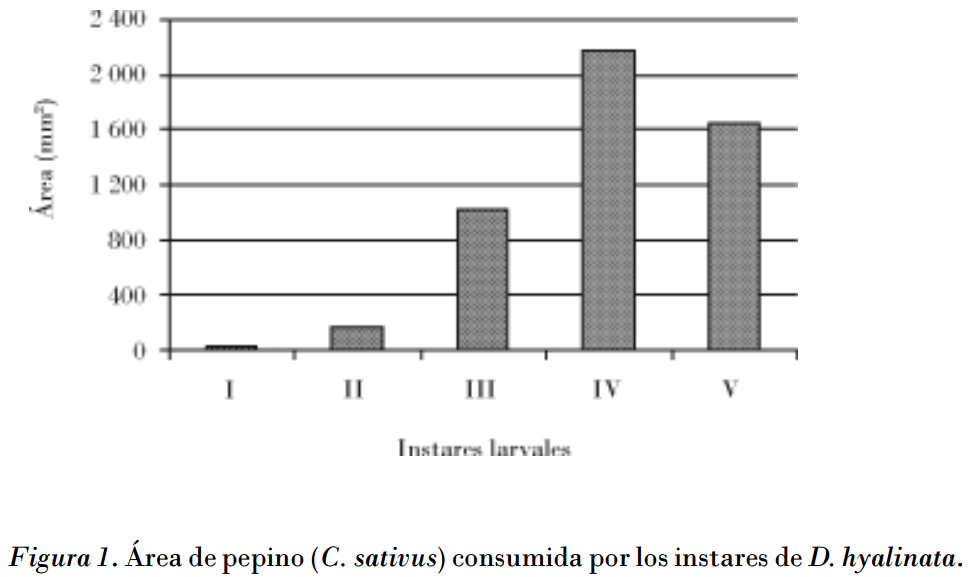
A study was carried out to know the food consumption of Diaphania hyalinata (L.) (Lepidoptera; Pyralidae) in the crop of cucumber (Cucumis sativus L.) by the determination of the leaf area (square millimeters) and the weight (grams) that consumes this lepidopteron in larval state according to the characteristics of each instar. Consumption resulted to be 1.14 g and 5 033 mm2 in area of the cucumber crop. The fourth larval instar consumed the higher quantity of food (in weight and area), with 0.4895 g and 2 049 mm². The conversion of the food was from 4.55 reached in the third instar to 2.52 for the fifth instar.
Article Details

This work is licensed under a Creative Commons Attribution-NonCommercial 4.0 International License.
Those authors who have publications with this journal accept the following terms of the License Attribution-NonCommercial 4.0 International (CC BY-NC 4.0):
You are free to:
- Share — copy and redistribute the material in any medium or format
- Adapt — remix, transform, and build upon the material
The licensor cannot revoke these freedoms as long as you follow the license terms.
Under the following terms:
- Attribution — You must give appropriate credit, provide a link to the license, and indicate if changes were made. You may do so in any reasonable manner, but not in any way that suggests the licensor endorses you or your use.
- NonCommercial — You may not use the material for commercial purposes.
- No additional restrictions — You may not apply legal terms or technological measures that legally restrict others from doing anything the license permits.
The journal is not responsible for the opinions and concepts expressed in the works, they are the sole responsibility of the authors. The Editor, with the assistance of the Editorial Committee, reserves the right to suggest or request advisable or necessary modifications. They are accepted to publish original scientific papers, research results of interest that have not been published or sent to another journal for the same purpose.
The mention of trademarks of equipment, instruments or specific materials is for identification purposes, and there is no promotional commitment in relation to them, neither by the authors nor by the publisher.
How to Cite
References
Faz de, A. B.: Control de plagas y enfermedades en los cultivos, Ministerio de Educación Superior, La Habana, 1985.
King, A. B.; J. L. Saunders: Las plagas invertebradas de cultivos anuales alimenticios en América Central, Administración de Desarrollo Extranjero, Londres, 1984.
Maes, J. M.: «Gusanos de Cucurbitaceae. Diaphania hyalinata, Diaphania nitidalis», Ficha Insectos Plagas no. 3, extraído el 20 de noviembre de 2003, en http://www.insectariumvirtual.com/termitero/nicaragua/DOCUMENTOS%20DE%20INTERES/DOCUMENTOS%-20DE%20INTERES.htm, 1991.
Martínez, P. P.; G. Lindo: «Ciclo biológico y comportamiento de Diaphania hyalinata en zapallo y melón», Revista Peruana de Entomología 29:113-115, 1986.
Mendoza, F.; J. Gómez: Principales insectos que atacan a las plantas económicas de Cuba, Ed. Pueblo y Educación, La Habana, 1982.
MINAGRI: Instructivo técnico de organopónicos, Ministerio de la Agricultura, La Habana, 1995.
Pérez, Nilda: «Control biológico, bases de la experiencia cubana». Curso de Control Biológico de Plagas y Enfermedades de Cultivos Agrícolas, CLADES.CET-Colina, Chile, 28-30 de noviembre, 1995.
Pozo, V. E.: «Tecnología para la cría artificial de Diaphania hyalinata (L.) (Lepidoptera: Pyralidae), Revista Centro Agrícola 24(1): 53-56, ene.-abr., La Habana, 1998.
––––: «Diaphania hyalinata (L.) (Lepidoptera: Pyralidae) en la región central de Cuba. Bionomía y lucha biológica». Tesis de Doctorado, Centro de Investigaciones Agropecuarias, Universidad Central de Las Villas, Cuba, 2000.
Trabanino, R.: «Cucúrbitas: plagas insectiles que afectan al cultivo en sus etapas fonológicas». Extraído el 20 de noviembre de 2003, de http://arneson.cornell.edu/ZamoPlagas/DIAFANIAS.htm.