
Influencia del perfil, el tamaño y el momento del muestreo de suelo en la determinación del potencial de malezas invasoras en cultivos anuales
Article Sidebar
Main Article Content
Abstract
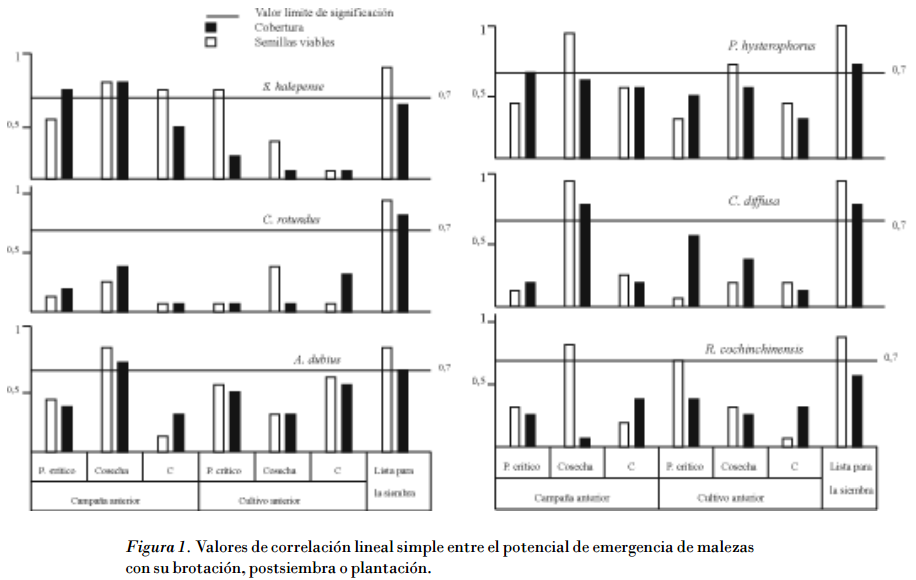
A weeds prediction will be more accurate as it will fulfill many times. In order to reach that precision it is necessary to know some factors like moment, magnitude of sample and better soil profile. To answer this matter some experiments were performed in the Experimental Station of Cuban Plant Health Research Institute in Alquizar. La Havana. It was proved that eight frames of 0.25 m2 for each hectare, placed in randomized form on the field diagonals was enough to obtain a representative weed population, and the same number of 500 g soil samples is enough to get the emerging plant potential. This potential, determined at pervious campaign harvest and after soil tillage, is the most correlated with emerged weeds and their cover thirty days after sowing or plantation. Weed cover at the harvesting time of campaign and previous crop showed an irregular behavior when its values were correlated with weeds population of post-sowing or plantation. This aspect must continue studying because it will make easier this activity in agricultural practice.
Article Details

This work is licensed under a Creative Commons Attribution-NonCommercial 4.0 International License.
Those authors who have publications with this journal accept the following terms of the License Attribution-NonCommercial 4.0 International (CC BY-NC 4.0):
You are free to:
- Share — copy and redistribute the material in any medium or format
- Adapt — remix, transform, and build upon the material
The licensor cannot revoke these freedoms as long as you follow the license terms.
Under the following terms:
- Attribution — You must give appropriate credit, provide a link to the license, and indicate if changes were made. You may do so in any reasonable manner, but not in any way that suggests the licensor endorses you or your use.
- NonCommercial — You may not use the material for commercial purposes.
- No additional restrictions — You may not apply legal terms or technological measures that legally restrict others from doing anything the license permits.
The journal is not responsible for the opinions and concepts expressed in the works, they are the sole responsibility of the authors. The Editor, with the assistance of the Editorial Committee, reserves the right to suggest or request advisable or necessary modifications. They are accepted to publish original scientific papers, research results of interest that have not been published or sent to another journal for the same purpose.
The mention of trademarks of equipment, instruments or specific materials is for identification purposes, and there is no promotional commitment in relation to them, neither by the authors nor by the publisher.
How to Cite
References
Alan, Elizaberth; U. Barrantes; A. Soto; R. Agüero: Elementos para el manejo de malezas en agroecosistemas tropicales, Instituto Tecnológico de Costa Rica, Ed. Tecnológicas de Costa Rica, 1995.
Belgique Jungens, G.: «Levantamiento de malezas en cultivos agrícolas», Plits 3:85-104, 1985.
Cardina, J.; P. Herms Catherine; D. J. Doohan: «Crop Rotation and Tillage System Effects on Weeds Seedbanks», Weed Science, 50(4):448-460, 2002.
Dagnelie, P.: Théorie et méthodos statistiques. Aplications agronomiques, Los Presses Agronomiques de Gembleux, ASBL, 1980.
Kawabata, O.; R. K. Nishimoto: «Temperature and Rhizome Chain Effect on Sprouting of Purple Nutsedge (Cyperus rotundus) Ecotypes», Weed Science, 51(3):348-355, 2003.
Koch, W.: «Crop Losses Due to Weed». Proceeding of FAO/IWSS expert consultation on improving weed management in developing countries, Roma, 6-10 september, 1989.
––––: Desarrollo de la herbología. Curso básico sobre control de malezas en la República Dominicana, Sociedad Alemana de Cooperación Técnica, LTDA (GTZ), RFA, 1975.
La O, F.; Tamara Mateo; Lilliam Otero: «Clasificación de semillas de malezas para Cuba en función de su nocividad», Fitosanidad, 3(1):55-59, 1999.
Muller-Dumbois, D.; H. Ellenberg: Aims and Methods of Vegetation Ecology, Wiley, New York, 1974.
Naylor, R. E.: «The Prediction of Blackgrass Einfestation», Weed Res., 10:296-299, 1970.
Paredes, E.; G. D. Prieto: «Manejo de malezas y otras plagas de importancia económica en la agricultura tropical», Agricultura sostenible (ecológica u orgánica). Subprograma no. XIX, Tecnología del Sector Agropecuario, Red Temática no. XIX. B. Agricultura y Ganadería Sostenibles, Panamá, 2003.