
Influencia del pH y la temperatura en la producción de las fitotoxinas producidas por la Pseudomonas aeruginosa pss. Evaluación de su efectividad en el control de malezas
Article Sidebar
Main Article Content
Abstract
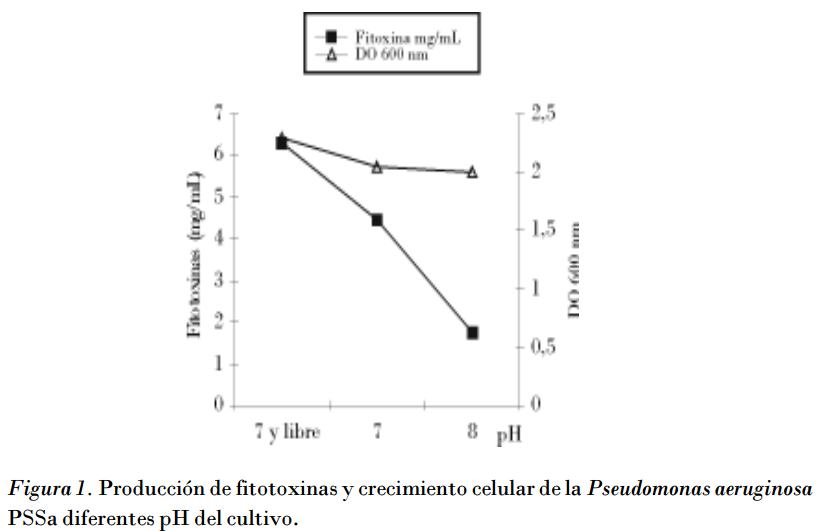
Biological control of weeds through the application of bioherbicides constituted by phytotoxins produced by microorganisms is a promising alternative due to the possibility to being included in integrated weeds management. Different environmentally factors affect phytotoxins production by strains of genus Pseudomonas, pH and temperature of the culture are among them. The evaluation of these parameters in the production of Pseudomonas aeruginosa PSS phytotoxins during liquid culture in 5 L fermentors, showed the best results when pH was adjusted at the beginning of the culture and then it leaves free, while the temperature was at 300C. The evaluation of the effectiveness in vitro of the bioherbicide with a concentration of 45 mg/mL in the germination of different weeds seeds, caused necrosis or atrophied development of emerged radicles and show a similar behaviour as hormonal herbicides. Treatments of soil application in greenhouse after sowing seeds weeds were not effective over germination and plant sprout. Foliar treatment showed difference between weeds species. Dicotyledonous (Amaranthus dubius, Bidens pilosa, Euphorbia hirta, Dichrostachys cinerea, Parthenium hysterophorus,) were more sensible than grasses.
Article Details

This work is licensed under a Creative Commons Attribution-NonCommercial 4.0 International License.
Those authors who have publications with this journal accept the following terms of the License Attribution-NonCommercial 4.0 International (CC BY-NC 4.0):
You are free to:
- Share — copy and redistribute the material in any medium or format
- Adapt — remix, transform, and build upon the material
The licensor cannot revoke these freedoms as long as you follow the license terms.
Under the following terms:
- Attribution — You must give appropriate credit, provide a link to the license, and indicate if changes were made. You may do so in any reasonable manner, but not in any way that suggests the licensor endorses you or your use.
- NonCommercial — You may not use the material for commercial purposes.
- No additional restrictions — You may not apply legal terms or technological measures that legally restrict others from doing anything the license permits.
The journal is not responsible for the opinions and concepts expressed in the works, they are the sole responsibility of the authors. The Editor, with the assistance of the Editorial Committee, reserves the right to suggest or request advisable or necessary modifications. They are accepted to publish original scientific papers, research results of interest that have not been published or sent to another journal for the same purpose.
The mention of trademarks of equipment, instruments or specific materials is for identification purposes, and there is no promotional commitment in relation to them, neither by the authors nor by the publisher.
How to Cite
References
Abbas, H. K.; S. O. Duke: «Phytotoxins from Plant Pathogens As Potential Herbicides», J. Toxicol- Toxin Review, 14:523-543, 1995.
Bender, C. L.; F. Alarcón-Chaidez; D. C. Gross: «Pseudomonas syringae Phytotoxins: Mode of Action, Regulation, and Biosynthesis by Peptide and Polyketide Synthetases», Microbiol. Mol. Rev., 63:266-292, 1999.
Díaz de Villegas, María Elena; L. Béress; A. Bell; R. Gallardo; E. Torres: «Producción y separación de fitotoxinas a partir de la cepa de Pseudomonas aeruginosa PSS con potencialidades como bioherbicida». Memorias XIII Congreso Científico, INCA, BF-P.12, La Habana, noviembre 2002.
Duke, S. O.; H. K. Abbas; C. D. Boyette; M. Gohbara: «Microbial Compounds with the Potential of Herbicidal Use». Brighton Crop Protection Conference, Weeds, 1:155-164, 1991.
Duke, S. O.; H. K. Abbas: «Natural Products with Potential Use As Herbicides», Amer. Chem. Soc. Symp. Ser., 582:348-362, 1994.
Frankhauser, B. D.: Protein Assay by Microbiuret Standardization, DBF’s Hopkins Notebook III, 2004.
King, E. O.; M. K. Ward; D. E. Raney: «Two Simple Media for the Demostration of Pyocyanin and Fluorescin», J. Lab. Clin. Med., 44:301-307, 1954.
Kremer, R. J.: «Microbial Interactions with Weed Seeds and Seedling and Its Potential for Weed Management», Integrated Weed and Soil Management, Sleeping Bear Press, 1998.
Palmer, D.; C. Bender: «Effects of Environmental and Nutritional Factors on Production of the Polyketide Phytotoxin Coronatine by Pseudomonas syringae pv. Glycineat», Appl. Envirom. Microbiol., 59:1619-1626, 1993.
Rohde B. H.; B. Pohlack; M. S. Ullrich: «Occurrence of Thermoregulation of Genes Involved in Coronatine Biosynthesis Among Various Pseudomonas syringae Strains», J. Basic Microbiol., 38:41-50, 1998.
Todar, K.: «Pseudomonas and Its Relatives. Todar´s Online Textbook of Bacteriology», www.textbookofbacteriology.net., 2004.