
Diversidad de insectos benéficos asociados a Morinda citrifolia L.
Article Sidebar
Main Article Content
Abstract
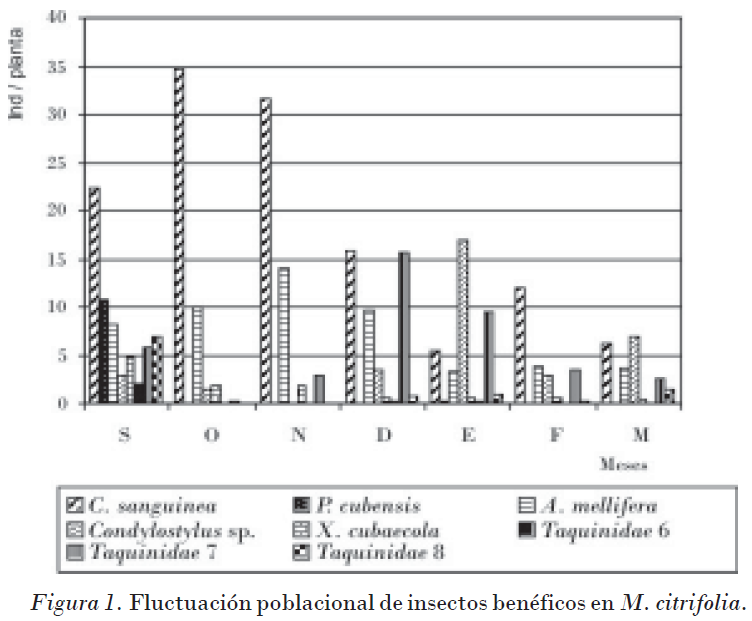
The crop of Morinda citrifolia L. (noni) is actually fomented in Urban Agriculture, besides other arboreal species associated to vegetables, grains and others, in order to promote biodiversity conservation, also including all benefical insect species which regulate pest populations that affect plants. A research was carried out in the Basic Unit of Cooperative Production Organopónico Vivero Alamar, located in the east of Havana, to describe taxonomic diversity and relative abundance of benefical insects associate to this plant. The period of evaluation was from September 2003 to March 2004. Foliage of M. citrifolia plants were sampled weekly and all detected insects were counted in situ. The species were identified in laboratory and the diversity was estimated with ecological indexes. Five orders, seven families, ten genera and seven species of benefical insects were detected, which is considered a high diversity of species, as well as a tendency to the uniformity of populations, and in contrast, a low dominance. Cycloneda sanguinea limbifer (Casey) and Apis mellifera L. presented a bigger relative abundance in the months of September, October and November, reaching values of 22.4, 34.8 and 31.6 individuals/plants for the first, and 8.2, 10 and 14 for the second, these preliminary results indicate the potential of this plant for the conservation of benefical insects population.
Article Details

This work is licensed under a Creative Commons Attribution-NonCommercial 4.0 International License.
Those authors who have publications with this journal accept the following terms of the License Attribution-NonCommercial 4.0 International (CC BY-NC 4.0):
You are free to:
- Share — copy and redistribute the material in any medium or format
- Adapt — remix, transform, and build upon the material
The licensor cannot revoke these freedoms as long as you follow the license terms.
Under the following terms:
- Attribution — You must give appropriate credit, provide a link to the license, and indicate if changes were made. You may do so in any reasonable manner, but not in any way that suggests the licensor endorses you or your use.
- NonCommercial — You may not use the material for commercial purposes.
- No additional restrictions — You may not apply legal terms or technological measures that legally restrict others from doing anything the license permits.
The journal is not responsible for the opinions and concepts expressed in the works, they are the sole responsibility of the authors. The Editor, with the assistance of the Editorial Committee, reserves the right to suggest or request advisable or necessary modifications. They are accepted to publish original scientific papers, research results of interest that have not been published or sent to another journal for the same purpose.
The mention of trademarks of equipment, instruments or specific materials is for identification purposes, and there is no promotional commitment in relation to them, neither by the authors nor by the publisher.
How to Cite
References
Agromet: Boletín Agrometeorológico Nacional, Instituto de Meteorología, Citma, vol. 25-36, 2003.
––––: Boletín Agrometeorológico Nacional, Instituto de Meteorología, Citma, vol. 37-39, 2004.
Alayo, P. D.: «Los neurópteros de Cuba», Poeyana, Serie B. no. 2, Academia de Ciencias de Cuba, 1968.
––––: «Introducción al estudio de los himenópteros de Cuba. Superfamilia Vespoidea», Serie Biológica no. 62, 1976, pp. 17 y 18.
Alayo, P. D.; G. Garcés: Introducción al estudio del orden Diptera en Cuba, Ed. Oriente, Santiago de Cuba, 1989.
Castillo, P.; Elizabeth Celi: «Entomofauna asociada al noni (Morinda citrifolia Linn.) en Tumbes», Bol. Resumen, XLV Convención Nacional de Entomología, Ayacucho, Perú, 1-5 diciembre, 2003.
Companioni, N.; Yanet Ojeda; E. Páez; Catherine Murphy: «La agricultura urbana en Cuba», Transformando el campo cubano. Avances de la agricultura sostenible, La Habana, 2001, pp. 93-110.
Gordon, R. D.: «Coccinellidae (Coleoptera) of America North of México », Journal of the New York Entomological Society 93(1):660-662, 1985.
Pérez, F. J.; F. M. Sola-Fernández: «Divers.exe: programa para el cálculo de los índices de diversidad [programa informático en línea], 1993, http://perso.wanadoo.es/jp-l/descargas.htm. (Consulta: 14-2-2003).
Ramos, A. Q.: «El noni (Morinda citrifolia L.): nuevo árbol para la agricultura orgánica», Agricultura Orgánica no. 3, 2002, pp. 22-25.