
Efectividad in vitro de Trichoderma harzianum rifai para el biocontrol de Rhizoctonia solani kühn y Pyricularia grisea sacc. aislados en el cultivo del arroz (Oryza sativa l.)
Article Sidebar
Main Article Content
Abstract
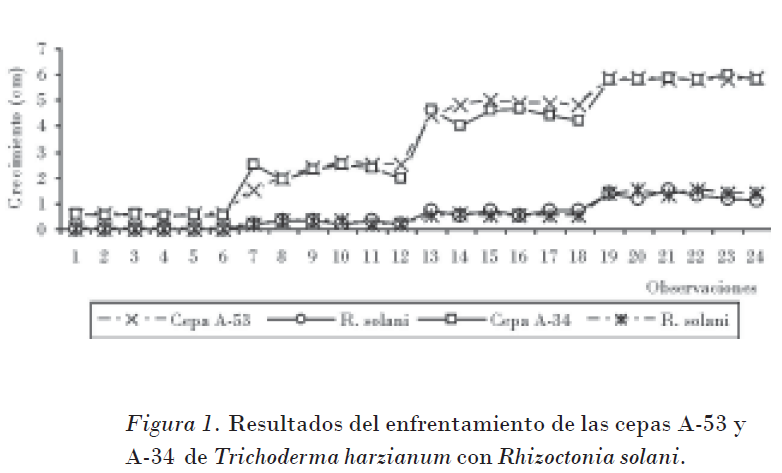
Steams, leaves and roots pieces of rice plants of variety J-104 with Pyricularia grisea (Sacc.) and Rhizoctonia solani Kühn symptoms were plated in vitro in agar-water and agar-peptone-dextrose by traditional methods. Observed symptoms were identified and described by suitable keys for verifying antagonist and hyperparasitic effectivity of Trichoderma harzianum against both pathogens. Bioassays of dual cultures agar-peptone-dextrose were realized for biocontrol tests between pathogens and two T. harzianum strains (A-34 and A-53) from the strain storage of biological control in Pant Health Provincial Laboratory of Las Tunas, generalized in mass production against different soil pathogens. Diameter of colonies was measured daily and so was the competence level by the substrate and the hyperparasitism of the pathogen, according to the growing level and sporulation over colonies. Results demonstrated high hyperparasitic and competitive activity of strains A-34 and A-53 of T. harzianum, which exhibit good potentialities for the control of these pathogens. Highly significant differences to 96 hours were found in statistic tests with a lineal rate growing of 7.37 cm in A-34 strain and 7.10 cm in A53 strain. Rate growing was 3.63 cm P. grisea and 2.62 cm R. solani in the case of pathogens.
Article Details

This work is licensed under a Creative Commons Attribution-NonCommercial 4.0 International License.
Those authors who have publications with this journal accept the following terms of the License Attribution-NonCommercial 4.0 International (CC BY-NC 4.0):
You are free to:
- Share — copy and redistribute the material in any medium or format
- Adapt — remix, transform, and build upon the material
The licensor cannot revoke these freedoms as long as you follow the license terms.
Under the following terms:
- Attribution — You must give appropriate credit, provide a link to the license, and indicate if changes were made. You may do so in any reasonable manner, but not in any way that suggests the licensor endorses you or your use.
- NonCommercial — You may not use the material for commercial purposes.
- No additional restrictions — You may not apply legal terms or technological measures that legally restrict others from doing anything the license permits.
The journal is not responsible for the opinions and concepts expressed in the works, they are the sole responsibility of the authors. The Editor, with the assistance of the Editorial Committee, reserves the right to suggest or request advisable or necessary modifications. They are accepted to publish original scientific papers, research results of interest that have not been published or sent to another journal for the same purpose.
The mention of trademarks of equipment, instruments or specific materials is for identification purposes, and there is no promotional commitment in relation to them, neither by the authors nor by the publisher.
How to Cite
References
Borda, F.; G. Arbeláez: «Determinación del antagonismo del aislamiento T-95 de T. harzianum sobre Fusarium oxysporum f. sp. Cucumerinum en plantas de pepino Cohombro», Agronomía Colombiana 10(1):45-51, 1993.
CMI: Descriptions of Pathogenic Fungi and Bacteria, Commonwealth Mycological Institute, Kew, Surrey, Inglaterra, 1983, pp. 169-409.
Cordero, V.; L. Rivero: «Principales enfermedades fungosas que inciden en el cultivo del arroz en Cuba», Boletín Técnico del Arroz, IIA, Minagri, octubre del 2001, pp. 3-7.
Correa-Victoria, F. J.: «Alternativas para el manejo del añublo de la vaina causado por Rhizoctonia solana», Arroz 41(378):32-37, 1992.
Correa-Victoria, F. J.; E. P. Guimarães: «Utilización del concepto de linaje genético de Pyricularia grisea en un programa de selección recurrente», Primer Taller Internacional de Selección Recurrente en Arroz, Goiania, Brasil, marzo de 1995, Centro Internacional de Agricultura Tropical (CIAT), Cali, Colombia, 1995, p. 19.
FAO: Production yearbook, vol. 34, 1981.
González, M.: «Utilización de Trichoderma spp. para el control de hongos patógenos de la semilla y del suelo en el cultivo del frijol», Fitosanidad 8(1):61, 2004.
ICA: ANALEST (v2.0): Programa. Sistema automatizado de análisis estadístico, Instituto de Ciencia Animal (ICA), La Habana, 1998.
––––: «Calidad del grano», Boletín no. 1, Instituto de Investigaciones del Arroz, Minagri, La Habana, octubre del 2001, pp. 1-12.
INISAV: «Información preliminar sobre los estudios de Trichoderma sp. como biocontrol de patógenos en cultivos de importancia económica», División Microbiología, INISAV, La Habana, 1992 (inédito).
Pantoja, A.; A. Ramírez; L. R. Sanint: «Producción de arroz en América Latina: área sembrada y costos», MIP en arroz. Manejo integrado de plagas (artrópodos, enfermedades y malezas), CIAT no. 292, septiembre de 1997.
Pérez, N.; M. Echemendía: «Efectividad de Trichoderma spp. en el control de la mancha púrpura en cebolla», Resúmenes IX Forum de Ciencia y Técnica, II Encuentro Nacional de Bioplaguicidas, II EXPOCREE, 25-27 de octubre, La Habana, 1994, p. 25.
Rodríguez, F.; Marusia Stefanova; U. Gómez: «Efecto del biopreparado de Trichoderma harzianum (Rifai) contra Pseudoperonospora cubensis (Bert. & Curt.) Rostov y Erisiphe cichoracearum D. C. en pepino (Cucumis sativus L.)», Fitosanidad 2(1-2):41-43, 1998.
Sandoval, Ileana; M. Neyra; D. García; María O. López; I. Mendoza: «Trichoderma: biocontrol de hongos fitopatógenos en el cultivo del tomate en hidropónico», Resúmenes. I Interamericano de de Micología, La Habana, 22-26 de junio del 1993, p. 61.
Sandoval, Ileana; María O. López; D. García; I. Mendoza: «Trichoderma harzianum (A-34): un biopreparado de amplio espectro para micopatologías del tomate y del pimiento», CID-Inisav, Boletín Técnico, 1995, pp. 4-36.
Sandoval, Ileana; Marusia Stefanova; María O. López; D. García; Blanca Bernal; M. Neyra; F. Rodríguez: «Una alternativa ecológica y efectiva para el biocontrol de enfermedades fúngicas con la utilización de Trichoderma harzianum (A-34)», Resúmenes. II Seminario Científico Internacional de Sanidad Vegetal, 23-27 de junio, La Habana, 1997, pp. 127 y 128.
Srivastava R. K.; R. D. Prasad; R. Rangeshwaran; P. Kannan: «Detection and Quantification of Proteins Induced by Trichoderma in Chickpea-Rhizoctonia System», Plant Desease Research 17(2):252-255, 2002.
Stefanova, Marusia; Ileana Sandoval; María L. Martínez; Irma Heredia; María D. Ariosa; Raquel Arévalo: «Control de hongos fitopatógenos del suelo en semilleros de tabaco con Trichoderma harzianum», Fitosanidad 8(2):35-38, 2004.
Varón, R. U.; S. I. Ramírez: «Evaluación del antagonista Trichoderma lignorum al tratar la semilla de arroz (Oryza sativa L.) contra el hongo Rhizoctonia solani, agente causal del añublo de la vaina», Memorias V Seminario Científico Internacional de Sanidad Vegetal, La Habana, 24-28 de mayo del 2004.