
Caracterización fitoquímica del aceite esencial de romero (Rosmarinus officinalis l.) y evaluación in vitro de su actividad acaricida
Article Sidebar
Main Article Content
Abstract
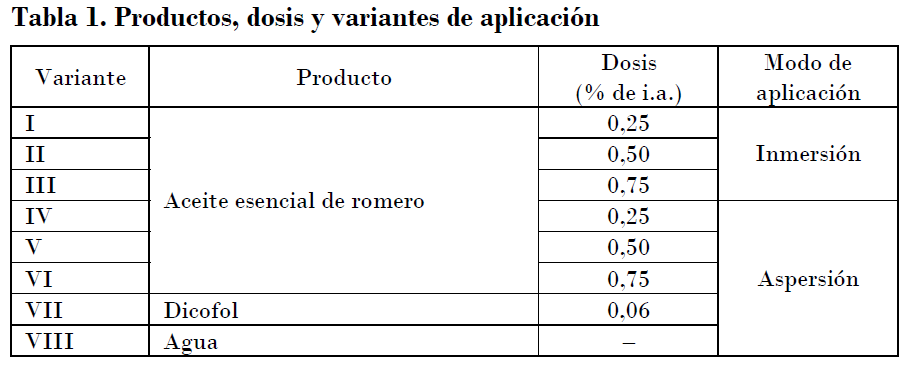
The acaricide effect of rosemary essential oil was characterized and evaluated on acari Tetranychus tumidus Banks. A laboratory experiment to test different dose and application form of the product was developed. Treatments with rosemary oil at 0.25%, 0.50% and 0.75% a.i. by aspersion and 0.75% a.i. by immersion caused a mortality of 100% in 48 hours; immersion treatments at 0.25% and 0.50% a.i. were near to 100% of mortality 72 hours later. Main components found were cineol (21.5%), camphor (18.0%) and alfa pineno (15.3%).
Article Details

This work is licensed under a Creative Commons Attribution-NonCommercial 4.0 International License.
Those authors who have publications with this journal accept the following terms of the License Attribution-NonCommercial 4.0 International (CC BY-NC 4.0):
You are free to:
- Share — copy and redistribute the material in any medium or format
- Adapt — remix, transform, and build upon the material
The licensor cannot revoke these freedoms as long as you follow the license terms.
Under the following terms:
- Attribution — You must give appropriate credit, provide a link to the license, and indicate if changes were made. You may do so in any reasonable manner, but not in any way that suggests the licensor endorses you or your use.
- NonCommercial — You may not use the material for commercial purposes.
- No additional restrictions — You may not apply legal terms or technological measures that legally restrict others from doing anything the license permits.
The journal is not responsible for the opinions and concepts expressed in the works, they are the sole responsibility of the authors. The Editor, with the assistance of the Editorial Committee, reserves the right to suggest or request advisable or necessary modifications. They are accepted to publish original scientific papers, research results of interest that have not been published or sent to another journal for the same purpose.
The mention of trademarks of equipment, instruments or specific materials is for identification purposes, and there is no promotional commitment in relation to them, neither by the authors nor by the publisher.
How to Cite
References
Adams, P. R.: Identification of Essential Oil Components by Gas Chromatography/Mass Spectroscopy, Ed. Amured Publishing Corp. Illinois, EE. UU., 1995.
Almaguel, Lérida; R. Pérez; M. Ramos; Z. Martínez; J. Ovies; B. Roselló; M. Márquez; I. Suárez; E. Massó; R. Chico; E. Feito; J. Cortinas: «Generalización en Cuba del programa de manejo integrado del ácaro rojo Tetranychus tumidus en plátano», Fitosanidad 4 (3-4):93-98, 2000.
Analest: Estadística versión 2.0, Instituto de Ciencia Animal, 1999.
Angioni, A.; A. Barra; E. Cereti; D. Barile; J. D. Coisson; M. Arlorio; S. Dessi; V. Coroneo; P. Cabras: «Chemical Composition, Plant Genetic Differences, Antimicrobial and antifungal Activity Investigation of the Essential Oil of Rosmarinus officinalis L.», Journal of Agricultural and Food Chemistry 52 (11):3530-3535, 2004.
Higes, M.; M. Suárez; J. Llorente: «Comparative Field Trials of Varroa Mite Control with Different Components of Essential Oils», Research and reviews in Prasitology 57(1):21-24, 1997.
Isman, M.: «Botanical Insecticides, Deterrents, and Repellents in Modern Agriculture and an Increasingly Regulated World», Annu. Rev. Entomol. 51:45-66, 2006.
Madera County: Biorganic Crop Protection. Disponible en www.biorganic.com (fecha de consulta: 2001).
Minagri: «Tecnología de futuro. Una nueva concepción en la producción de plátano fruta y vianda en Cuba», Ministerio de la Agricultura, La Habana, 2004.
Miresmailli, S.; R. Bradbury; M. B. Isman: «Comparative Toxicity of Rosmarinus officinalis L. Essential Oil and Blends of its Major Constituents Against Tetranychus urticae Koch (Acari: Tetranychidae) on Two Different Host Plants», Pest Management Science 62 (4):366-371, 2006.
Pérez, R., L. Almaguel; I. Cáceres; E. Feito; E. de la Torre: «Los depredadores de Tetranychus tumidus Banks en Cuba», Fitosanidad 8 (1):47-50, 2004.
Santoyo, S.; S. Cavero; L. Jaime; E. Ibáñez; F. J. Senorans; G. Reglero: «Chemical Composition and Antimicrobial Activity of Rosmarinus officinalis L. Essential Oil Obtained Via Supercritical Fluid Extraction», Journal of Food Protection 68 (4):790-795, 2005.
Simón, S.: «Les acariens et les thrips sur bananier», Fruit, Institut de Recherches sur les Fruits et Argumes (número especial):72-76, 1990.
Thacker, J. M. R.: An Introduction to Arthropod Pest Control. Cambridge Univ. Press, Inglaterra, 2002.
Touafek, O.; A. Nacer; A. Kabouche; Z. Kabouche; C. Bruneau: «Chemical Composition of the Essential Oil of Rosmarinus officinalis Cultivated in the Algerian Sahara», Chemistry of Natural Compounds 40 (1):28-29, 2004.
Zaouali, Y.; C. Messaoud; A. Ben Salah; M. Boussaid: «Oil Composition Variability Among Populations in Relationship with Their Ecological Areas in Tunisian Rosmarinus officinalis L.», Flavour and Fragance Journal 20 (5):512-520, 2005.