
Desarrollo de anticuerpos contra Pseudomonas syringae pv tabaci con la utilización de sulfoximina de metionina
Article Sidebar
Main Article Content
Abstract
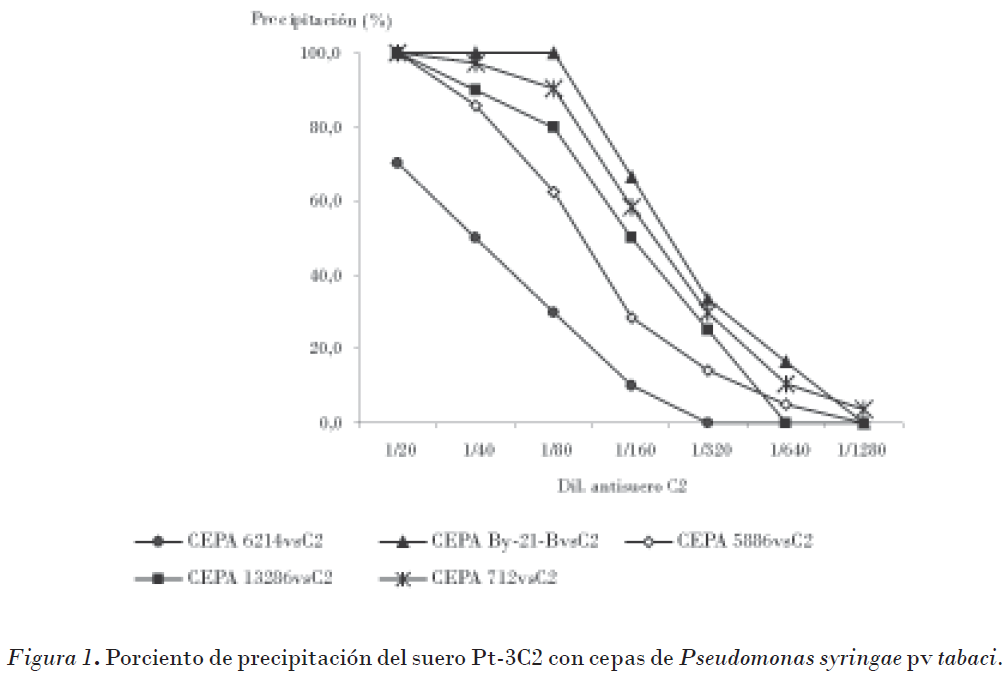
Wild fire disease (Pseudomonas syringae pv tabaci) is characterized by round chlorotic lesions produced by bacterial tabtoxin, which chemical and functional homologous is metionine sulfoximine. Two inmunosera (Pt-3C1 and Pt-3C2) that recognize Pseudomonas syringae pv tabaci strains were obtained, using the Pseudomonas syringae pv tomato Pt-3 isolate as immunogen, treated with metionine sulfoximine by means of a procedure of conjugation with sodium periodate. Rabbits were intravenously injected with increasing doses of the immunogen. The presence of specific antibodies in the obtained sera was evaluated by precipitation in tubes. Sera showed titres of 1/2560 against the immunogen. Particularly As Pt-3 anti Pseudomonas syringae pv tomato serum, obtained against Pt-3 strain, caused precipitation with significantly inferior values, below 20%, when it was tested against the same strains of Pseudomonas syringae pv tabaci. Results show the feasibility of using metionine sulfoximine, under the described treatment, for the generation of antisera, which can recognize the bacterium Pseudomonas syringae pv tabaci.
Article Details

This work is licensed under a Creative Commons Attribution-NonCommercial 4.0 International License.
Those authors who have publications with this journal accept the following terms of the License Attribution-NonCommercial 4.0 International (CC BY-NC 4.0):
You are free to:
- Share — copy and redistribute the material in any medium or format
- Adapt — remix, transform, and build upon the material
The licensor cannot revoke these freedoms as long as you follow the license terms.
Under the following terms:
- Attribution — You must give appropriate credit, provide a link to the license, and indicate if changes were made. You may do so in any reasonable manner, but not in any way that suggests the licensor endorses you or your use.
- NonCommercial — You may not use the material for commercial purposes.
- No additional restrictions — You may not apply legal terms or technological measures that legally restrict others from doing anything the license permits.
The journal is not responsible for the opinions and concepts expressed in the works, they are the sole responsibility of the authors. The Editor, with the assistance of the Editorial Committee, reserves the right to suggest or request advisable or necessary modifications. They are accepted to publish original scientific papers, research results of interest that have not been published or sent to another journal for the same purpose.
The mention of trademarks of equipment, instruments or specific materials is for identification purposes, and there is no promotional commitment in relation to them, neither by the authors nor by the publisher.
How to Cite
References
Alfano, J. B.; A. Collmer: «Bacterial Pathogens in Plants: Life up Against the Wall», Plant Cell 8:1683-1698, 1996.
Basulto, A.; M. Stefanova; H. García: «Efecto de metionin sulfoximina en tejido foliar de Nicotiana tabacum», Cubatabaco 5 (2):13-18, 2004.
Bender, C. L.; F. Alarcón-Chaidez; D. C. Gross: «Pseudomonas syringae Phytotoxins: Mode of Action, Regulation, and Biosynthesis by Peptide and Polyketide Synthetases», Microbiology and Molecular Biology Reviews 63 (2):266-292, 1999.
Braun A. C.: «A Study on the Mode of Action of the Wildfire Toxin», Phytopathology 45:659-664, 1955.
Carlson P. S.: «Methionine Sulfoximine-Resistant Mutants of Tobacco», Science 180:1366-1368, 1973.
Costacurta, A.; J. Vanderleyden: «Synthesis of Phytohormones by Plant-Associated Bacteria», Crit. Rev. Microbiol. 21:1-18, 1995.
Denny, T. P.: «Involvement of Bacterial Polysaccharides in Plant Pathogenesis», Annu. Rev. Phytopathol. 33:173-197, 1995.
Gross, D. C.: «Molecular and Genetic Analysis of Toxin Production by Pathovars of Pseudomonas syringae», Annu. Rev. Phytopathol. 29:247-278, 1991.
Lelliot, R. A.; E. Billing; A. C. Hayward: «A Determinative Scheme for the Fluorescent Plant Pathogenic Pseudomonads», J. Appl. Bacteriology 29:470-489, 1966.
Lucas G. B.: Diseases of tobacco, Biologycal Consulting Associated, Raleigh, NC, EE.UU., 1975.
Prestes, E. B.; I. M. G. Almeida; L. O. S. Beriam; V. A. Malavolta Jr.; T. Yano: «Variabilidad entre isolados de Pseudomonas patogénicos ao pepino», Summa Phytopathologica 24:210-215, 1998.
Scholz, B. K.; J. L. Jakobek; P. B. Lindgren: «Restriction Fragment Length Polymorphism Evidence for Genetic Homology Within a Pathovars of Pseudomonas syringae», Applied and Environmental Microbiology 60 (4):1093-1100, 1994.
Shoemaker, P. B.: «Foliar Diseases Caused by Bacteria», Compendium of Tobacco Diseases, The American Phytopathology Society, APS Press, EE.UU., 1990.
Turner, J. G.; R. R. Taha; J. Debbage: «Effects of Tabtoxin on Nitrogen Metabolism», Phisiologia Plantarum 67 (4):649-653, 1986.
Turner, J. G.: «Inhibition of Photosynthesis in Nicotiana tabacum Leaves Treated with Tabtoxin and its Relation to Pigment Loss», Physiologia Plantarum 74 (3):549-555, 1988.
Woolley, D. W., G. Schaffner; A. C. Braun: «Isolation and Determination of Structure of a New Amino Acid Contained Within the Toxin of Pseudomonas tabaci», J. Biol. Chem., 198,807-813, 1952.