
Determination of the rodenticide effect of Lantana aculeata var parviflora on mice of the Mus musculus L. species
Article Sidebar
Main Article Content
Abstract
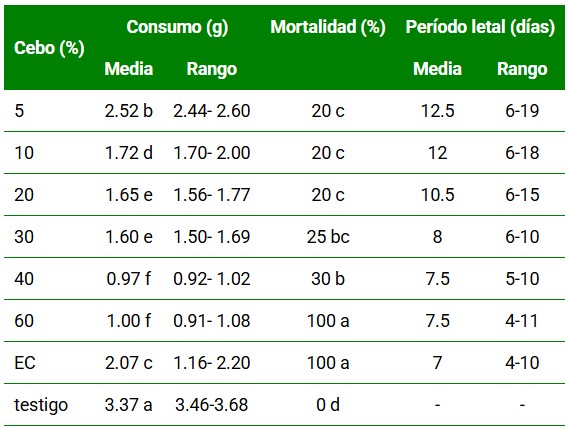
The employment of the local flora in the fight against rodents is a field little exploded to have a new alternative in this task was harvested plants of the species L.cauleta var paraviflora those were cut in its different vegetative organs and these they were given like food to mice of the species M.musculus during seven days. Subsequently leaves were collected that dried off to ambient temperature until obtaining constant weight these they were milled and they sifted until obtaining a size of particle of 0.02mm with these was create a group of concentrations corresponding at 5; 10; 15; 20; 40 and 60% (p/p) which were administered to mice of the species M. musculus during seven days. After they took the limits of mortality and were make another group of five concentrations being these: 40, 45; 50, 55 and 60% (p/p). In the treatments where it was used the leaves the mortality it was of 100% the same as in the comparison standard, in green fruits 80% was obtained, when a bait was used with 60% of leaves of the plant the mortality it was of 100%. The bait of leaves of L.aculeata var parviflora was highly effective against M. musculus under laboratory conditions.
Article Details

This work is licensed under a Creative Commons Attribution-NonCommercial 4.0 International License.
Those authors who have publications with this journal accept the following terms of the License Attribution-NonCommercial 4.0 International (CC BY-NC 4.0):
You are free to:
- Share — copy and redistribute the material in any medium or format
- Adapt — remix, transform, and build upon the material
The licensor cannot revoke these freedoms as long as you follow the license terms.
Under the following terms:
- Attribution — You must give appropriate credit, provide a link to the license, and indicate if changes were made. You may do so in any reasonable manner, but not in any way that suggests the licensor endorses you or your use.
- NonCommercial — You may not use the material for commercial purposes.
- No additional restrictions — You may not apply legal terms or technological measures that legally restrict others from doing anything the license permits.
The journal is not responsible for the opinions and concepts expressed in the works, they are the sole responsibility of the authors. The Editor, with the assistance of the Editorial Committee, reserves the right to suggest or request advisable or necessary modifications. They are accepted to publish original scientific papers, research results of interest that have not been published or sent to another journal for the same purpose.
The mention of trademarks of equipment, instruments or specific materials is for identification purposes, and there is no promotional commitment in relation to them, neither by the authors nor by the publisher.
How to Cite
References
Almeida A., Corrigan R., Sarno R., 2013.The economic impact of commensal rodents on small businesses in Manhattan’s Chinatown: trends and possible causes. Sub Sust. 1(1). Article 2. doi: 10.5038/2164- 0866.1.1.2.
Barroso O., 2014. Evaluación de las propiedades rodenticidas de la planta venenosa Lantana trifolia L.”. Universidad de Artemisa Facultad de agronomía Cuba. Tesis para optar por el título de Ingeniero Agrónomo. 53 pp.
Cárdenas C., 2017.Taxonomía y distribución del género de roedores andinos: Nephelomys (Cricetidae: Sigmodontinae) en Colombia. Colombia. Universidad Nacional de Colombia. Tesis presentada como requisito parcial para optar al título de: Magister en Ciencias - Biología.
Di Rienzo J. A., Casnoves F., Balzarini M. G., González L., Tablada M., Robledo C. W., 2008. InfoStat versión 2008, Grupo InfoStat, FCA. Universidad Nacional de Córdoba Argentina.
EPPO., 1975. Guidelines for development and biological evaluation of rodenticides. EPPO Bulletin. Vol. 5, No 1. Junio.
Grossman D., 2021. El arma secreta para vencer a todas las ratas. http://blogs.ucl.uk/museums. Consulta 23 de junio de 2021.
Kissmann G. K, Groth D., 1997.Plantas infestantes e nocivas. 2da edición tomo I y II. Camara Brasileira do Livro, Sp; Brasil.
Monge J., 2007. ¿Qué son plagas vertebradas? Agronomía costarricense 31(2): 111-121.
OPS., 2012. Manual para el control integral de roedores. Oficina regional de la OMS.82pp.
Panti A. J., Gurubel Y. M., Palomo E. E., Cetina., Machain C., Robles M. R., Hernández S. F., Rosy C., 2018. Características poblaciones de Rattus rattus Y Mus musculus presentes en comunidades rurales de Yucatán, México. Tropical and Subtropical Agroecosystems, 21: 345 - 356.
Pérez E., Miralles L., Almaguer L., Vázquez L., Piedra F., Navarro A., Hernández G., Piedrahita J., Sotomayor S., 2010. Manejo integrado de plagas en almacenes, silos, instalaciones de la industria molinera y transportación de alimentos. Editorial CIDISAV. Impreso Editora Centenario, Santo Domingo, República Dominicana. 69pp.
Rando J. C..2019. Control de roedores en espacios abiertos de Tenerife. http://www.interreg bionatura.com/especies/docs/enerife.pdf. Consulta 9 de septiembre de 2019.
Sánchez H., Suarez N., García Bárbara., Izquierdo Deysi., Rúa M., 2011. Empleo de plantas del genero Lantana en la lucha contra roedores. Informe Final de proyecto. INISAV
Sánchez H., Suárez N., García B., Izquierdo D., 2014. Estudio de las propiedades rodenticidas de la planta Lantana trifolia, L. Memorias Congreso Internacional LABIOFAM. Palacio de las Convenciones. Habana. Cuba.331 p.
Suárez N., 2004. Efecto rodenticida de Lantana camara L var camara f portorricensis. Las Villas Cuba. Universidad Central de las Villas Martha Abreu. Tesis en opción al grado científico de Doctor en Ciencias Agrícolas.
Suárez N., 2011. Manejo agroecológico de roedores en la finca. Manual para la adopción del manejo agroecológico de plagas en fincas de la agricultura suburbana. Volumen I. La Habana. Cuba. Instituto de Investigaciones de Sanidad Vegetal. Instituto de Investigaciones de Agricultura Tropical y Fondo para el ogro de ODM. 231-242 pp.
Tanikawa T., Iñaki Y., kawakauni Y., Murata Y., Taniguchi N., Uchida A., 2000. Warfarin susceptibility of the wild brown rat, Rattus norvegicus captured in 11 localities in Japan and laboratory rats. Medical, Entomology and Zoology. 51: 2, 95-100.
Torres A. B., 2014. Determinación de las propiedades rodenticidas de Lantana aculeta var parviflora. Universidad de Artemisa Facultad de Agronomía. Cuba. Tesis para optar por el título de Ingeniero Agrónomo. 54 pp.
Torres M. A., 2017. ¿Son los roedores sinantrópicos una amenaza para la salud pública de Yucatán? Rev Biomed. 28:179-186.
Vera A., Espino R., Fraga J. A., Moreno Y., 2012. Evolución de los rodenticidas hasta llegar al Biorat®. Labiofam.Grupo Empresarial de producciones biofarmacéuticas y químicas, 3 (1): 88-94.