
Effectiveness of the rodenticides bait of leaves of Lantana camara L var camara f portorrisencis
Article Sidebar
Main Article Content
Abstract
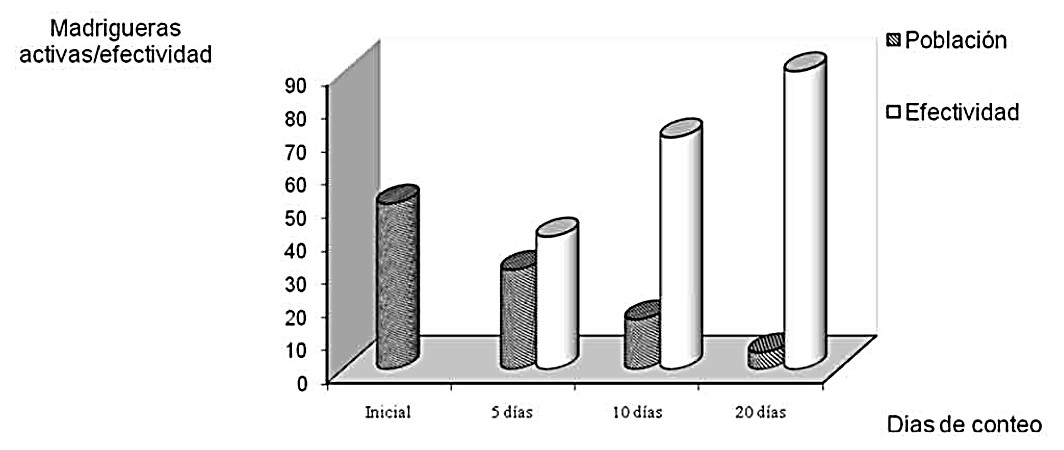
The rodents are the mammals that more damage causes the humanity in economic terms and of health. In the fight against them big perspectives open up with the use of toxic plants, for that which a rodenticide bait was elaborated with leaves of L. camara L var. camara f. portorricensis that was used in the sugar cane crop, in schools located in Güira of Melena and porcine exploitation. In all the experiments the initial population was determined and after having applied the rodenticida to the 5, 10 and 20 days. In the cultivation of the cane of sugar the rodenticide was applied to dose of 2, 7 and 13 kg.ha-1, with the last two doses carried out two treatments an initial with half of the product and the other one to the 10 days, while in the other two variants the bait was used to a dose of 7Kg.ha-1. The effectiveness in the sugar cane cultivation when was applied the dose of 7Kg.ha-1 was 94% to the 20 days, even though in the schools was reached 86% and in the porcine exploitation was obtained 90%
Article Details

This work is licensed under a Creative Commons Attribution-NonCommercial 4.0 International License.
Those authors who have publications with this journal accept the following terms of the License Attribution-NonCommercial 4.0 International (CC BY-NC 4.0):
You are free to:
- Share — copy and redistribute the material in any medium or format
- Adapt — remix, transform, and build upon the material
The licensor cannot revoke these freedoms as long as you follow the license terms.
Under the following terms:
- Attribution — You must give appropriate credit, provide a link to the license, and indicate if changes were made. You may do so in any reasonable manner, but not in any way that suggests the licensor endorses you or your use.
- NonCommercial — You may not use the material for commercial purposes.
- No additional restrictions — You may not apply legal terms or technological measures that legally restrict others from doing anything the license permits.
The journal is not responsible for the opinions and concepts expressed in the works, they are the sole responsibility of the authors. The Editor, with the assistance of the Editorial Committee, reserves the right to suggest or request advisable or necessary modifications. They are accepted to publish original scientific papers, research results of interest that have not been published or sent to another journal for the same purpose.
The mention of trademarks of equipment, instruments or specific materials is for identification purposes, and there is no promotional commitment in relation to them, neither by the authors nor by the publisher.
How to Cite
References
Cárdenas C., 2017.Taxonomía y distribución del género de roedores andinos: Nephelomys (Cricetidae: Sigmodontinae) en Colombia. Colombia. Universidad Nacional de Colombia. Tesis presentada como requisito parcial para optar al título de: Magister en Ciencias - Biología.
Di Rienzo J. A., Casnoves F., Balzarini M. G., González L., Tablada M., Robledo C. W., 2008. InfoStat versión 2008, Grupo InfoStat, FCA. Universidad Nacional de Córdoba Argentina.
Henderson C. F., Tilton E. N., 1955.test with acaricides against the brown mite. J.Econ. Entomol. 48:157-161.
Mathur R. P., 1996. Effectiveness of various rodent control measures in cereal crops and plantations in India. Belgian Journal of Zoology. Vol 127.137-144 pp.
Miron H. H., 2005. Propuesta de una formula rodenticida utilizando hojas de Gliricidia sepium (madre cacao). San Salvador, El Salvador, Centroamérica. Trabajo de graduación para optar al grado de: Licenciatura en Química y Farmacia. 76 p.
Montero G., Pérez M., Escobar J., Rian G., Vásquez L., Ortiz V., Castañeda C., 1997. Aplicación del rodenticida biológico Biorat en brotes de tifus endémico en la localidad de Zaragoza. Memorias del I Simposio Internacional de Control Biológico de Ratas y Ratones. Palacio de las Convenciones. Ciudad Habana. 44p.
Morhaim D., Espino R., 2020. Biorat rodenticida natural biológico contra ratas y ratones. https://www.ideassonline.org/public/pdf/br_24_38.pdf. Consulta 26 de mayo de 2020.
Panti A. J., Gurubel Y. M., Palomo E. E., Machain C., Robles M. R., Hernández S. F., Rosy C., 2018. Características poblaciones de Rattus rattus Y Mus musculus presentes en comunidades rurales de Yucatán, México. Tropical and Subtropical Agroecosystems, 21: 345 - 356.
Peregrin F. A., Bornote J. G., Villafaña F. T., Barceló G. M., Rodríguez P. J., Sánchez M. E., Eneme J., 2014. Uso operacional de biorat® en los distritos de Malabo, Luba y Bata, República de Guinea Ecuatorial. Memorias Congreso Internacional LABIOFAM. Palacio de las Convenciones. La Habana. 315p.
Pervez A., Ahmad S. M., Tariq S. A., 2019. Assessment of sugarcane varietal damage from field rats and their management strategy in Sindh. PSJ Vol. XXXIV, January-March, No.01 11-13 pp.
Reninson B. D., 1977. Methods of testing rodenticides in the field against Rats. Pesticide Science. Vol. 8, 405-413 pp.
H., Suárez N., García B., Izquierdo D., 2014. Estudio de las propiedades rodenticidas de la planta Lantana trifolia, L. Memorias Congreso Internacional LABIOFAM. Palacio de las Convenciones. Habana. Cuba.331 p.
SARH, 1977.Fitofilo. México, DF. No 74. Año XXX. Sept- Dic. 101pp.
Schlachter A., 1999. Rodenticida cubano causa asombro. http://www.oie.org.co/sii/entrega5/Art05.htm . Consulta 26 de abril 1999.
Suárez N., 2004. Efecto rodenticida de Lantana camara L var camara f portorricensis. Las Villas Cuba. Universidad Central de las Villas Martha Abreu. Tesis en opción al grado científico de Doctor en Ciencias Agrícolas.
Suárez N., Sánchez H., Mora P. P., Rodríguez M. E., García B., Rúa M., 2005. Efectividad del cebo de hojas de Lantana camara L var camara f portorricensis en cultivos agrícolas y objetivos sociales. Memorias del II Simposio Internacional Sobre Vigilancia Fitosanitaria y su Relación con la Protección al Entorno. Centro de Convenciones de Varadero. Matanzas. 314p.
Suárez N., 2011.Manejo agroecológico de roedores en la finca. Manual para la adopción del manejo agroecológico de plagas en fincas de la agricultura suburbana. Volumen I. La Habana. Cuba. Instituto de Investigaciones de Sanidad Vegetal. Instituto de Investigaciones de Agricultura Tropical y Fondo para el ogro de ODM. 231-242 pp.
Torres A. B., 2014. Determinación de las propiedades rodenticidas de Lantana aculeta var parviflora. Universidad de Artemisa Facultad de Agronomía. Cuba. Tesis para optar por el título de Ingeniero Agrónomo. 54 pp.