
Preference of hospedante of Raoiella indica (Acari:Tenuipalpidae) under laboratory conditions
Article Sidebar
Main Article Content
Abstract
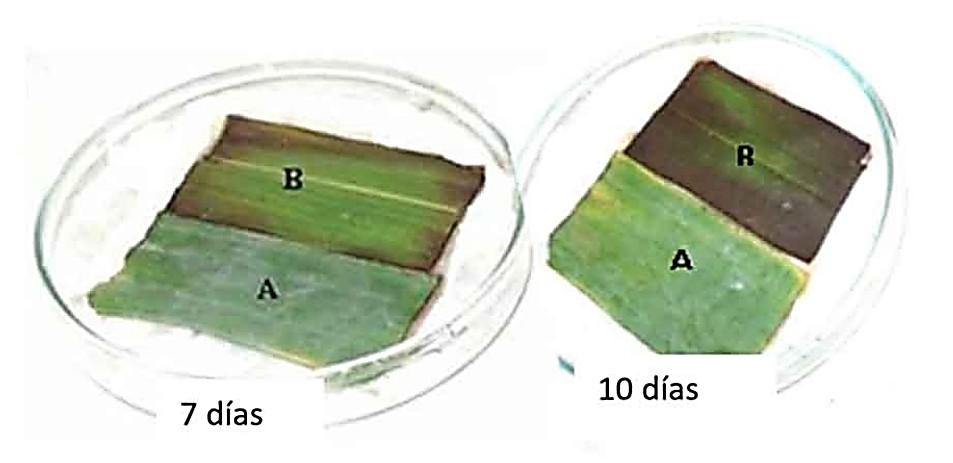
Raoiella indica (palm red mite), an invasive pest, described in 1924 by Hirst on coconut leaves (Cocos nucifera) in India, was recorded in Guantánamo, Cuba in 2008 on this host and Adonidia merrillii (Becc.)( de la Torre et al., 2010), it quickly spread throughout the country, on various Arecaceae and also some records on Mussa spp, gardens and green areas.The objective of this work was to determine under laboratory conditions the behavior of R. indica on banana (M. paradisiaca), a crop of agricultural interest against A. merrillii, a useful tool to adjust the management of this pest in production areas. A test was set up in the INISAV Acarology laboratory, consisting of facing sections of plantain leaves ‘Macho –’ (AAB) and garden palm (A. merrillii) 3 cm long by 5 cm wide, placed on moist cotton in a 9-inch petri dish. cm, on each one five young females of the mite were placed and 18 units were mounted. The observations began 24 hours later and three per day (11:00 AM, 1:00 and 3:00 PM) were made at 2, 3, 4, 7 and, only one at 10 days, the leaves of A. merrillii, with more than 50% necrosis. In all the counts, the individuals present, the number of eggs, droppings and other traces were recorded. Isolated individuals were less active, had low oviposition and did not have a defined structure; the natural gregarious behavior of the mite on these hosts was not observed. Under the experimental conditions, M. paradisiaca L. was more effective for the survival and oviposition of R. indica than A.merrilli, although both with low indicators due to the use of virgin females and the manipulation of the breeding sands.
Article Details

This work is licensed under a Creative Commons Attribution-NonCommercial 4.0 International License.
Those authors who have publications with this journal accept the following terms of the License Attribution-NonCommercial 4.0 International (CC BY-NC 4.0):
You are free to:
- Share — copy and redistribute the material in any medium or format
- Adapt — remix, transform, and build upon the material
The licensor cannot revoke these freedoms as long as you follow the license terms.
Under the following terms:
- Attribution — You must give appropriate credit, provide a link to the license, and indicate if changes were made. You may do so in any reasonable manner, but not in any way that suggests the licensor endorses you or your use.
- NonCommercial — You may not use the material for commercial purposes.
- No additional restrictions — You may not apply legal terms or technological measures that legally restrict others from doing anything the license permits.
The journal is not responsible for the opinions and concepts expressed in the works, they are the sole responsibility of the authors. The Editor, with the assistance of the Editorial Committee, reserves the right to suggest or request advisable or necessary modifications. They are accepted to publish original scientific papers, research results of interest that have not been published or sent to another journal for the same purpose.
The mention of trademarks of equipment, instruments or specific materials is for identification purposes, and there is no promotional commitment in relation to them, neither by the authors nor by the publisher.
How to Cite
References
Alcívar J., Mesa N. C., & Vásquez C., 2020. First report of Raoiella indica Hirst (Acari: Tenuipalpidae) in Province of Manabí, Ecuador. International Journal of Acarology, 46(2), 120-122.https://doi.org/10.1080/01647954.2020.17191 (Consulta 27 abril, 2022 https://www.tandfonline.com/doi/abs/10.1080/01647954.2020.1719195?journalCode=taca20
Almaguer Rojas L., Díaz Finalé Y., de la Torre Santana P.E., Pérez Montesbravo E., Estrada Vanegas E.G., y Rojas Leyva D., 2012. Biología y aspectos ecológicos de Raoiella indica (Acari: Tenuipalpidae), detectada en La Habana. Raoiella Indica (Hisrt, 1924). En: G.Estrada- Vanega, E.G., Equinhua - Martinez A., Jesús A. Acuña-Soto J., M. Patricia Chaires-Grijalva M.P., Durán- Ramírez G. (Eds.) Acarología Latinoamericana 2012. pag 400-414. Editorial Sociedad Mexicana de Entomología A.C. México. 1ra edición 2012.
Almaguer Rojas L., Díaz Finalé Y., Navarro Lantes A., Pérez Montesbravo E., de la Torre P. E. Rojas Leyva D. (2010). Raoiella indica (Acari: Tenuipalpide), detectada en la Habana y Ciudad de la Habana. Informe Interno al Instituto de Investigaciones de Sanidad Vegetal y al Centro Nacional de Sanidad Vegetal (CNSV).
Alonso Rodríguez D., Hernández Oliver R., Chico Morejón R., Miranda Cabrera I., Rodríguez Morell H., 2015. Incidencia de Raoiella indica Hirst y Tetranychus tumidus Banks en diferentes genotipos de plátano (Musa spp. Colla). Métodos en Ecología y Sistemática 10(2): 79-82. ISSN impreso 1659-2182 ISSN digital 1659-3049 Agosto 2015
Barroso G., Yammoto P., de Moraes G. J., 2016. Raoiella indica: ácaro de importancia cuarentenaria en Brasil. SIMPOSIO 8: Ácaros de importancia cuarentenaria. Proceedings II Congreso Latinoamericano De Acarología. Montenegro, Quindío, Colombia. 27 a 31 de mayo de 2016. Sociedad Latinoamericana de Acarología II CLAc Vol. 1 116:117 (pdf internet 23 abril 2022)
Carrillo D., Amalin D., Hosein F., Roda A., Duncan R. E., Peña J. E., 2012. Host plant range of Raoiella indica (Acari: Tenuipalpidae) in areas of invasion of the New World. Exp Appl Acarol. 57: 271-289.
Cocco A., Hoy M. A., 2009. Feeding, reproduction, and development of the red palm mite (Acari:Tenuipalpidae) on selected palms and banana cultivars in quarantine. Florida Entomologist. 2009; 92(2):276-291.
De La Torre P. E., Suárez A., González A. I., 2010. Presencia del ácaro Raoiella indica Hirst (Acari: Tenuipalpidae) en Cuba. Protección Vegetal 25 (1): 1-4
Etienne J., Flechtmann C. H. W., 2006. First record of Raoiella indica (Hirst, 1924) (Acari: Tenuipalpidae) in Guadeloupe and Saint Martin, West Indies. Exp Appl Acarol 32:331-332
Estrada E. G., 2014. Estatus de Raoiella Indica Hirst (Acari: Tenuipalpidae) a cinco años de su arribo a México. Conferencias Magistrales. Entomología Mexicana, 1: 2-12
Galindo M. G., 2022. Impacto geoespacial de especies invasoras en la agricultura mexicana: la próxima amenaza a la seguridad alimentaria. Revista Inclusiones Vol: 9 num Esp (2022): 127-151 (pdf Internet: Consulta 26 marzo del 2022)
Gómez C. A., Lima T. P., Morais E. G., Gondim Jr., M. G., & De Moraes G. J., 2017. Hosts of Raoiella indica Hirst (Acari: Tenuipalpidae) Native to the Brazilian Amazon. Journal of Agricultural Science, 9(4), 86-94. https://doi.org/10.5539/jas.v9n4p86 . PDF . https://www.ccsenet.org/journal/index.php/jas/article/view/66092 / Consultado: 9 de Mayo de 2022)
González A. I., Ramos M., 2010. Desarrollo y reproducción de Raoiella indica Hirsts (Acari: Tenuipalpidae) en laboratorio. Revista de Protección Vegetal 25 (1): 7-10
Hirst S. (1924). On some new species of red spider. Ann and Magazine of Natural History Serv. 1924;14:522-527.
León G A., Campos J. C., Sierra J. A., 2021. Nuevos registros de plantas hospedantes de Raoiella indica Hirst en Colombia. Agronomía Mesoamericana, vol. 32, núm. 2: 629-637. Universidad de Costa Rica, Costa Rica (https://www.redalyc.org/articulo.oa?id=43766744020/ Consultado el 2 de mayo 2022)
Otero G., González R., Martínez L., Otero J. A., López RM, Graciamedrano E., 2016. Infestation of Raoiella indica Hirst (Trombidiformes: Tenuipalpidae) on Host Plants of High Socio-Economic Importance for Tropical America. Pest Management Neotrop Entomol DOI 10.1007/s13744-016-0368-z / PDF (Author's personal copy. (Consulta, 7 de marzo 2020)
Polanco C. A., Osorio R., Hernández L. U., Marquez C., De la Cruz E., Salinas R. M., Hernández V., 2017. Colonization, Abundance,and Damage of Raoiella indica Hirst on Cultivars of Musa spp.at Tabasco, México. Southwestern Entomologist 42:363-374
Ramírez M. B., Sarubbi H. J., Arias O., Azevedo L. H. de, & Flechtmann C. H. W., 2020. First report of Raoiella indica Hirst (Acari: Tenuipalpidae) in Paraguay. Journal of Plant Diseases and Protection, 127, 715-717. https://doi.org/10.1007/s41348-020-00312-2
Ramos M., Moreno D., Vargas Sandoval M., 2017. Nuevas palmas hospedantes de Raoiella indica (Acari: Tenuipalpidae) en Cuba. Revista Colombiana de Entomología 43 (1): 113-120
Rodrigues J.C.V., Irish B.M. (2012) Effect of coconut palm proximities and Musa spp. germplasm resistance to colonization by Raoiella indica (Acari: Tenuipalpidae). Exp Appl Acarol 57:309-316
Rodríguez H., Flores G., Montoya A., Franco F., Pérez H. M., 2015. Host plant of Raoiella indica (Acari: Tenuipalpidae) in Baracoa municipality, with report of six new hosts in Cuba. Métodos en Ecología y Sistemática Vol. 10(3): 60-66. ISSN impreso 1659-2182 ISSN digital 1659-3049 Diciembre 2015/ https://www.researchgate.net/publication/317516534 (Consulta 20 febrero 2020
Statgraphics Plus for Windows. Version 5.1. Statistical Graphics Corp.2001