
Characterization of four cuban isolates of Beauveria spp. promising for agricultural pest control
Article Sidebar
Main Article Content
Abstract
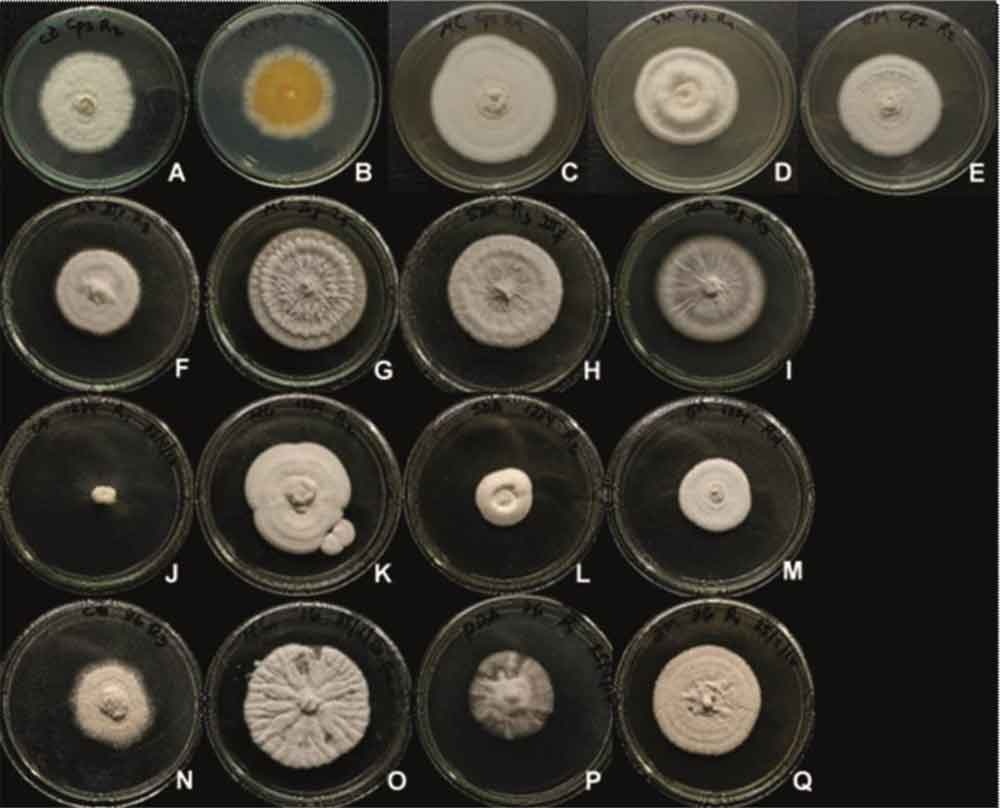
The enthomopathogenic fungi of the Beauveria genus are considered biological control agents for their high effectiveness against agricultural pests and their minimal impact on benefits insects, the environment and humans. The objective of this research was to evaluate four Cuban isolates of Beauveria spp. belong to the Microbial Culture Collection of the INISAV, promising for agricultural pests control. The isolates LBb-1234, LBb-Cp2, LBb-76 and LBb-IIIF were characterized in terms of morphology of the conidia and cultural characteristics of the colonies. The influence on growth of different culture media and incubation temperatures and sporulation were determinate. The production of extracellular enzymes was qualitatively evaluated, as well as the pathogenicity against adults of Cylas formicarius. In addition, LBb-1234 isolate was selected for growth by two-stage production, on rice as substrate. The results indicated that the culture media and different temperatures influence in the growth and sporulation of the isolates, being LBb-1234 the one with the highest level of sporulation and high pathogenicity towards C. formicarius. The bioproduct based on LBb-1234 reached the quality parameters established as requirements in the Cuban Standard for this type of technology.
Article Details

This work is licensed under a Creative Commons Attribution-NonCommercial 4.0 International License.
Those authors who have publications with this journal accept the following terms of the License Attribution-NonCommercial 4.0 International (CC BY-NC 4.0):
You are free to:
- Share — copy and redistribute the material in any medium or format
- Adapt — remix, transform, and build upon the material
The licensor cannot revoke these freedoms as long as you follow the license terms.
Under the following terms:
- Attribution — You must give appropriate credit, provide a link to the license, and indicate if changes were made. You may do so in any reasonable manner, but not in any way that suggests the licensor endorses you or your use.
- NonCommercial — You may not use the material for commercial purposes.
- No additional restrictions — You may not apply legal terms or technological measures that legally restrict others from doing anything the license permits.
The journal is not responsible for the opinions and concepts expressed in the works, they are the sole responsibility of the authors. The Editor, with the assistance of the Editorial Committee, reserves the right to suggest or request advisable or necessary modifications. They are accepted to publish original scientific papers, research results of interest that have not been published or sent to another journal for the same purpose.
The mention of trademarks of equipment, instruments or specific materials is for identification purposes, and there is no promotional commitment in relation to them, neither by the authors nor by the publisher.
How to Cite
References
Benz, G. 2015. Environment, In: Epizootiology of Insect Diseases. J. R.Fuuxa y Y. Tanada. (Eds.) Wiley & Sons, New York: 177-214.
Carrillo-Rayas M. y Blanco-Labra A. 2009. Potencial y algunos mecanismos de acción de los hongos entomopatógenos para el control de insectos plaga. Acta Universitaria, 19 (2): 40-49.
Chan-Cupul W., Ruiz E., Cristóbal J., Pérez A., Mungía R. y Lara R. 2010. Desarrollo in vitro de cuatro cepas nativas de Paecilomyces fumosoro seus y su patogenicidad en estados inmaduros de mosquita blanca. Agrociencia, 44(5): 587-597.
Elósegui O., Jiménez J., Car A. 2006. Aislamiento, identificación y caracterización morfométrica de aislados nativos de hongos mitospóricos con potencialidades para el control de especies de insectos plaga. Fitosanidad, 10(4): 265-267.
Fernández E., Valerio H., Feltrin T., Van Der Sand S. 2012. Variability in the productionof extracellular enzimes by entomopatogenic fungi grown on different substrates. Brazilian Journal of Microbiology, 827-833.
Ibarra-Cortés K., Guzmán F., González H., Suárez E. y Baverstock, J. 2013. Selection of a fungal isolate for the controlof the pink hibiscus mealybug Maconelli coccus hirsutus. Pest Manag. Sci. 69: 874-882.
Imoulan A., Hussain M., Kirk P., El Mezianee A. y Yi Jian Y. 2017. Entomopathogenic fungus Beauveria: Host specificity, ecology and significance of morpho-molecular characterization in accurate taxonomic classification. Journal of Asia-Pacific Entomology, 20: 1204-1212.
Imoulan A., Hai-Jun W., Wei-Lai L., Yi L., Bin L., Rei Y., Wen-Jing W. Xiao-Liang W., Paul M. y Yi-Jian Y. 2016. Beauveria medogensi ssp. nov, a new fungus of the entomopathogenic genus from China. J. Invertebr. Pathol. 139: 74-81.
Khonsanit A., Luangsa-ard J. Thanakitpipattana D., Noisripoom W., Chaitika T. & Kobmoo N. 2020. Cryptic diversity of the genus Beauveria with a new species from Thailand. Mycol Progress 19:291-315.
Kumar C., Jacob T., Devasahayam S. y D’Silva S. 2016. Characterization and virulence of Beauveria bassiana associated with auger beetle (Sinoxylonanale) infesting allspice (Pimenta dioica). J. Invertebr. Pathol. 139:67-73.
Lacey A., Grzywacz D., Shapiro-Ilan D. I., Frutos R., Brownbridge M. y Goettel M. 2015. Insect pathogens as biological control agents: back to the future. J. Invertebr. Pathol. http://dx.doi.org/10.1016/j.jip.2015.07.009.
Lang W., Lung I., How C., Choan K., Teish W., Kuo Y., Jon J. y Lu C. 2002. Production of antifungal compounds from chitin by Bacillus subtilis. Enzyme andmicrobial Technology. 31: 321-328.
Li Z., Alves S., Roberts D., Fan M., Delalibera I., Tang J., Lopes R., Faria M. y Rangel D. 2010. Biological control of insects in Brazil and China: history, current programs and reasons for their successes using entomopathogenic fungi. Biocontrol Sci Technol. 20: 117-136.
Liu H., Skinner M., Bridge M. y Parker B. 2003. Characterization of Beauveria bassiana and Metarhizium anisopliae isolates for management of tarnished plant bug, Lygus lineolaris (Hemiptera: Miridae). J. Invertebr. Pathol. 82: 139-147.
Márquez M., Fernández-Larrea O., Jiménez J., Elósegui O., Gómez R., Carreras B., Laguardia E., Monzón S., Ayala J., Massó E., Veitía M., Borges G. y Baró Y. 2010.Formas de obtención de controladores biológicos microbianos para su uso en el sistema de producción agrícola del Minag: 34-35.
Mascarin G. y Jaronski S. 2016. The production and uses of Beauveria bassiana as a microbial insecticide. World J Microbiol Biotechnol. 32,177. DOI:10.1007/s11274-016-2131-3.
Murad A., Laumann R. Lima T., Sarmento R., Noronha E., RochaT., Valadares-Inglis M. y Franco O. 2006. Screening of entomopathogenic Metarhiziuman isopliae isolates and proteomic analysis of secretion synthesized in response to cowpea weevil (Calloso bruchus maculatus) exoskeleton. Comp. Biochem. Physiol. 142(3): 365-367.
Norma cubana NC1016: 2014. Biotecnología agrícola. Métodos de ensayos para biopreparados de entomopatógenos. Oficina Nacional de Normalización.
Obando J., Bustillo A., Castro U., Mesa N. 2013. Selección de cepas de Metarhiziuman isopliae para el control de Aeneolamia varia (Hemiptera: Cercopidae). Revista Colombiana de Entomología. 39(1): 26-33.
Ondiaka S., Maniana N., NyamasyG., Nderitu J., Onofre S. Miniuk C., Monteiro N. y Azevedo J. 2001. Growth and sporulation of Metarhizium flavoviride var. flavoviride on culture media and lighting regimens. Scientia Agricola. 58 (3): 613-616.
Paccola-Meirelles L. y Azevedo J. 1990. Variabilidae natural no fungo entomopatogénico Beauveria bassiana. Arq. Biol. Tecnol. 33(3):657-672.
Paddy L., Villalba M., Ravelo H. y Cupull S. 2009. Producción de esporas de Beauveria bassiana (Balsamo) Vuillemin sobre polvos de arroz, sorgo y maíz. Centro Agrícola. 36(4): 25-32.
Perinotto W., Golo P., Coutinho C., Sa F., Santi L., Beys da Silva W., Jungues A., Vainteins M., Schrank A., Salles C. y Bittencourt V. 2014. Enzymatic activities and effects of mycovirus infection on the virulence of Metarhiziuman isopliae in Rhipicephalus microplus. Veterinary Parasitology. 203: 189-196.
Reddy G., Zhao Z. y Humber R. 2014. Laboratory and field efficacy of entomopathogenic fungi for the management of sweet potato weevil, Cylasformicarius (Coleoptera: Brentidae). J. Invertebr. Pathol. 122: 10-15.
Rehner S.y Buckley E. 2005. A Beauveria phylogeny inferred from ITS andEF1-a sequences: evidence for cryptic diversification and links to Cordycepsteleomorphs. Mycologia. 97: 84-98.
Rehner S., Minnis A., Sung G., Luang-sard J., Devotto L. y Humber R. 2011. Phylogeny and systematics of the anamorphic, entomopathogenicgenus Beauveria. Mycologia. 103: 1055-1073.
Rehner S., Posada F., Buckley E., Infante F., Castillo A. y Vega F. 2006. Phylogenetic origins of African and Neotropical Beauveria bassiana s. l. pathogens of the coffee berry borer, Hypothenemus hampei. J. Invertebr. Pathol.93: 11-21.
Sanivada S. y Challa M. 2014. Mycolytic effect of extracellular enzymes ofentomopathogenic fungi to Colletotrichum falcatum, red rot pathogen ofsugarcane. J. Biopest. 7: 33-37.
Saranraj P. y Jayaprakash A. 2017. Agrobeneficial entomopathogenic fungi - Beauveria bassiana: A review. Indo - Asian Journal of Multidisciplinary Research (IAJMR). 3 (2): 1051- 1087DOI: 10.22192/iajmr.2017.3.2.4
Senthil Kumar C., Jacob T., Devasahayam S., D’Silva S., Jinsha J. y Rajna S. 2015. Occurrence and characterization of a tetrahedralnucleopolyhedrovirus from Spilarctia oblique (Walker). J. Invertebr. Pathol. 132: 135-141.
Senthil Kumar C., Jacob T., Devasahayam S., D’Silva S. y Nandeesh P. 2016. Characterization and virulence of Beauveria bassiana associated with auger beetle (Sinoxylon anale) infesting allspice (Pimenta dioica). J. Invertebr. Pathol. 139: 67-73.
St Leger R., Joshi L. y Roberts D. 1997. Adaptation of proteases, carbohydrases of saprophytic, phytopathogenic, and entomopathogenic fungi tothe requirements of their ecological niches. Microbiology. 143: 1983-1992.
Valero-Jiménez C., Wiegers H., Zwaan B., Koenraadt C. y Van Kan J. 2016. Genes involved in virulence of the entomopathogenic fungus Beauveria bassiana. J. Invertebr. Pathol. 133: 41-49.
Zimmermann G. 2007. Review on safety of the entomopathogenic fungus Metarhizium anisopliae. Biocontrol Science and Technology. 17 (9): 879-920.