
Crazy top of maize caused by Sclerophthora macrospora in Cuba
Article Sidebar
Main Article Content
Abstract
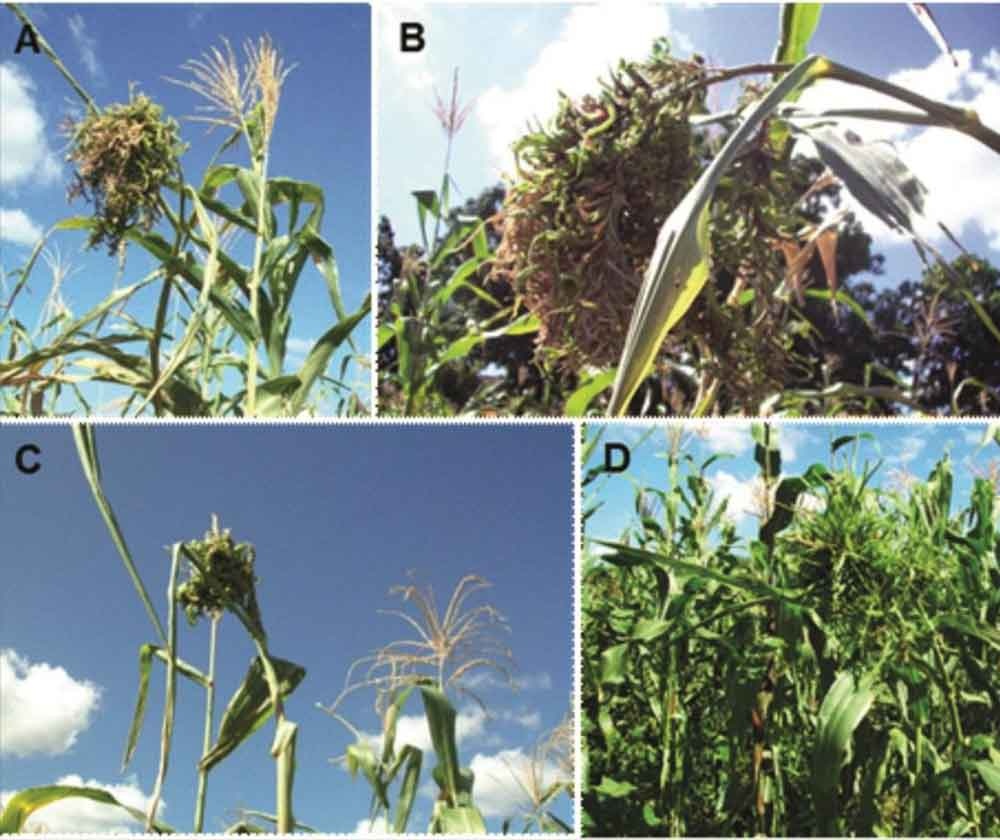
In November 2011, in maize fields of El Salvador municipality, Guantánamo province, plants with proliferation of male inflorescence on which foliar structures were substituted by small, rolled and twisted leaves were detected. These plants also showed light green chlorotic streaks on true leaves. With the aim of identify the causal agent of this symptomatology, foliar samples were placed in humid chamber and incubated by 24 h at 25°C. Also, leaves with chlorotic streaks were sectioned, fragments were placed in tubes containing NaOH (5 %) and incubated at 60 ºC for 10 min. Decolorated leaf fragments were washed with distilled sterile water and mounted in slides for microscopic observation. No sporangia were detected on the samples leaves and on the leaf fragments placed in moistened chambers. However, in decolorated leaf fragments, rounded, pale yellow oospores with a diameter of 36-70 µm (average 53 µm), thick walls and granular center were detected. Samples symptoms and characteristics of the oospores agree with those described for Sclerophthora macrospora. This is the first report of crazy top of maize caused by S. macrospora in Cuba.
Article Details

This work is licensed under a Creative Commons Attribution-NonCommercial 4.0 International License.
Those authors who have publications with this journal accept the following terms of the License Attribution-NonCommercial 4.0 International (CC BY-NC 4.0):
You are free to:
- Share — copy and redistribute the material in any medium or format
- Adapt — remix, transform, and build upon the material
The licensor cannot revoke these freedoms as long as you follow the license terms.
Under the following terms:
- Attribution — You must give appropriate credit, provide a link to the license, and indicate if changes were made. You may do so in any reasonable manner, but not in any way that suggests the licensor endorses you or your use.
- NonCommercial — You may not use the material for commercial purposes.
- No additional restrictions — You may not apply legal terms or technological measures that legally restrict others from doing anything the license permits.
The journal is not responsible for the opinions and concepts expressed in the works, they are the sole responsibility of the authors. The Editor, with the assistance of the Editorial Committee, reserves the right to suggest or request advisable or necessary modifications. They are accepted to publish original scientific papers, research results of interest that have not been published or sent to another journal for the same purpose.
The mention of trademarks of equipment, instruments or specific materials is for identification purposes, and there is no promotional commitment in relation to them, neither by the authors nor by the publisher.
How to Cite
References
Arnold G. R. W., 1986. Lista de hongos fitopatógenos de Cuba. Ministerio de Cultura Ed.Cientifico-Técnica, 207 p.
CAB International (CABI), 2007. Crop Protection Compendium. Wallingford, UK: CAB International. Reino Unido.
Camino M., Mena J. y Minter D. W., 2006. Hongos de Cuba [sitio internet, versión 1.00]. www.cybertruffle.org.uk/cubafung. Febrero, 2018.
EPPO, 2017. PQR-EPPO databaseonquarantinepests. http://www.eppo.int. Enero 2019.
Food and Agriculture Organization (FAO), 2019. FAOSTAT. Datos sobre alimentación y agricultura, www.fao.org/faostat/es. Enero 2019.
Farr D. F. y Rossman A. Y., 2019. Fungal Databases. Systematic Mycology and Microbiology Laboratory, ARS, USDA. http://nt.ars-grin.gov/fungaldatabases/index.cfm. Enero 2019.
Fernández M., 1973. Catálogo de enfermedades de plantas cubanas. Serie Agrícola no. 27. Academia de Ciencias de Cuba. 78 p.
Myco Bank, 2018. Myco Bank Database, Fungal database, nomenclature and species Banks. http://www.mycobank.org. Febrero, 2018.
Martín E. L., Álvarez C. y Neninger H., 1998. Peronosclerospora sorghi (Weston y Uppal) C. G. Shaw causante del mildiu del sorgo. Centro Agrícola. 2:34-38.
Martínez E., Wilson D., Lorenzo M. E., Guerrero D., García D., Rodríguez G., Sierra P. M. y Gómez Y., 2016. El carbón de la espiga del maíz causado por Sphacelotheca reiliana (J. G. Kühn) G. P. Clinton en Cuba. Fitosanidad. 20(1): 33-38.
Martínez M., Ortiz R. y Raigón M. D., 2017. Contenido de fósforo, potasio, zinc, hierro. sodio, calcio y magnesio. Análisis de su variabilidad en accesiones cubanas de maíz. Cultivos Tropicales. 38(1): 92-101.
Minter D. W., Rodríguez M. y Mena J., 2001. Fungi of the Caribbean. An annotated checklist. Isleworth, UK: PDMS Publs, 2001, 943 pp.
Oficina Nacional de Estadística e Información, 2019. Agricultura, Ganadería y Silvicultura. En: Anuario Estadístico de Cuba 2018. http:// www.onei.cu. Febrero, 2019.
Shurtleff M. C., 1986. Compendium of Corn diseases. pp 28-29. APS Press. St. Paul, Minnessota, Estados Unidos.
Steindl D. R. L. y Steib R. J., 1969. Sclerophthora disease. En: Sugarcane Diseases of the World. Vol. 1. Hughes, C. G., Abbot, E. V. and Wismer, C. A (eds.) Edición Revolucionaria. Instituto del Libro, pp. 310-325.
Telle S., Shivas R. G., Ryle, M. J. y Thines M., 2011. Molecular phylogenetic analysis of Peronosclerospora (Oomycetes) reveals cryptic species and genetically distinct species parasitic to maize. European Journal of Plant Pathology. 130:521-528.