
Determinación de 1,3 dicloropropeno y cloropicrina por cromatografía gaseosa
Article Sidebar
Main Article Content
Abstract
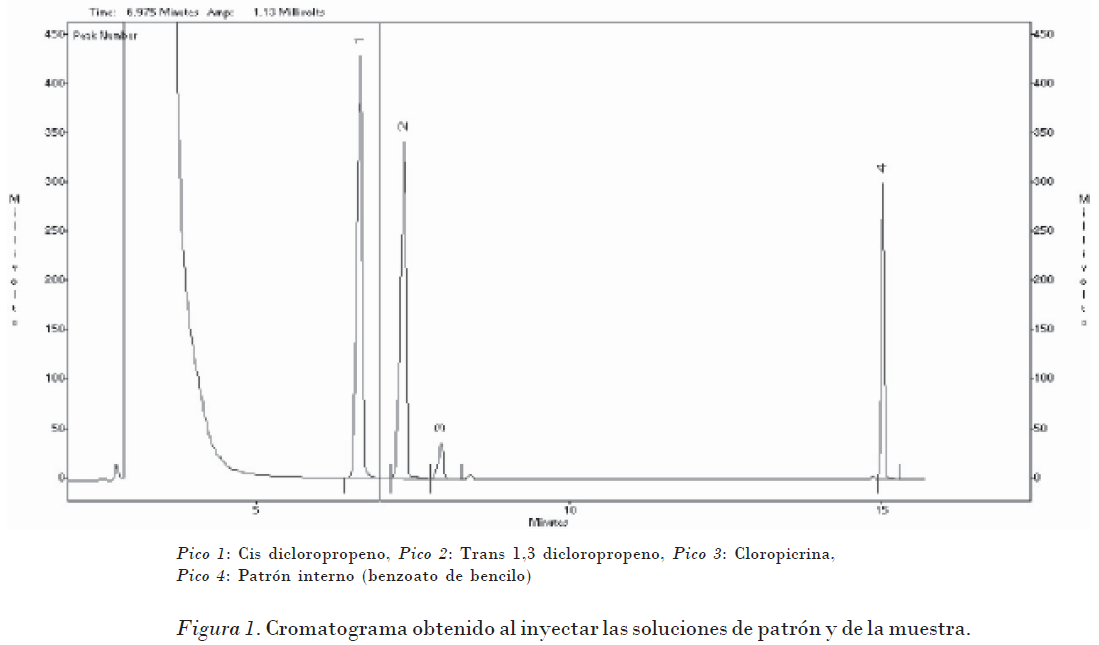
The formulation of 1, 3 dicloropropeno and cloropicrina could substitute methyl bromide in the disinfection of substrata and therefore it would have a quick and wide use for integrated pest management in some crops. To guarantee good biological effectiveness is necessary to carry out a systematic control of its quality, reason why it is important to have precise and exact analytic methods to determine the real concentration of 1, 3 dicloropropeno and cloropicrina. In that way an analytical method based on the separation by gas chromatografy of 1,3 dicloropropeno and cloropicrina from the rest of formulation components was developed in the Quality Control Laboratory of INISAV, using a column DB 5 of 25 m of longitude; 0,54 mm of internal diameter and 1,5 ìm of thickness and an flame ionization detector (FID). The benzyl benzoato was used as internal standard. The method showed a good reproducibility and accuracy. It is the official method of Quality Control Laboratory for the commercial signatures that offer this product to the country, at this moment.
Article Details

This work is licensed under a Creative Commons Attribution-NonCommercial 4.0 International License.
Those authors who have publications with this journal accept the following terms of the License Attribution-NonCommercial 4.0 International (CC BY-NC 4.0):
You are free to:
- Share — copy and redistribute the material in any medium or format
- Adapt — remix, transform, and build upon the material
The licensor cannot revoke these freedoms as long as you follow the license terms.
Under the following terms:
- Attribution — You must give appropriate credit, provide a link to the license, and indicate if changes were made. You may do so in any reasonable manner, but not in any way that suggests the licensor endorses you or your use.
- NonCommercial — You may not use the material for commercial purposes.
- No additional restrictions — You may not apply legal terms or technological measures that legally restrict others from doing anything the license permits.
The journal is not responsible for the opinions and concepts expressed in the works, they are the sole responsibility of the authors. The Editor, with the assistance of the Editorial Committee, reserves the right to suggest or request advisable or necessary modifications. They are accepted to publish original scientific papers, research results of interest that have not been published or sent to another journal for the same purpose.
The mention of trademarks of equipment, instruments or specific materials is for identification purposes, and there is no promotional commitment in relation to them, neither by the authors nor by the publisher.
How to Cite
References
Barberá, C.: Pesticidas agrícolas, 2.ª ed., Ed. Omega, Barcelona, 1974.
Camacho, M. A.; A. I. Torres; M. E. Gil; M. M. Obregón; V. Ruz: «Validation Protocol of Analytical Methods for Finished Pharmaceutical Products», ATP Pharma Practique, 3 (3):197-202, 1993.
Cipac: Guidelines on Method Validation To Be Performed in Support of Analytical Methods for Agrochemical Formulations, Collaborative International Pesticides Analytical Council, Document 3807, 1995.
Citma: «Resolución 108/2004», Dirección Jurídica del Ministerio de Ciencia, Tecnología y Medio Ambiente, La Habana, Cuba. 2004.
CNSV: Lista oficial de plaguicidas autorizados, Registro Central de Plaguicidas, Centro Nacional de Sanidad Vegetal, Minag, La Habana, 2006.
Dierksmeier, G.: Métodos cromatográficos, Ed. Científico-Técnica, La Habana, 2005.
Pesticide Action Network: «Alternativas al bromuro de metilo», extracto de la evaluación de 1995 del Comité de Opciones Técnicas al Bromuro de Metilo de NN.UU. para Norteamérica, San Francisco, California, EE. UU., agosto de 1995.
Tomlin, C.: The Pesticide Manual. A World Compendium, British Crop Protection Council, Inglaterra, 2000.