
Molluscs associated with semi-protected vegetable system of the municipality of Morón, Ciego de Ávila
Article Sidebar
Main Article Content
Abstract
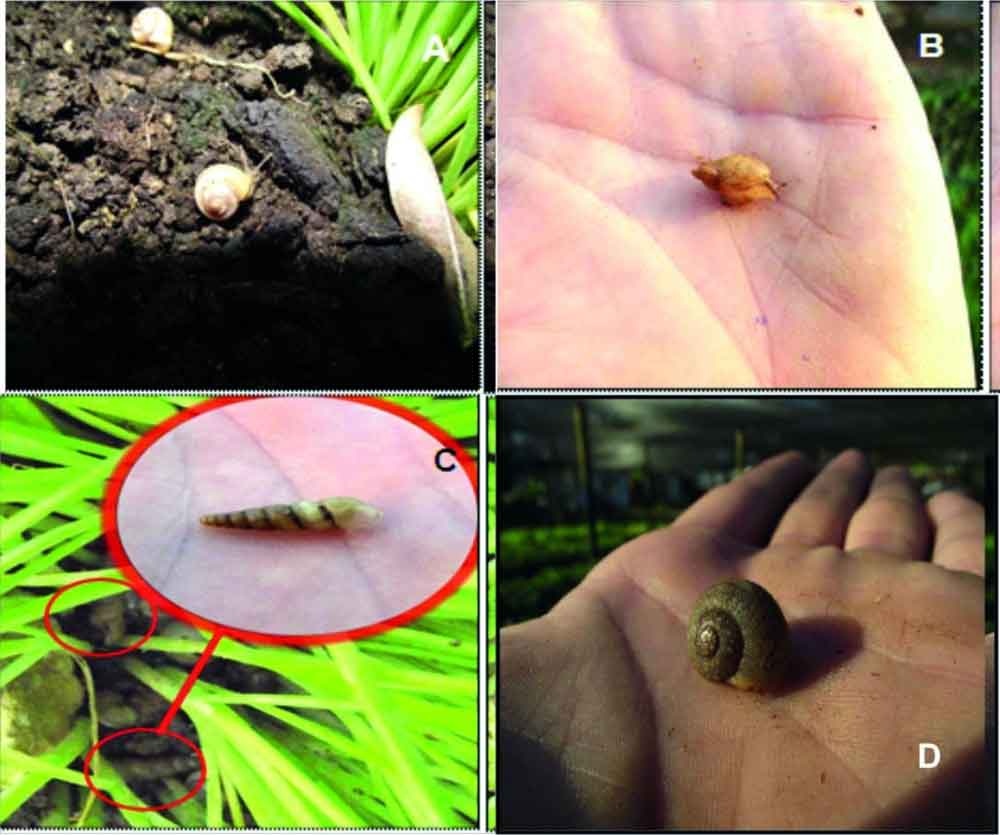
The arable area of the organoponic and semi-protected is formed on substrate, based on organic materials, these constitute, for the most part, food for terrestrial molluscs. The malacofauna present in the semi-protected organoponics systems of the Morón municipality is unknown, which is why the objective of this study was to determine the molluscs that inhabit this agroecosystem and the plant species to which it is associated. The study was carried out in the period between March and April 2017 in three semi-protected areas of the Morón municipality. A 1 m2 square frame was placed in each bed. 10 micro-plots were sampled in each bed where the vegetation was checked and the soil was removed in the first five cm. The data on the abundance of molluscs was subjected to a Kruskal-Wallis test and a non-parametric Dunn test was used to locate the differences. All analyzes were carried out with the R statistical package (R Core Team, 2016). In the sampled semi-protected cultures were found, five families, grouped intofive genera and equal number of molluscs species were identified, Praticolella griseola (Pfeiffer, 1841); Succinea sp.; Subulina octona (Bruguiere, 1792); Zachrysia auricoma (Férussac, 1822) and Veronicella cubensis (Pfeiffer, 1840).
Article Details

This work is licensed under a Creative Commons Attribution-NonCommercial 4.0 International License.
Those authors who have publications with this journal accept the following terms of the License Attribution-NonCommercial 4.0 International (CC BY-NC 4.0):
You are free to:
- Share — copy and redistribute the material in any medium or format
- Adapt — remix, transform, and build upon the material
The licensor cannot revoke these freedoms as long as you follow the license terms.
Under the following terms:
- Attribution — You must give appropriate credit, provide a link to the license, and indicate if changes were made. You may do so in any reasonable manner, but not in any way that suggests the licensor endorses you or your use.
- NonCommercial — You may not use the material for commercial purposes.
- No additional restrictions — You may not apply legal terms or technological measures that legally restrict others from doing anything the license permits.
The journal is not responsible for the opinions and concepts expressed in the works, they are the sole responsibility of the authors. The Editor, with the assistance of the Editorial Committee, reserves the right to suggest or request advisable or necessary modifications. They are accepted to publish original scientific papers, research results of interest that have not been published or sent to another journal for the same purpose.
The mention of trademarks of equipment, instruments or specific materials is for identification purposes, and there is no promotional commitment in relation to them, neither by the authors nor by the publisher.
How to Cite
References
Caballero R., Thomé J.W., Andrews K.L. and Rueda A.,1991.Babosas de Honduras (Soleolifera: Veronicellidae): biología, ecología, distribución, descripción, importancia económica, y claves para su identificación. Ceiba 32, 107-125.
Cabrera M. y Hobán C., 2021. Colección y evaluación mediante marcadores fenotípicos de morfotipos de hospederos intermediarios resistentes a formas infestivas de Fasciola hepática. Revista Peruana de Innovación Agraria. 1(1), 63- 78.
Capinera J.L., 2013. Cuban brown snail, Zachrysia provisoria (Gastropoda): Damage potential and control. Crop Protection. 52 (2013) 57- 63. CIEG., 2017). Centro de Investigaciones de Ecosistemas Costeros
Dávila S y Almeida C.,2005. Influencia do substrato sobre crescimento de Subulina octona (Bruguiére) (Mollusca,Subulinidae) sobcondicoes de laboratorio. Revista Brasileira de Zoologia 22 (1): 205-211, março.
Dias R. J. P., Almeida B. E. y Ávila S. D.,2007. Influence of substrate humidity on desiccation resistance Capacity in Subulina octona (Mollusca, Subulinidae). Brazilian archives of biology and technology, 50 (1), 137-139.
Estrada B., Zoila L., 2020. Diagnóstico de la meningitis eosinofílica por Angiostrongylus en la atención primaria. Examen Complexivo. Universidad Técnica de Machala.
Fahy N. E., 2003. Clave de los géneros de moluscos terrestres mexicanos usando caracteres conquiológicos, Rev. Biol. Trop. 51 (3): 473-482 Costa Rica
Gomes R.S., 2007. Filogenia morfológica de Veronicellidae, filogenia molecular de Phyllocaulis Colosi e descrição de uma nova espécie para a família (Mollusca, Gastropoda, Pulmonata). Tese do título de Doutor em Biologia Animal. Universidade Federal do Rio Grande do Sul, Porto Alegre.
Herrera N.S. y Castellanos L.G., 2013. Informe sobre la incidencia de moluscos plaga en organopónicos del municipio de Cienfuegos, Cuba. Centro Agrícola, 40(1): 89-90.
Kadry W. M., Abd A. E., Boules M. W., Shimaa, M.,2018. Survey and population dynamics of some land snails infesting different plant hosts at Sharkia Governorate. J. Environ. Sci. Institute of Environmental Studies and Research - Ain Shams University. Vol., 42, No.1, Jun. 33.
Kadry W. M., Abd A. E., Boules M. W., Shimaa, M.,2018. Survey and population dynamics of some land snails infesting diferent plant hosts at Sharkia Governorate. Journal of Environmental Sciencie, 42 (1), 107- 118.
Le Gall M. y Tooker J. F., 2017. Developing ecologically based pest management programs for terrestrial molluscs in field and forage crops. J Pest Sci. 90(3): 825-838 p
Maceira D. F., 2003. Las especies de la familia Veronicellidae (Mollusca: Soleolifera) en Cuba. Rev. Biol. Trop. 51 (Suppl. 3): 453-461.
Maceira D. F., 2003. Plantas usadas como recurso trófico por Veronicella cubensis (Pfeiffer, 1840) (Gastropoda: Veronicellidae) en dos localidades del Parque Nacional “Alejandro de Humbolt” Centro Agrícola, no. 1, año 29, enero-marzo, 2002, 82-84 pp.
MansoM. y Garrido T. E., 2018.Meningitis eosinofílica causada por Angiostrongylus cantonensis: SOS Caracol Gigante Africano. Convención Internacional de Salud, Cuba Salud.
Matamoros M., 2014. Los moluscos fitófagos en la agricultura cubana. Agricultura Orgánica.
Matamoros M., 2011. Manejo agroecológico de moluscos. En: Manual para la adopción del manejo agroecológico de plagas en fincas de la agricultura suburbana.Capítulo 12. (Vázquez, L.V.M. Ed.) La Habana: 213 p.
Matamoros M.T., 2014. Malacofauna en agroecosistemas representativos de las provincias occidentales de Cuba. Fitosanidad. 18 (1) abril 23- 27.
Nodarse M., Martínez R. C., Cabrera E., Aday Y. M., y Reyes A., 2019. Moluscos de importancia agrícola en Cienfuegos, Cuba. Universidad y Sociedad, 11 (1), 81-85.
Nodarse M., Castellanos L., Herrera, N., Morfa M., 2017. Acción molusquicida de extractos vegetales de tres especies de la familia Agavaceae contra Praticolella griseola (Pfeiffer). Rev. Protección Veg., Vol. 32(2).
Pedroso R.J., Almeida E.C. y Ávila S.D., 2007. Influence of substrate humidity on desiccation resistance Capacity in Subulina octona (Mollusca, Subulinidae). Brazilian Archives of Biology and Technology. Vol. 50: 137-139.
Pérez A. M. y López A., 2003. Listado de la malacofauna continental (Mollusca: Gastropoda) del Pacífico de Nicaragua. Revista de Biología Tropical, vol. 51, núm. 3, 2003, pp. 405-451, Universidad de Costa Rica, Costa Rica.
R Development Core Team: “A language and environment for statistical computing. R. Foundation for Statistical Computing”, Viena, Austria, http://www.R-project.org, 2016.
Rahmawati Y.F., Putri R.A., Prakarsa T.B.P., Muflihaini M.A. and Putra Y. A., 2021. Diversity and Distribution of Molluscs in the Intertidal Zone of Nglambor Beach, Gunung Kidul, Yogyakarta. Bio Web of Conference 33, 01002.
Rodríguez A., Concepción N. C., Buides J. F., Ortiz J. E., Prades F. C., y García R. R., 2011. Manual técnico para organopónicos, huertos intensivos y organoponía semiprotegida. (L. E. M. Oliva Ed. Décima edición. ed.). La Habana, Cuba: Editorial Pueblo y Educación.
Rysavy B., 1969. Ciclo evolutivo del helminto pulmonar Muellerius capillaris (Müller, 1889) en Cuba. Torreia: Nueva Serie No. 6.
Sánchez C. R., Núñez Y. O., Rodríguez O. R., Ricardo C. V.,Cruz B., y García B. C., 2016. Buenas prácticas para el control de caracoles y babosas. Boletín Informativo de la Agricultura Urbana 12 (21).
Thomé, J. W., 1989. Annotated and illustrated preliminary list of the Veronicellidae (Mollusca: Gastropoda) of the Antilles, and Central and North America. J. Med. & Appl. Malacol., 1: 11-28.
Vázquez P.A.A., Sánchez J. N., Alba M. y Rodríguez E. V., 2014. Papel de los moluscos cubanos en la transmisión de Angiostrongylus cantonensis: ¿diferentes especies significa mismo resultado?8th Cuban Congress on Microbiology and Parasitology, 5th National Congress on Tropical Medicine and 5th International Symposium on HIV/aids infection in Cuba.
Vázquez A. A., 2016. Los moluscos: hospederos intermediarios de nemátodos en Cuba. En: Angiostrogylus cantonensis, Emergencia en América (Ed.: Martini, L.R. y Dorta, A. J. C.). Editorial Academia. 193- 201 pp.