
Biología reproductiva de Dichrostachys cinerea (L.) Wight & arn (marabú). (II) Evaluación de reproducción por porciones de tallos y raíces
Article Sidebar
Main Article Content
Abstract
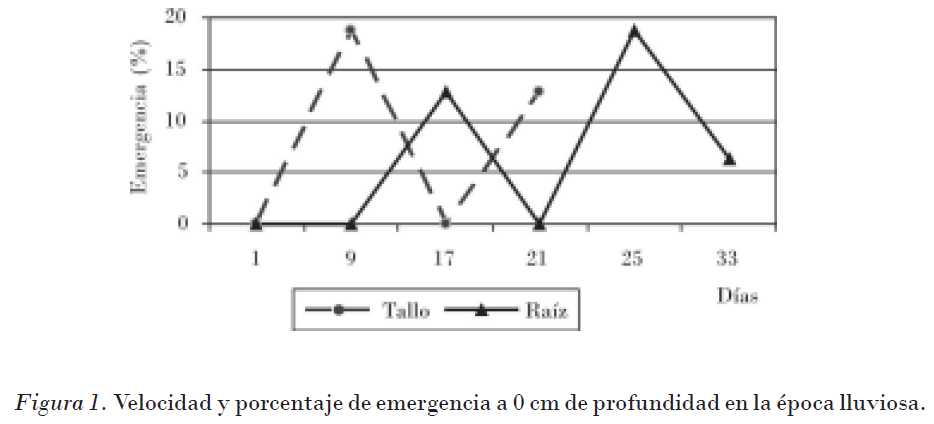
Reproduction of Dichrostachys cinerea (L.) Wight & Arn (sicklebush) by shafts and roots was evaluated. This is one of the most invasive of Cuban woody weeds Shafts and roots were collected from a population of the weed located near Havana, and percentage, energy or emergency speed in field conditions were evaluated in a soil plot of Plant Health Research Institute. There were not sprout differences of vegetative parts sowed, which was greatest in the rainy season with 5 cm depth; emergency speed was between nine to eleven days. It was evident that superficial sow of shafts and roots of D. cinerea in dry season are not successful and they lose its reproductive capacity in depths over than 15 cm.
Article Details

This work is licensed under a Creative Commons Attribution-NonCommercial 4.0 International License.
Those authors who have publications with this journal accept the following terms of the License Attribution-NonCommercial 4.0 International (CC BY-NC 4.0):
You are free to:
- Share — copy and redistribute the material in any medium or format
- Adapt — remix, transform, and build upon the material
The licensor cannot revoke these freedoms as long as you follow the license terms.
Under the following terms:
- Attribution — You must give appropriate credit, provide a link to the license, and indicate if changes were made. You may do so in any reasonable manner, but not in any way that suggests the licensor endorses you or your use.
- NonCommercial — You may not use the material for commercial purposes.
- No additional restrictions — You may not apply legal terms or technological measures that legally restrict others from doing anything the license permits.
The journal is not responsible for the opinions and concepts expressed in the works, they are the sole responsibility of the authors. The Editor, with the assistance of the Editorial Committee, reserves the right to suggest or request advisable or necessary modifications. They are accepted to publish original scientific papers, research results of interest that have not been published or sent to another journal for the same purpose.
The mention of trademarks of equipment, instruments or specific materials is for identification purposes, and there is no promotional commitment in relation to them, neither by the authors nor by the publisher.
How to Cite
References
Acuña, J.: Plantas indeseables en los cultivos cubanos, Inifat, Academia de Ciencias de Cuba, Consejo Editorial de la ACC, La Habana, 1974.
Anon, A.: Orientaciones para combatir el marabú. Una contribución de la Escuela de Ingeniería Agronómica de la Universidad de La Habana, 1962.
Bässler, M.: Flora de la República de Cuba, Fascículo 2: Mimosaceae, Koeltz Scientific Books, RFA, 1998.
CSIRO.: Flora de Australia, vol. 12: Mimosaceae (excl. Acacia), Caesalpiniaceae, Australian Biological Resources Study, Canberra, Australia, s/a, pp. 19-21.
Labrada, R.; F. La O; Y. N. Geshtovt: «Metodología sobre malas hierbas», t. III, Información Técnica, IISV 2(3), La Habana, 1979.
Pérez, E.: «Agroecological Management of Dichrostachys cinerea (L.) Wight & Arn in Cuba: Present and Future», Weed Congress, Bloemfontein, Sudáfrica, pp. 8-20, January, 2000.
Roig, J. T.: «Marabú y aroma», Circular no. 50, t. II, Estación Experimental Agronómica, Ed. Científico-Técnica. Compendio de las obras de J. T. Roig, La Habana, 1983, pp. 3-6.
Ross, J. H.: Flora of Southern Africa, Vol. 6, Part 1. Botanical Research Inst., Sudáfrica, 1975, pp. 123-129.