
Evaluación de la resistencia a la roya parda (Puccinia melanocephala Syd.) de somaclones de caña de azúcar (Saccharum spp. híbrido) obtenidos en el Ecuador
Article Sidebar
Main Article Content
Abstract
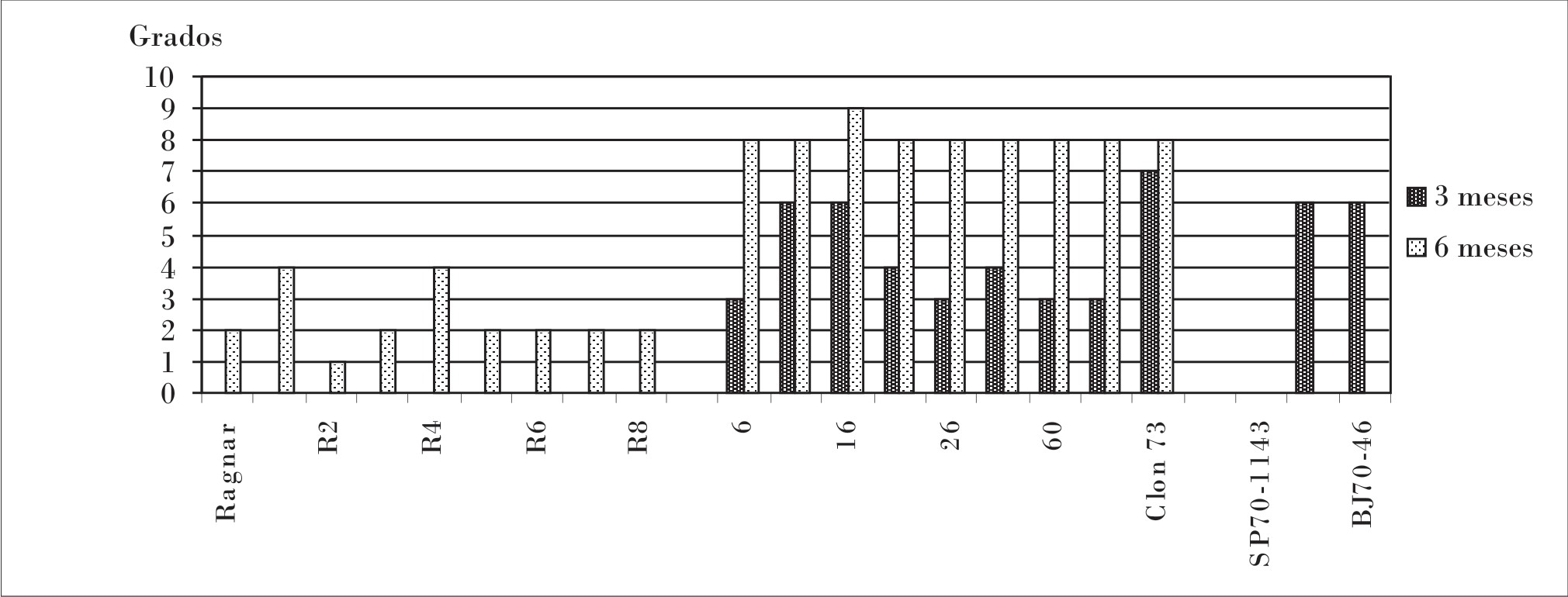
A group of somaclons obtained exploiting somaclonal variation from the donor sugarcane (Saccharum spp. hybrid) cultivars Ragnar and CC85-92 and several commercial varieties used as control was evaluated to determine brown rust disease resistance in field trials in areas with heavy infection of the disease. Five plants of each indivi- dual were randomly used as samples and the means of this evaluation was determined. Results confirmed that somaclones from the cultivar Ragnar kept the resistance trait, but the somaclones from the variety CC85-92 were more affected. Evaluation of these somaclonal variants should be continued in several places exhibiting different infection level to the disease.
Article Details

This work is licensed under a Creative Commons Attribution-NonCommercial 4.0 International License.
Those authors who have publications with this journal accept the following terms of the License Attribution-NonCommercial 4.0 International (CC BY-NC 4.0):
You are free to:
- Share — copy and redistribute the material in any medium or format
- Adapt — remix, transform, and build upon the material
The licensor cannot revoke these freedoms as long as you follow the license terms.
Under the following terms:
- Attribution — You must give appropriate credit, provide a link to the license, and indicate if changes were made. You may do so in any reasonable manner, but not in any way that suggests the licensor endorses you or your use.
- NonCommercial — You may not use the material for commercial purposes.
- No additional restrictions — You may not apply legal terms or technological measures that legally restrict others from doing anything the license permits.
The journal is not responsible for the opinions and concepts expressed in the works, they are the sole responsibility of the authors. The Editor, with the assistance of the Editorial Committee, reserves the right to suggest or request advisable or necessary modifications. They are accepted to publish original scientific papers, research results of interest that have not been published or sent to another journal for the same purpose.
The mention of trademarks of equipment, instruments or specific materials is for identification purposes, and there is no promotional commitment in relation to them, neither by the authors nor by the publisher.
How to Cite
References
Aday, O.; F. J. Barroso; F. Díaz; E. L. Martín; L. Pérez; I. Alfonso; J. Pérez; J. Barroso: «Presencia de la roya naranja Puccinia kuehnii (Kruger) Butler en áreas experimentales de caña de azúcar de la región central de Cuba», Fitosanidad 14 (2): 83-89, Cuba, 2010.
Ángel, J. C.; J. I. Victoria: «Evaluación de la incidencia de la roya en la variedad CC 93-3895», Boletín Cenicaña 29 (1) ener.-marz., Colombia. 2007.
CINCAE: «Presencia de roya naranja en áreas de producción del Ecuador», Boletín del Centro de Investigaciones de la Caña de Azúcar del Ecuador (CINCAE), 2011.
Comstock, J. C.; S. G. Good; N. C. Glynn; J. Shineii; J. M. McKemy; L. A. Castlebury: «First Report of Puccinia kuehnii Butler, Causal Agent of Orange Rust of Sugarcane in United States and Western Hemisphere», Plant Disease 92 (1): 75, EE. UU., 2008.
Krishnamurtii, M.; J. Tlaskal: «Fiji Disease Resistant Saccharum officinarum cv. Pindar Subclones from Tissue Culture», Proc. XV ISSCT Congress (Plant Breeding), Durban, Sudáfrica, junio 1974.
Larkin, P.; W. Scowcroft: «Somaclonal Variation: a Novel Source of Variability from Cell Cultures for Plant Improvement», Theor. Appl. Genet. 60: 197-214, Alemania, 1981.
Magarey, R. T.; T. Staier; J. Bull; B. Croft; T. Wilcox: «The Australian Sugarcane Orange Rust Epiphytotic», Res. XXV ISSCT Congreso, Ciudad Guatemala, 2005, pp 648-653.
Ovalle, W.; H. Orozco; J. L. Quemé; M. Melgar; S. García: «La roya de la caña de azúcar en Guatemala y estrategia para su manejo», Boletín Cengicaña 5, Guatemala, 2007, http://www.cengicaña.org/ Portal/Web2/boletín (consultado en enero de 2008).
Pérez, G.; N. Bernal; A. Chinea; J. O‘Really; F. De Prada: Recursos genéticos de la caña de azúcar,Publicaciones Imago, Cuba, 1997.
Pérez, L.; E. L. Martín; F. Barroso; B. Martínez; O. Borrás; I. Hernández: «Definitive Identification of Orange Rust of Sugarcane Caused by Puccinia kuehnii Butler in Cuba», New Disease Report 20: 16, 2009, http://www.ndrs.org.uk/article.php?id=020016 (consultado en enero de 2010).
Purdy, L. H.; J. L. Dean: «Un sistema para registrar los datos sobre las interacciones entre la roya de la caña de azúcar y el hospedero», Memorias del Seminario Interamericano de la Caña de Azúcar I. Enfermedades de la caña de azúcar, Miami, 8-10 oct., EE. UU., 1980, pp. 177-180.
Ramos, M.; R. H. Maribona; A. Ruiz; S. B. Korneva; E. Canales; T. D. Dinkova; F. Izquierdo; O. Coto; D. Rizo: «Somaclonal Variation as a Source of Resistance to Eyespot Disease of Sugarcane», Plant Breeding 1l5 (1): 37-42, Alemania, 1996.