
Mites associated with the stored products of the milling industry of Regla
Article Sidebar
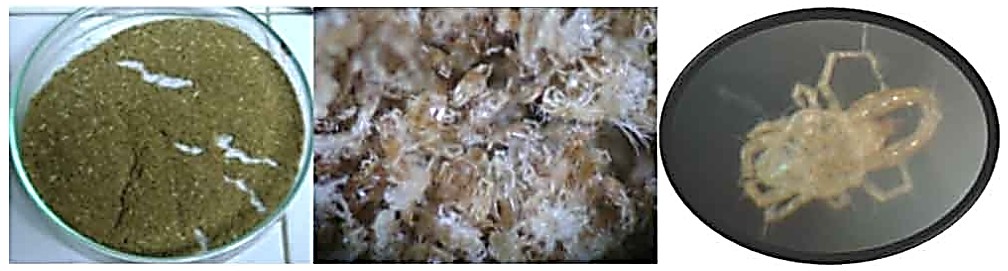
Main Article Content
Abstract
The country's strategy, by substituting imports and especially those that have to do with food, entails an increase in production and productive yields. However, large quantities of food continue to be imported at high prices, so pest control measures must be used to avoid economic losses. Despite the work, there is still ignorance of the mite species that affect stored products and the direct effects on grains and by-products and on human health. So the objective was to determine the incidence of mites that were affecting the products stored in the port of Havana and the milling industry of the Regla Municipality. For this, consecutive samplings were carried out in the Concrete and Metal silos of the Cereal Companies "Tulcios Lima" and "José Antonio Echevarría", as well as in the milling industry facilities: The products sampled were soybeans, wheat, enriched soybeans, bran, bran, whole wheat flour and wheat flour. The samples were transferred and processed in the Acarology Laboratory of the Plant Health Research Institute. A total of 422 samples were analyzed, of which only 24 were negative for diagnosis. Of the detected acari the biggest number corresponds to the organisms considered in the category of plagues with 72% followed by the predatory mite with 21%. Wheat flour and sweeps were the ones that detected the highest number of species with 6 and 5 species respectively. The species that affected the greatest diversity of products were Tyrophagus longior (Gervais) and T. putrescentiae (Shrank). The average of mites ranged from 12 to 15 mites in 5 grams of the product, except for the whole wheat flour which was 2.34.
Article Details

This work is licensed under a Creative Commons Attribution-NonCommercial 4.0 International License.
Those authors who have publications with this journal accept the following terms of the License Attribution-NonCommercial 4.0 International (CC BY-NC 4.0):
You are free to:
- Share — copy and redistribute the material in any medium or format
- Adapt — remix, transform, and build upon the material
The licensor cannot revoke these freedoms as long as you follow the license terms.
Under the following terms:
- Attribution — You must give appropriate credit, provide a link to the license, and indicate if changes were made. You may do so in any reasonable manner, but not in any way that suggests the licensor endorses you or your use.
- NonCommercial — You may not use the material for commercial purposes.
- No additional restrictions — You may not apply legal terms or technological measures that legally restrict others from doing anything the license permits.
The journal is not responsible for the opinions and concepts expressed in the works, they are the sole responsibility of the authors. The Editor, with the assistance of the Editorial Committee, reserves the right to suggest or request advisable or necessary modifications. They are accepted to publish original scientific papers, research results of interest that have not been published or sent to another journal for the same purpose.
The mention of trademarks of equipment, instruments or specific materials is for identification purposes, and there is no promotional commitment in relation to them, neither by the authors nor by the publisher.
How to Cite
References
Adam B; Phillips P. & Flinn P., 2006. The economics of imp in stored grain: Why don’t more grain handlers use imp? 9th International Working Conference on Stored Product Protection. Plenary session 1. Stored Grain Losses., páginas 3-12.
Almaguel L. 2006. Combate integral contra ácaros fitófagos. Selección de Conferencias sobre Manejo Integrado de Plagas. La Habana, Cuba. Vol. 11; No. 1. 70-113.
Atencio K. R., Vinatea M., 2018. “Control de plagas en almacenamiento de arroz (Oryza sativa) en Sullana, Lima y Arequipa en el periodo 2017” Trabajo de Suficiencia Profesional para optar el Título Profesional de ingeniero en industrias alimentarias. Lima, Perú. 77 pág.
Athanassiou C. G., Palyvos, N. E., 2015. The Cheyletoidea (Prostigmata), with Special Reference to the Potential of Cheyletus malaccensis Oudemans as Biological Control Agent of Post-harvest Pests. In Carrillo D., de Moraes G., Peña J. (eds) Prospects for Biological Control of Plant Feeding Mites and Other Harmful Organisms. Progress in Biological Control. Vol 19. 2015. Springer, Cham. 241-249.
Bayu M. S., Ullah. I., Takano M. S., 2017. Impact of constant versus fluctuating temperatures on the development and life history parameters of Tetranchus utricae (Acari: Tetranychidae). Exp. Appl. Acarol. 72, 205-227.
Cebolla R., Pekár S., Hubert, J., 2009. Prey range of the predatory mite Cheyletus malaccensis (Acari: Cheyletidae) and its efficacy in the control of seven stored-product pests, Biol. Control. 50, 1-6.
Dirección Nacional de Alimentación Argentina y Aventis Environmental Science. «Manejo Integrado de Plaga en el Sector Agroalimentario.» Comisión Nacional de Alimentos., 2016. http://www.conal.gob.ar [Consulta: 23 de enero de 2018].
FAO. La ingeniería en el desarrollo-Manejo y tratamiento de granos poscosecha. Disponible en: http://www.fao.org/docrep/X5041S/x5041S00.htm [Consulta: diciembre 13 2017].
Hernández J. A., Carballo A. C., 2014. Almacenamiento y conservación de granos y semillas. http://www.sagarpa.org.mx [Consulta: junio 13 2020].
Hughes, A. M. ,1976. The Mites of Stored Food and Houses. University of London. 400.
Jiadong Y., Yanhui L., Xueer L., Weifen M., Cong Z., Jing W., 2019. Predation of Cheyletus malaccensis (Acari: Cheyletidae) on Megoura japonica (Hemiptera: Aphididae) under five different temperatures. International Journal of Acarology 45(3):1-5. [Consulta: junio 13 2020].
Krantz, G. W., 1978. A Manual of Acarology, Second Edition. Oregon State University Book Stores, Inc. Corvalis. 509 pág.
Krantz, G. W., Walter D. E., 2009. A Manual of Acarology. Third Edition. Texas Tech Universty Press. 795 pág.
Lagunes, A., Rodríguez C. H., 1989. Búsqueda de tecnología apropiada para el combate de plagas del maíz almacenado en condiciones rústicas. CONACYT. Colegio de Postgraduados. Montecillo, Texcoco, México. 150 pág.
Lannacone, J., Lamas, G., 2003. Plantas biocidas usadas en el control de la polilla de la papa, Phthorimaea operculella (Zeller) (Lepidoptera: Gelechiidae). Rev. Per. Ent. 43:79-87.
Oliveira M.R.C., Corrêa A.S., de Souza G.A., Guedes R.N.C., Oliveira L.O. 2013. Mesoamerican origin and pre- and post-Columbian expansions of the ranges of Acanthoscelides obtectus Say, a cosmopolitan insect pest of the common bean. PLoS One 8, e70039.
Peihuan He., Wu Y., Wang J., Ren Y., Ahmad W., Liu R., Ouyang Q., Jiang H. Chen Q., 2020. Detection of mites Tyrophagus putrescentiae and Cheyletus eruditus in flour using hyperspectral imaging system coupled with chemometrics. Journal of food process engineering. Volumen 43(6). https://onlinelibrary.wiley.com/doi/epdf/10.1111/jfpe.13386 [Consulta: junio 13 2020].
Pekár S., Hubert J., 2008. Assessing biological control of Acarus siro by Cheyletus malaccensis under lab-oratory conditions: effect of temperatures and prey density. J. Stored Prod. Res. 44, 335-340.
Peña M., Pérez J. C., Serrano D., 2019. Manejo integrado de plagas de almacén en Jesús Menéndez. Ojeando la Agenda. No. 60.
Pérez A., Sánchez J., Pérez A., Garza R., Ramírez S., 2018. Incidencia de insectos fitófagos en campo y almacén sobre maíces nativos de San Juan Ixtenco, Tlaxcala, México. Cuadernos de Agroecología- Anais do VI CLAA, X CBA e V SEMDF - Vol. 13 (1).
Ramos J. M., Rodríguez Y. F., Palmero M., 2016. La fauna de insectos y ácaros asociados a almacenes de alimentos en la provincia de Sancti Spíritus. Fitosanidad 20 (1). 13-19.
Rodríguez H., Acutín Y., Fernández N., Suris M., Ramírez S., Miranda I., Pino O., 2019. Percepción de productores de granos del municipio Guanabacoa, Cuba, sobre la incidencia de las plagas de almacén. Revista de Protección Vegetal, Vol. 34, No. 1, enero-abril 2019, 1-6.
Serratos H. J. A., 2009. El origen y la diversidad del maíz en el continente americano. Nueva imagen, México, Mex.
Viteri-Jumbo L. O., Faroni L. R. A., Oliveira E. E., Pimentel M. A., Silva G.N., 2014. Potential use of clove and cinnamon essential oils to control the bean weevil, Acanthoscelides obtectus Say, in small storage units. Ind Crops and Products. 56:27-34.
Zhu P., Fan Y., Mo W., Xin T., Xia B., Zou Z., 2019. Functional response of adult Cheyletus malaccensis (Acari: Cheyletidae) to different developmental stages of Aleuroglyphus ovatus (Acari: Acaridae). Journal of Stored Products Research. School of Life Science, Nanchang University, Nanchang, 330031, China. Volume 84, 101525.